


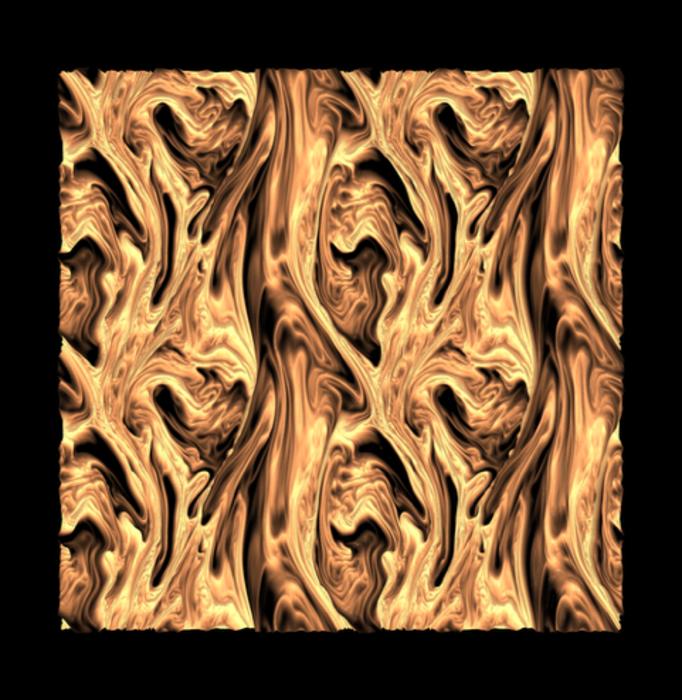
Blood, lymph fluid and other biological liquids can have surprising and sometimes troubling properties. Many of these biological solutions are non-Newtonian fluids, a type of liquid that is characterized by a non-linear relationship between stress and strain. Consequently, non-Newtonian fluids don’t necessarily behave as one would expect from a liquid. For example, some of these peculiar fluids deform when touched lightly but will act almost as a solid when a strong force is applied.

Credit: Prof. Marco E. Rosti/OIST
Blood, lymph fluid and other biological liquids can have surprising and sometimes troubling properties. Many of these biological solutions are non-Newtonian fluids, a type of liquid that is characterized by a non-linear relationship between stress and strain. Consequently, non-Newtonian fluids don’t necessarily behave as one would expect from a liquid. For example, some of these peculiar fluids deform when touched lightly but will act almost as a solid when a strong force is applied.
And biological solutions are no exception when it comes to unique properties – one of them being elastic turbulence. A term that describes the chaotic fluid motion that results from adding polymers in small concentrations to watery liquids. This type of turbulence exists only in non-Newtonian fluids.
Its counterpart is classical turbulence, occurring in Newtonian fluids, for example in a river when the water at high speed flows past a bridge’s pillar. While mathematical theories exist to describe and predict classical turbulence, elastic turbulence yet awaits such tools despite their importance for biological samples and industrial applications. “This phenomenon is important in microfluidics, for example when mixing small volumes of polymeric solutions which can be difficult. “They don’t mix well because of the very smooth flow,” explains Prof. Marco Edoardo Rosti, head of the Complex Fluids and Flows Unit.
So far scientists have thought of elastic turbulence as completely different from classical turbulence, but the Lab’s most recent publication in the journal Nature Communications might change this view. Researchers from OIST worked collaboratively with scientists from TIFR in India and NORDITA in Sweden to reveal that elastic turbulence has more in common with classical Newtonian turbulence than expected.
“Our results show that elastic turbulence has a universal power-law decay of energy and a so far unknown intermittent behavior. These findings allow us to look at the problem of elastic turbulence from a new angle,” explains Prof. Rosti. When describing a flow, scientists often use a velocity field, “we can look at the distribution of velocity fluctuations to make statistical predictions about flow,” says Dr. Rahul K. Singh, the publication’s first author.
When studying classical Newtonian turbulence, researchers measure velocity over the entire flow and use the difference between two points to create a velocity difference field. “Here we measure velocity at three points and compute the second differences. First, a difference is computed by subtracting fluid velocities measured at two different points. We then subtract two such first differences yet again, which gives us the second difference,” explains Dr. Singh.
This type of research came with an additional challenge – running these complex simulations requires the power of advanced supercomputers, “our simulations sometimes run for four months and output a huge amount of data,” says Prof. Rosti. This added level of detail led to a surprising finding – that the velocity field in elastic turbulence is intermittent. To illustrate what intermittency in flow looks like, Dr. Singh uses the electrocardiogram (ECG) as an example.
“In an ECG measurement the signal has small fluctuations interrupted by very sharp peaks. This sudden large burst is called intermittency,” says Dr. Singh. In classical fluids, such fluctuations between small and very large values had already been described but only for turbulence that occurs at high flow speeds. The researchers were surprised to now find the same pattern in elastic turbulence occurring at very small flow speeds, “at these low speeds we did not expect to find such strong fluctuations in the velocity signal,” emphasizes Dr. Singh.
Their findings are not only a big step towards a better understanding of the physics behind low velocity turbulence but also lay the foundations for developing a complete mathematical theory describing elastic turbulence. “With a perfect theory, we could make predictions about the flow and design devices that can alter mixing of liquids. This might be useful when working with biological solutions,” says Prof. Rosti.
Journal
Nature Communications
Method of Research
Computational simulation/modeling
Article Title
Intermittency in the not-so-smooth elastic turbulence
Article Publication Date
27-May-2024
Cite Scienmag News
Reid Dalton. (May 27, 2024). Surprising properties of elastic turbulence discovered. Scienmag. https://scienmag.com/surprising-properties-of-elastic-turbulence-discovered/
Reid Dalton. "Surprising properties of elastic turbulence discovered." Scienmag, 27 May 2024, https://scienmag.com/surprising-properties-of-elastic-turbulence-discovered/. Accessed 3 September 2026.
Reid Dalton. "Surprising properties of elastic turbulence discovered." Scienmag. May 27, 2024. https://scienmag.com/surprising-properties-of-elastic-turbulence-discovered/

