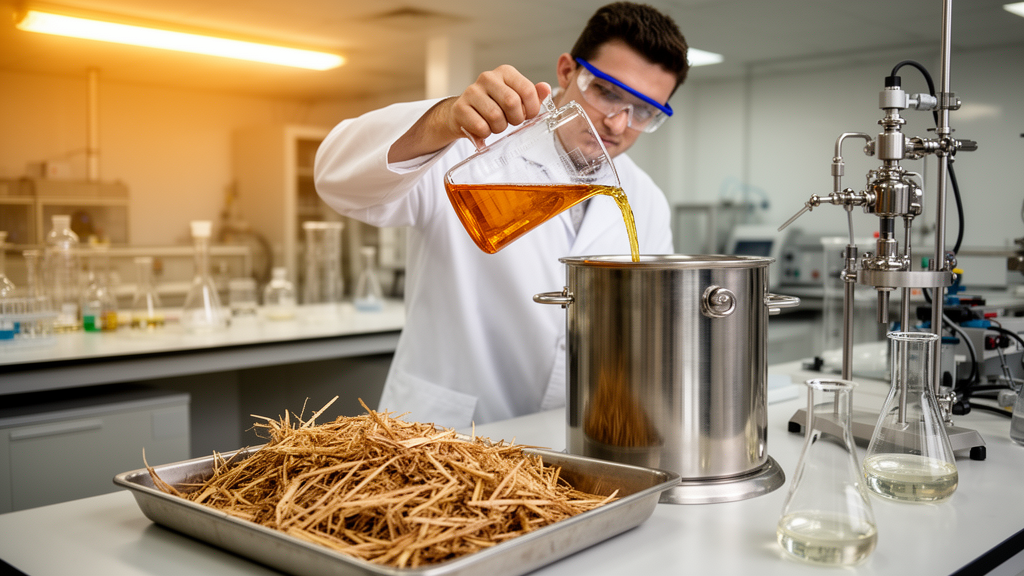
A research team now reports a carefully optimized laboratory process that converts this agricultural waste into liquid bio-polyols with a yield of 95.6 percent, using polyethylene glycol as both solvent and reactive partner. The polyols produced under the optimized conditions showed physicochemical characteristics that fall within ranges reported for polyols used in elastic polyurethane formulations, suggesting a possible route for turning a low-value residue into a feedstock for plastics manufacturing.
The study, published as an open access research article in Environmental Science and Pollution Research, was carried out by Sobhan Mohamadi, Soleiman Abbasi, María González-Alriols, Fabio Hernández-Ramos and Rasoul Rahnemaei. The work addresses two problems at once: the management of agricultural waste and the partial substitution of petrochemical polyols in polyurethane production.
Sugarcane bagasse is an attractive candidate for this kind of valorization because of its chemical composition. According to existing reports cited by the authors, the material contains roughly 32 to 45 percent cellulose, around 20 to 32 percent hemicellulose, and about 17 to 32 percent lignin, along with other extractives. Its high cellulose and hemicellulose contents make it a promising raw material for producing value-added products. Previous studies on bagasse liquefaction, however, have mainly focused on alkaline conversion routes and on rigid polyurethane foams, with limited optimization of the liquefaction process itself and only partial characterization of the resulting polyols. The new study set out to fill that gap by systematically varying reaction conditions and tracking both yield and product quality.
The method at the heart of the work is solvothermal liquefaction, a technique that converts solid biomass into a liquid in the presence of an appropriate solvent and catalyst, typically under mild conditions of 80 to 200 degrees Celsius and atmospheric pressure. The researchers chose polyethylene glycol 400, a low-molecular-weight PEG, as the organic solvent. This choice was grounded in earlier findings: low-molecular-weight PEGs exhibit lower viscosity, better penetration into the lignocellulosic matrix, and higher reactivity toward cellulose and hemicellulose degradation products, which enhances liquefaction efficiency. PEG also acts as a reactive medium capable of stabilizing the degradation products generated during the process, limiting the formation of insoluble residues. Previous work had shown that lower-molecular-weight PEGs favor more efficient conversion and lower-viscosity products, and PEG 400-based solvent systems have been used to produce polyurethane precursors from biomass liquefaction.
As the catalyst, the team used sulphuric acid, which has shown the highest catalytic efficiency among acids in biomass liquefaction for polyol production. Its elevated boiling point and strong acidity generate a substantial amount of hydrogen ions, which facilitate the hydrolysis or alcoholysis of lignocellulose at lower temperatures. The amount of acid matters greatly, because prolonged exposure to excessive acid levels can reduce efficiency by shifting the balance between depolymerization and secondary repolymerization reactions.
To optimize the process, the researchers employed a Box-Behnken experimental design within response surface methodology, a statistical framework for modeling how several factors jointly influence an outcome. Three independent variables were tested at three levels each: reaction temperature at 120, 150 and 180 degrees Celsius; sugarcane bagasse content at 2, 4 and 6 grams mixed with 25 milliliters of PEG 400; and sulphuric acid catalyst at 1.5, 3.0 and 4.5 percent by weight of the total mixture. The reactions ran for two hours at 500 rotations per minute in sealed flasks fitted with condensers to prevent solvent loss. In total, 15 experimental runs, including three center-point replicates, were carried out. After each reaction, the mixture was cooled, diluted with acetone, filtered to remove unreacted solids, and the liquefaction yield was calculated from the mass of retained solid residue relative to the initial dry bagasse.
The statistical analysis revealed a clear hierarchy among the process variables. Only the yield model showed adequate fit, with a p-value below 0.0001 and a coefficient of determination of 0.92, while no adequate models could be fitted for the other measured responses, including acid number, hydroxyl number, molecular weight, functionality, viscosity and the polydispersity index. The authors attribute this to the intrinsic heterogeneity of lignocellulosic structures and the simultaneous depolymerization and recondensation reactions occurring during liquefaction, which make the physicochemical properties of the products inherently variable. Within the yield model itself, temperature and bagasse content had significant effects, and the interaction between these two factors was also significant, whereas the linear effect of catalyst content was not statistically significant. The quadratic term for catalyst was significant, however, indicating a non-linear influence in which both insufficient and excessive acid levels adversely affect the process. The model showed a non-significant lack of fit and a high coefficient of determination of 0.9766, supporting its predictive capability.
The optimized conditions identified by the model called for 2 grams of sugarcane bagasse, 3.13 percent catalyst, and a reaction temperature of about 161 degrees Celsius. When the team validated the prediction with triplicate experiments, the model had predicted a liquefaction yield of 100 percent, while the experimentally obtained yield was 95.6 percent, a relative error of 4.40 percent. The data also illustrated how strongly the solvent-to-biomass ratio matters: under identical conditions of 180 degrees Celsius and 3 percent catalyst, a 94.91 percent yield was achieved with 2 grams of bagasse, but only 46.82 percent when the bagasse load was raised to 6 grams. This decline is consistent with literature findings that agricultural residues like bagasse generally require a minimum solvent-to-biomass weight ratio of 5 to 1 for comparable liquefaction efficiency.
Beyond yield, the researchers characterized the bio-polyols in detail. For the three high-yield samples, the hydroxyl number ranged from approximately 195 to 233 milligrams of potassium hydroxide per gram, molecular weight spanned 3839.27 to 7582.06 grams per mole, functionality fell between 3.12 and 4, viscosity ranged from 187.5 to 238.4 millipascal-seconds, and the polydispersity index lay between 4.25 and 7.50. Across all 15 runs, hydroxyl numbers ranged from 182.4 to 251 milligrams of potassium hydroxide per gram, acid numbers from 6.32 to 27.11, molecular weights from 1130.47 to 22,926.36 grams per mole, and polydispersity indices from 1.40 to 18.40. The authors explain the wide molecular-weight distributions as the result of a dynamic balance between decomposition, which releases macromolecular fragments from the biomass, and recondensation, which can be promoted by the acid catalyst and rebuild larger structures. The moderate viscosities observed, which are lower than many values reported in the literature, were attributed to the use of PEG 400, since PEG-based bio-polyols generally exhibit lower viscosities than those synthesized with solvents such as glycerol.
Structural analysis by infrared spectroscopy showed that liquefaction primarily affected the hydroxyl and methyl-methylene groups of the biomass. The broad hydroxyl band of plain bagasse narrowed in the liquefied samples, a change the authors link to a reduction in hydrogen bonding complexity and increased chemical uniformity of hydroxyl groups following solvolytic cleavage. The high-yield samples had hydroxyl numbers between the typical ranges reported for rigid polyurethanes, 250 to 1000 milligrams of potassium hydroxide per gram, and flexible polyurethanes, 28 to 160, placing them closer to the characteristics associated with elastic polyurethane manufacture. The authors are careful to note the limits of the work: no polyurethane formulations were actually prepared in the study, so the suitability of the polyols for elastic foams remains a suggestion based on physicochemical comparison rather than a demonstrated performance. Future studies, they write, should focus on synthesizing and testing polyurethane materials from these bio-polyols, and should also address the recovery and recycling of PEG 400 to assess the economic and environmental feasibility of scaling the process beyond the laboratory.
Subject of Research: Optimization of acid-catalyzed PEG 400 liquefaction of sugarcane bagasse to produce bio-polyols for potential elastic polyurethane applications
Article Title: High-yield bio-polyols from sugarcane bagasse: process optimization, structural analysis, and application potential
Article References: Mohamadi, S., Abbasi, S., González-Alriols, M., Hernández-Ramos, F., & Rahnemaei, R. (2026). High-yield bio-polyols from sugarcane bagasse: process optimization, structural analysis, and application potential. Environmental Science and Pollution Research. https://doi.org/10.1007/s11356-026-38351-1
Image Credits: AI Generated
DOI: 10.1007/s11356-026-38351-1
Keywords: sugarcane bagasse, bio-polyols, liquefaction, polyurethane, response surface methodology, PEG 400, agricultural waste, biomass valorization, sulphuric acid catalyst, hydroxyl number, Box-Behnken design, green chemistry
Cite Scienmag News
Bethany Barker. (October 28, 2026). Sugarcane Waste Turned Into High-Yield Liquid Polyols for Polyurethanes. Scienmag. https://scienmag.com/sugarcane-waste-turned-into-high-yield-liquid-polyols-for-polyurethanes/
Bethany Barker. "Sugarcane Waste Turned Into High-Yield Liquid Polyols for Polyurethanes." Scienmag, 28 October 2026, https://scienmag.com/sugarcane-waste-turned-into-high-yield-liquid-polyols-for-polyurethanes/. Accessed 29 October 2026.
Bethany Barker. "Sugarcane Waste Turned Into High-Yield Liquid Polyols for Polyurethanes." Scienmag. October 28, 2026. https://scienmag.com/sugarcane-waste-turned-into-high-yield-liquid-polyols-for-polyurethanes/