


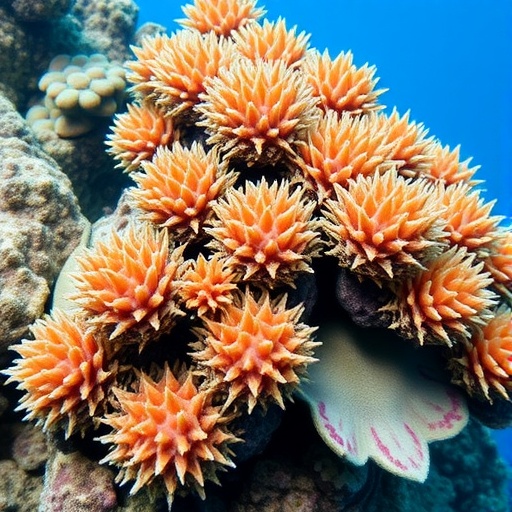
Hawaiian reefs are entering a new era of heat stress as warming intensifies beyond the first major coral bleaching recorded in 1996. Bleaching events have grown more frequent, placing sensitive reef-building species under mounting physiological strain.
A new study by oceanographers at the University of Hawai‘i at Mānoa examines how severe that stress could become through the 21st century. Using high-resolution ocean modeling, the researchers incorporate small-scale ocean processes that influence local temperatures—an advance over more coarse regional projections.
Lead author Kate Feloy and co-authors compared future heat stress patterns to earlier estimates of how quickly corals might adapt to changing thermal conditions. Their analysis suggests that, even under a high emissions scenario, Hawaiian corals may have a pathway to adaptation—though the exposure levels could still become unprecedented in coming decades.
To produce the projections, the team ran simulations under three climate emissions pathways, enabling a direct look at how different forcing levels reshape reef conditions. The model’s ability to represent local variability is key: reef temperatures do not change uniformly along the island chain.
The results reveal striking spatial differences in expected heat stress. Corals around Hawaiʻi Island are projected to experience higher thermal burdens than those elsewhere across the Main Hawaiian Islands, indicating that risk and adaptive requirements are not evenly distributed.
Feloy attributes the contrasts to complex ocean dynamics operating on small spatial scales in the waters surrounding Hawaiʻi. These dynamics alter where and how human-driven warming concentrates, effectively changing the tempo of thermal change that corals must withstand.
While temperature is the focus of this work, the authors emphasize that future stress will not occur in isolation. Marine heatwaves can overlap with other hazards such as ocean acidification and low-oxygen episodes, together compounding pressure on coral ecosystems.
Other research suggests corals exposed to naturally variable temperature backgrounds may be more resilient to heat extremes. Consistent with that idea, the study team is now investigating how tides contribute to natural temperature fluctuations around Hawaiian reefs.
Finally, the researchers argue that managers can use the detailed spatial projections to guide planning. However, effective conservation will require integrating temperature forecasts with broader stressor forecasts to support reef persistence under climate change.
Cite Scienmag News
Russell Cooper. (July 27, 2026). Study Suggests Hawaiian Corals May Adapt Despite Approaching Heat Stress. Scienmag. https://scienmag.com/study-suggests-hawaiian-corals-may-adapt-despite-approaching-heat-stress/
Russell Cooper. "Study Suggests Hawaiian Corals May Adapt Despite Approaching Heat Stress." Scienmag, 27 July 2026, https://scienmag.com/study-suggests-hawaiian-corals-may-adapt-despite-approaching-heat-stress/. Accessed 4 September 2026.
Russell Cooper. "Study Suggests Hawaiian Corals May Adapt Despite Approaching Heat Stress." Scienmag. July 27, 2026. https://scienmag.com/study-suggests-hawaiian-corals-may-adapt-despite-approaching-heat-stress/


