


Like most primates, humans are remarkably touchy-feely. Starved of touch, we release more of the stress hormone cortisol, which causes the immune system to be down-regulated and the heart rate and blood pressure to go up. On the other hand, touch causes the brain to be flooded by natural opioids, the ‘bonding hormone’ oxytocin, and the ‘feel-good’ neurotransmitters dopamine and serotonin.

Credit: L Samain-Aupic
M Dione
E Ribot-Ciscar
R Ackerley
JM Aimonetti
Like most primates, humans are remarkably touchy-feely. Starved of touch, we release more of the stress hormone cortisol, which causes the immune system to be down-regulated and the heart rate and blood pressure to go up. On the other hand, touch causes the brain to be flooded by natural opioids, the ‘bonding hormone’ oxytocin, and the ‘feel-good’ neurotransmitters dopamine and serotonin.
It is generally assumed that our sense of touch worsens with age, just like our vision and sense of hearing. However, new results are good news for those who wished they could stave off age-related decline forever: they show for the first time that a deterioration in touch sensitivity only happens in regions of the body with hairless skin, but not in more hairy regions. The results are published in Frontiers in Aging Neuroscience.
“Touch gets worse on the hands with age, but not on our hairy arms and cheeks, of which the cheek is especially sensitive to touch,” said Dr Jean-Marc Aimonetti, a researcher at the Research Center in Psychology and Neurosciences, in Marseille, France, and one of the corresponding authors.
Testing sensitivity
The authors recruited 96 left-handed female volunteers between 20 and 75 years old and tested the sensitivity of their skin in three regions: the hairless tip of the right index finger, and the right forearm and cheek, which are typically both covered in a downy layer of hair. The women sat down in a quiet room, closing their eyes and wearing noise-canceling headphones to avoid distractions.
In the first experiment, the subjects had to blindly move the tip of their right index finger over a series of 11 plates with differently spaced grooves, between 3.6mm and 6mm wide. They had to indicate whether the grooves felt wider or narrower than those on a reference plate, 4.8mm wide. Each subject was tested 132 times, and received a score for correct responses. The results confirmed that the index finger’s sensitivity for spatial exploration through touch decreases with age.
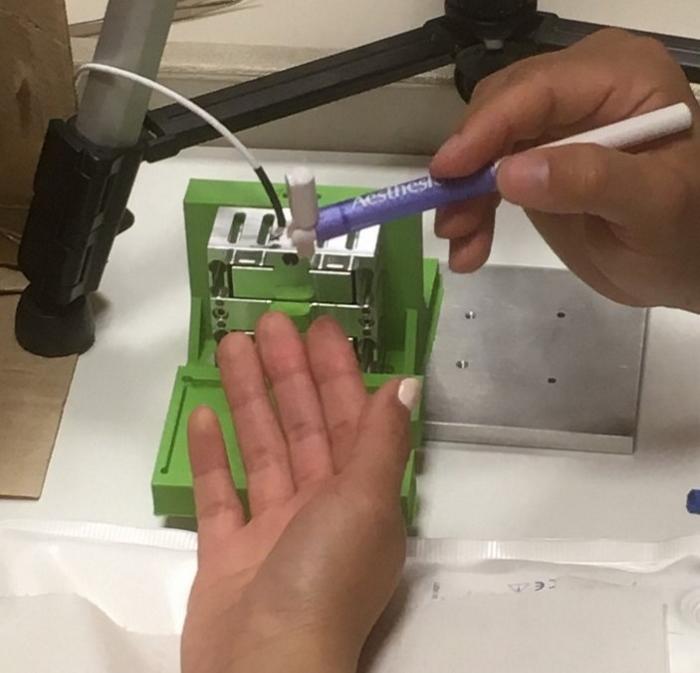
In a similar, second experiment, the researchers applied 13 classes of monofilaments (each with a unique calibrated force between 0.08 and 75 millinewton) to the women’s skin in a randomized, dose de-escalating pattern. The subjects had to indicate whenever they sensed a touch. This experiment ended when a subject made two successive errors, indicating that she could no longer accurately detect the stimulus. This is a widely used, proven method for measuring touch sensitivity, for example in people with neuropathy from diabetes.
The results again confirmed that the detection threshold increased linearly with age for the index finger, thus showing a deterioration of touch sensitivity over the lifespan.
Keeping in touch
However, unexpectedly, no such deterioration was found for the cheek and forearm. For example, the ten youngest women had a mean detection threshold of 5.6 millinewton on the forearm, compared to a mean of 5.6 millinewton for the ten oldest women – a difference that was not statistically significant. Likewise, the mean threshold on the cheek was 0.9 millinewton for the 10 youngest women, not significantly lower than the mean of 1.1 millinewton for the ten oldest.
These results imply that the cheek remains especially responsive throughout the lifespan. This was a surprise, as hairless skin generally has a higher density of mechanoreceptors– that determine our sensitivity to touch – than hairy skin.
“Although our hands are very important for touch, we receive caresses from others more on our hairy skin. This so-called affective touch actually increases with age and preserving this sensitivity would make sense, as we are social animals,” said Aimonetti’s colleague Dr Rochelle Ackerley, the second corresponding author.
Hair is our friend
The researchers speculate that the preservation of touch sensitivity in the forearm and cheek is directly due to the presence of hairs. Hair doesn’t only protect the skin, but also acts as an antenna to transmit mechanical stimuli, including at very low forces.
“Hair is our friend. It protects us from bacteria and tell us which way the wind is blowing. It’s not for nothing that we have hair in the most sensitive areas” explained Aimonetti.
But what can we do ourselves to keep our skin sensitive?
“Studies show that people exposed throughout their lives to thermal environmental extremes, such as the cold for soldiers or the heat for bakers, lose more tactile sensitivity. We can also avoid negative lifestyle factors such as alcohol, tobacco, and sun bathing, which damage the skin, as well as other factors, such as pollution,” said Ackerley.
Journal
Frontiers in Aging Neuroscience
Method of Research
Experimental study
Subject of Research
People
Article Title
Relations between tactile sensitivity of the finger, arm, and cheek skin over the lifespan showing decline only on the finger
Article Publication Date
2-Jul-2024
COI Statement
We disclose that Clarins and L’Oréal provided funds to conduct parts of the data collection. The authors declare no other competing interests.
Cite Scienmag News
Courtney Benton. (July 2, 2024). Study shows hairy skin does not become less sensitive with age. Scienmag. https://scienmag.com/study-shows-hairy-skin-does-not-become-less-sensitive-with-age/
Courtney Benton. "Study shows hairy skin does not become less sensitive with age." Scienmag, 2 July 2024, https://scienmag.com/study-shows-hairy-skin-does-not-become-less-sensitive-with-age/. Accessed 3 September 2026.
Courtney Benton. "Study shows hairy skin does not become less sensitive with age." Scienmag. July 2, 2024. https://scienmag.com/study-shows-hairy-skin-does-not-become-less-sensitive-with-age/

