

Thursday, September 3, 2026
Science
No Result
View All Result
  • Login
  • HOME
  • SCIENCE NEWS
  • CONTACT US
  • HOME
  • SCIENCE NEWS
  • CONTACT US
No Result
View All Result
Scienmag
No Result
View All Result
Home Science News Cancer

Study sheds light on cancer cell ‘tug-of-war’

May 7, 2024
in Cancer
Nathaniel Bowman
By Nathaniel Bowman Scienmag Editorial Profile - Precision Oncology
Reading Time: 3 mins read
0
Study sheds light on cancer cell ‘tug-of-war’
66
SHARES
600
VIEWS
Share on FacebookShare on Twitter
ADVERTISEMENT

WASHINGTON, May 7, 2024 – Understanding how cancerous cells spread from a primary tumor is important for any number of reasons, including determining the aggressiveness of the disease itself. The movement of cells into the extracellular matrix (ECM) of neighboring tissue is an essential step in cancer progression that directly correlates to the onset of metastasis.

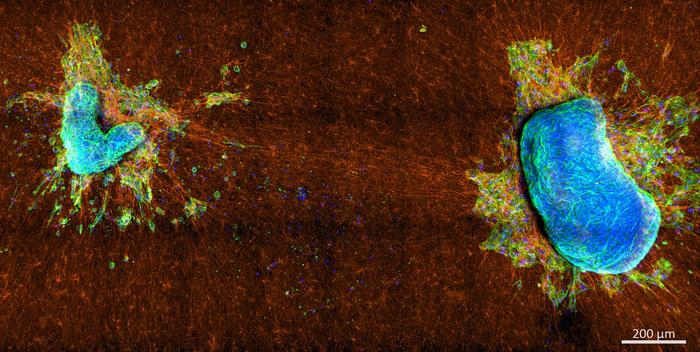
Two malignant mixed mullerian tumor explants on collagen network

Credit: Steffen Grosser, Frank Sauer, and Eliane Blauth

WASHINGTON, May 7, 2024 – Understanding how cancerous cells spread from a primary tumor is important for any number of reasons, including determining the aggressiveness of the disease itself. The movement of cells into the extracellular matrix (ECM) of neighboring tissue is an essential step in cancer progression that directly correlates to the onset of metastasis.

In APL Bioengineering, by AIP Publishing, a team of researchers from Germany and Spain used a breast cancer cell line panel and primary tumor explants from breast and cervical cancer patients to examine two different cellular contractility modes: one that generates collective tissue surface tension that keeps cell clusters compact and another, more directional, contractility that enables cells to pull themselves into the ECM.

“We focused on two parameters, namely the ability of the cells to pull on the ECM fibers and generate traction forces and on their ability to pull on each other, thereby generating a high tissue surface tension,” said author Eliane Blauth. “We linked each property to different contractile mechanisms and asked how they are connected to cancer cell escape and tumor aggressiveness.”

The team found that more aggressive cells pull more strongly on the ECM than on themselves while noninvasive cells pull more strongly on themselves than on the ECM – and that the different pulling behaviors are attributed to different structures of actin cytoskeleton inside the cells. Invasive cells use predominantly actin stress fibers — thick actin bundles that span the cell — to generate forces on their surroundings, while noninvasive cells generate forces through their actin cortex, a thin network directly under the cell membrane.

The study showed it is not the overall magnitude of these contractility modes but the interplay between them that determines a cell’s potential for escape. Experiments with only moderately invasive cells demonstrated the total force these cells generate on the ECM fibers is comparable to that of noninvasive cells, yet they can still detach and invade the ECM, which is not possible for noninvasive cells.

“The noninvasive cells still have a high cortical contractility, keeping them together, while the moderately invasive cells have a nearly disappearing cortical contractility,” said Blauth. “So not much is holding them back even though they pull much weaker on the ECM fibers.”

The team’s measurements with patient-derived vital tumor explants confirmed their findings from the cell line experiments. Here, the number of cells with a high cortical contractility decreased during tumor progression.

“This further indicates that the ability of the cells to pull on each other and hold themselves clustered together becomes weaker as the tumor grows, potentially increasing metastasis risk.”

###

The article “Different contractility modes control cell escape from multicellular spheroids and tumor explants” is authored by Eliane Blauth, Steffen Grosser, Frank Sauer, Mario Merkel, Hans Kubitschke, Enrico Warmt, Erik W. Morawetz, Philip Friedrich, Benjamin Wolf, Susanne Briest, Grit Gesine Ruth Hiller, Lars-Christian Horn, Bahriye Aktas, and Josef A. Käs. The article will appear in APL Bioengineering on May 7, 2024 (DOI: 10.1063/5.0188186). After that date, it can be accessed at https://doi.org/10.1063/5.0188186.

ABOUT THE JOURNAL

APL Bioengineering is an open access journal publishing significant discoveries specific to the understanding and advancement of physics and engineering of biological systems. See http://aip.scitation.org/journal/apb.

###


Journal

APL Bioengineering

DOI

10.1063/5.0188186

Article Title

Different contractility modes control cell escape from multicellular spheroids and tumor explants

Article Publication Date

7-May-2024

Subject of Research: Cancer

Article Title: Study sheds light on cancer cell ‘tug-of-war’

Article References: Original research article

Image Credits: AI Generated

DOI: Not provided

Keywords: Not provided

Cite Scienmag News

Nathaniel Bowman. (May 7, 2024). Study sheds light on cancer cell ‘tug-of-war’. Scienmag. https://scienmag.com/study-sheds-light-on-cancer-cell-tug-of-war/

Nathaniel Bowman. "Study sheds light on cancer cell ‘tug-of-war’." Scienmag, 7 May 2024, https://scienmag.com/study-sheds-light-on-cancer-cell-tug-of-war/. Accessed 3 September 2026.

Nathaniel Bowman. "Study sheds light on cancer cell ‘tug-of-war’." Scienmag. May 7, 2024. https://scienmag.com/study-sheds-light-on-cancer-cell-tug-of-war/

Share26Tweet17
Previous Post

Free-forming organelles help plants adapt to climate change

Next Post

Enabling rapid screening of poly(2-oxazoline)-based nanomedicine through divergent synthesis; towards alternative mRNA-vaccines

Related Posts

Electric Pulse Therapy Shows Disappointing Results for Lung Cancer
Cancer

Electric Pulse Therapy Shows Disappointing Results for Lung Cancer

September 3, 2026
PD-L1 Emerges as Key Survival Marker in Aggressive Canine Gastric Cancer
Cancer

PD-L1 Emerges as Key Survival Marker in Aggressive Canine Gastric Cancer

September 3, 2026
Gliamimic: multimodal organoid platform tracks glioblastoma treatment response and progression
Cancer

Gliamimic: multimodal organoid platform tracks glioblastoma treatment response and progression

September 3, 2026
Pancreatic cancer organoids uncover genes driving chemotherapy resistance
Cancer

Pancreatic cancer organoids uncover genes driving chemotherapy resistance

September 3, 2026
Mini-Tumors Meet Immune Cells: Organoid Co-Cultures Emerge as Personalized Cancer Immunotherapy Testbeds
Cancer

Mini-Tumors Meet Immune Cells: Organoid Co-Cultures Emerge as Personalized Cancer Immunotherapy Testbeds

September 3, 2026
Virologist awarded $2 million NIH grant to investigate how virus-infected cells live and die
Cancer

Virologist awarded $2 million NIH grant to investigate how virus-infected cells live and die

September 3, 2026
Next Post
Enabling rapid screening of poly(2-oxazoline)-based nanomedicine through divergent synthesis; towards

Enabling rapid screening of poly(2-oxazoline)-based nanomedicine through divergent synthesis; towards alternative mRNA-vaccines

  • Mothers who receive childcare support from maternal grandparents show more optimized

    Mothers who receive childcare support from maternal grandparents show more parental warmth, finds NTU Singapore study

    27656 shares
    Share 11059 Tweet 6912
  • University of Seville Breaks 120-Year-Old Mystery, Revises a Key Einstein Concept

    1061 shares
    Share 424 Tweet 265
  • Bee body mass, pathogens and local climate influence heat tolerance

    682 shares
    Share 273 Tweet 171
  • Researchers record first-ever images and data of a shark experiencing a boat strike

    546 shares
    Share 218 Tweet 137
  • Groundbreaking Clinical Trial Reveals Lubiprostone Enhances Kidney Function

    531 shares
    Share 212 Tweet 133
Science

Embark on a thrilling journey of discovery with Scienmag.com—your ultimate source for cutting-edge breakthroughs. Immerse yourself in a world where curiosity knows no limits and tomorrow’s possibilities become today’s reality!

RECENT NEWS

  • New framework optimizes dynamic task allocation across edge-fog-cloud crowdsensing systems
  • Deep Learning Models Compared for Multi-Touch Attribution in Online Advertising
  • Benzophenone-Grafted Acrylic Adhesives Quadruple Shear Strength Through Post-Polymerization Modification
  • Statistical Model Powers Release of New High-Yield Wheat Variety in Ethiopia

Categories

  • Agriculture
  • Anthropology
  • Archaeology
  • Athmospheric
  • Biology
  • Biotechnology
  • Blog
  • Bussines
  • Cancer
  • Chemistry
  • Climate
  • Earth Science
  • Editorial Policy
  • Marine
  • Mathematics
  • Medicine
  • Pediatry
  • Policy
  • Psychology & Psychiatry
  • Science Education
  • Social Science
  • Space
  • Technology and Engineering

Subscribe to Blog via Email

Enter your email address to subscribe to this blog and receive notifications of new posts by email.

Join 5,151 other subscribers

© 2025 Scienmag - Science Magazine

Welcome Back!

Login to your account below

Forgotten Password?

Retrieve your password

Please enter your username or email address to reset your password.

Log In
No Result
View All Result
  • HOME
  • SCIENCE NEWS
  • CONTACT US

© 2025 Scienmag - Science Magazine

Discover more from Science

Subscribe now to keep reading and get access to the full archive.

Continue reading