


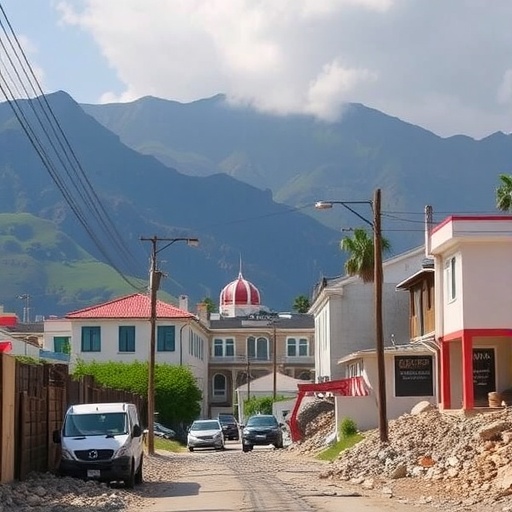
A groundbreaking study has revealed that socially and economically marginalized communities in the metropolitan areas of Montreal and Ottawa-Gatineau face disproportionately higher risks from earthquakes. This research, co-authored by McGill University civil engineering professor Daniele Malomo, marks the first comprehensive Canadian investigation into seismic vulnerability through an equity-focused lens. By integrating social vulnerability with traditional seismic risk models, the study delivers a nuanced perspective that challenges conventional approaches to disaster preparedness and urban resilience.
Utilizing sophisticated spatial mapping techniques combined with rigorous statistical analysis, the researchers identified critical intersections between earthquake hazard zones and socially vulnerable populations. The study draws on data derived from the 2021 Canadian Census alongside Canada’s Probabilistic Seismic Risk Model, a sophisticated tool that predicts potential earthquake impacts based on geological and structural factors. The fusion of these datasets allows for an unprecedented evaluation of risk that transcends purely physical or economic measures.
Historically, seismic risk assessments in Canada—and globally—have concentrated on tangible infrastructure vulnerabilities, such as building age, materials, and design standards, as well as quantifiable economic losses. However, this study pioneers the inclusion of social determinants such as race, income, language proficiency, educational attainment, and housing conditions to reveal how these factors exacerbate earthquake risk exposure. Professor Malomo emphasizes that incorporating social metrics is particularly vital in Canada’s culturally diverse urban centers, where marginalized communities are disproportionately situated in high-risk areas.
The research highlights a troubling correlation between older housing stock and elevated seismic risk in both Montreal and Ottawa-Gatineau. These neighborhoods often feature structures built before modern seismic building codes were established, rendering them more susceptible to structural failure during seismic events. Crucially, these vulnerable buildings are predominantly occupied by recent immigrants, seniors, single-parent families, and visible minorities. In Montreal, the risks compound further with factors such as limited English or French language proficiency and individuals living alone, who may face barriers to timely emergency response or evacuation.
Traditional disaster-risk models tend to overlook these socio-economic dimensions, focusing narrowly on the physical damage potential to infrastructure. Such models may underestimate the true human and societal cost of seismic events by failing to account for the differential capacity of communities to prepare, respond, and recover. This study therefore advocates for a paradigm shift in disaster risk assessment—a transformation from a purely technical focus to a holistic approach that recognizes and addresses systemic social inequalities.
Dr. Liton Chakraborty, lead author of the study and a research associate at the University of Waterloo’s Climate Risk Research Group, underscores this shift. He states that recognizing earthquake risk as an equity issue integrates environmental justice and social justice into disaster planning. “It becomes clear that some groups disproportionately face environmental hazards and risks not because of where they live by choice, but because of historical and ongoing socio-economic inequities,” Chakraborty explains. This insight calls for urgent policy interventions tailored to ameliorate disproportionate vulnerabilities.
The implications for policymakers and urban planners are profound. By identifying neighborhoods where seismic hazard exposure and social vulnerability overlap, emergency management strategies can be more precisely targeted. This includes the development of inclusive emergency preparedness plans that prioritize resources for marginalized populations and ensure accessibility across linguistic and cultural barriers. Strategically prioritizing investments for seismic retrofitting in older buildings within these vulnerable areas could significantly reduce potential casualties and economic losses.
Building on these findings, the research team recommends integrating social vulnerability indicators—such as income levels, educational attainment, and housing conditions—into all stages of disaster risk assessment and mitigation planning. Neighborhood-specific emergency response protocols should be established, emphasizing community engagement and tailored communication strategies. Additionally, investment in upgrading ageing infrastructure in socio-economically disadvantaged neighborhoods must be prioritized to close the equity gap in disaster resilience.
The study’s combination of advanced probabilistic seismic risk modeling with granular socio-demographic data provides a replicable framework for other urban centers in Canada and beyond. As climate change and urban densification exacerbate natural hazards globally, integrating social equity into resilience planning becomes ever more urgent. This fusion of engineering, social science, and data analytics exemplifies multidisciplinary innovation critical to addressing the complex challenges of disaster risk reduction in multicultural societies.
By advancing the discourse beyond mere structural vulnerability, this research also adds a new dimension to the concept of environmental justice. It challenges urban planners and disaster risk managers to confront the uncomfortable reality that disaster impacts are unevenly distributed across society and that vulnerability is as much a product of social systems as it is of natural phenomena. This insight is particularly relevant in Canada’s cities, where systemic disadvantages often dictate living conditions and access to safety measures.
Moreover, the study contributes to the growing body of research highlighting the importance of inclusive and equitable disaster resilience frameworks. As seismic risks are traditionally underestimated in Canadian contexts, the research advocates for a concerted policy shift that embraces broader social variables. This endeavor aligns with international best practices encouraging vulnerability assessments to incorporate socio-economic disparities to enhance community-level resilience.
Ultimately, the study’s findings serve as a clarion call for governments and urban planners to rethink seismic risk through an equity lens. The goal is to empower vulnerable communities by reducing their exposure and enhancing their capacity to cope with earthquake hazards. By doing so, Canada can move toward more just, inclusive, and effective disaster risk reduction models that safeguard not only infrastructure but also the social fabric of its diverse urban populations.
Cite Scienmag News
Courtney Benton. (May 14, 2025). Study Reveals Marginalized Communities Face Higher Risks During Earthquakes. Scienmag. https://scienmag.com/study-reveals-marginalized-communities-face-higher-risks-during-earthquakes/
Courtney Benton. "Study Reveals Marginalized Communities Face Higher Risks During Earthquakes." Scienmag, 14 May 2025, https://scienmag.com/study-reveals-marginalized-communities-face-higher-risks-during-earthquakes/. Accessed 4 September 2026.
Courtney Benton. "Study Reveals Marginalized Communities Face Higher Risks During Earthquakes." Scienmag. May 14, 2025. https://scienmag.com/study-reveals-marginalized-communities-face-higher-risks-during-earthquakes/


