


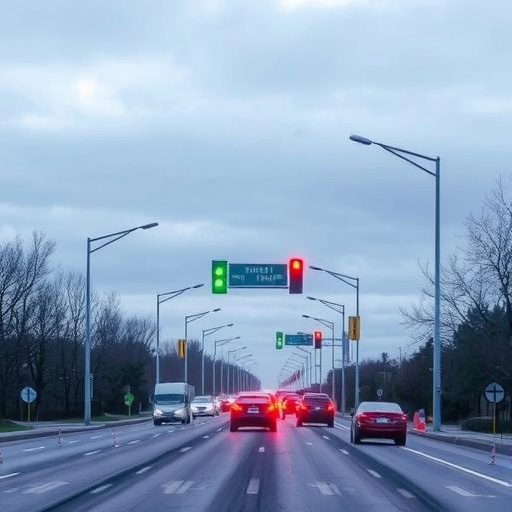
In a groundbreaking new study, researchers from Brown University shed light on an often overlooked urban environmental factor influencing mental health: community severance caused by roadways and traffic patterns. While previous research has extensively documented the harmful impacts of traffic-related air pollution and noise on psychological well-being, this study uniquely focuses on how the physical fragmentation of neighborhoods by roads and the resultant social isolation affect mental health outcomes, with a particular emphasis on schizophrenia-related hospital visits.
Central to this research is the innovative Community Severance Index, a metric developed initially at Columbia Mailman School of Public Health and refined through collaboration with Brown University experts. Unlike traditional measures of urban pollution and noise, this index captures the extent to which road infrastructure—such as divided highways, lack of sidewalks, and inadequate crosswalks—disrupts pedestrian connectivity and social interactions within communities. This framework allows for an unprecedented evaluation of how urban design elements contribute independently to mental health disorders, separate from pollution-related factors.
The study analyzes ZIP code-level data throughout New York City, integrating annual hospital visit counts related to mood, anxiety, adjustment, and schizophrenia disorders, as reported by the New York State Department of Health. The results are striking: areas exhibiting higher community severance scores showed significantly increased rates of schizophrenia-related hospital admissions. This finding held consistent across diverse age groups, signaling that the mental health impact of physical isolation transcends demographic boundaries.
Dr. Jaime Benavides, an epidemiology investigator at Brown’s School of Public Health and co-author of the study, offers a vivid portrayal of an ideal urban environment contrasted with current realities. According to Benavides, a neighborhood walkable on foot with vibrant social interactions – children playing freely and neighbors exchanging greetings – represents a stark contrast to spaces dominated by vehicular traffic barriers that sever social ties. These barriers not only discourage pedestrian activity but also engender psychological stress and restrict social cohesion essential for mental wellbeing.
The research extends beyond associations, proposing mechanisms by which community severance may exacerbate mental health disorders. Physical disconnection may limit residents’ access to essential services and social support networks, critical for managing psychological stress. Moreover, the increased traffic and absence of safe pedestrian routes compound stress and reduce opportunity for exercise and outdoor activities that are known protective factors for mental health.
Professor Marianthi-Anna Kioumourtzoglou, who led the development of the Community Severance Index and holds an epidemiology professorship affiliated with Brown’s Center for Climate, Environment and Health, emphasizes the study’s broader implications. While transitioning to electrified vehicles can reduce emissions and noise pollution, these infrastructural changes alone might not sufficiently mitigate mental health risks if urban design continues to prioritize car dependency at the expense of communal connectivity. Her insight underlines a pressing need to rethink urban planning paradigms towards fostering socio-environmental resilience in cities.
Urban living has long been correlated with elevated risks of anxiety, mood disorders, and schizophrenia, a pattern that this research contextualizes within specific urban infrastructure contexts. The striking independent association of community severance with schizophrenia-related hospitalizations contributes new evidence to the complex web of urban determinants impacting psychotic disorders. This highlights how built environments can shape epidemiological trends of severe mental illnesses in metropolitan areas.
Experts advocate for urban planning reforms including reduction of through-traffic within residential neighborhoods, expansion of pedestrian-friendly parks and open spaces, and limiting highways or arterial roads that cut through community cores. These interventions not only improve physical safety and mobility but foster the social interactions and connectivity necessary for collective mental health. As Dr. Benavides notes, these planning strategies represent actionable pathways to buffer against the mental health challenges posed by contemporary urbanization.
Notably, this study highlights an urgent gap in current environmental health perspectives that heavily prioritize chemical and noise pollution. Mental health interventions rarely consider how physical urban form and road patterns directly contribute to psychological distress and disorder prevalence. By integrating spatial urban design metrics with epidemiological data, this research pioneers a holistic approach to understanding and addressing mental health risks in city environments.
Anticipating future directions, the research team aims to generalize the Community Severance Index for application across other major U.S. cities, enabling broader comparative studies of urban severance and mental health correlations. Additionally, Brown University collaborators are exploring the compounded effects of environmental stressors—extreme heat, air pollution, and community isolation—on elderly populations’ mental wellbeing. These combined exposures may provide new insights into how complex urban challenges intersect to affect vulnerable subgroups.
This federally funded project, supported by the National Institute of Environmental Health Sciences and the National Institute on Aging, reinforces the critical role of interdisciplinary approaches in urban epidemiology. It combines civil engineering, urban planning, social science, and clinical psychology perspectives to unravel the multifactorial influences of built environments on mental health outcomes. The findings call for integrated policy responses to create healthier, more connected, and resilient cities fostering mental health equity.
As cities around the world grapple with rapid urbanization and environmental hazards, this pioneering study amplifies a vital message: the design of our streets and neighborhoods matters profoundly not just for physical safety and mobility, but for the very fabric of human social and mental wellbeing. Moving beyond emissions and noise, prioritizing pedestrian access and community cohesiveness may represent a crucial frontier in public health innovation to mitigate urban mental health burdens.
Cite Scienmag News
Glenn Wilkins. (April 27, 2026). Study Reveals Impact of Road Infrastructure and Traffic on Community Mental Health. Scienmag. https://scienmag.com/study-reveals-impact-of-road-infrastructure-and-traffic-on-community-mental-health/
Glenn Wilkins. "Study Reveals Impact of Road Infrastructure and Traffic on Community Mental Health." Scienmag, 27 April 2026, https://scienmag.com/study-reveals-impact-of-road-infrastructure-and-traffic-on-community-mental-health/. Accessed 3 September 2026.
Glenn Wilkins. "Study Reveals Impact of Road Infrastructure and Traffic on Community Mental Health." Scienmag. April 27, 2026. https://scienmag.com/study-reveals-impact-of-road-infrastructure-and-traffic-on-community-mental-health/


