


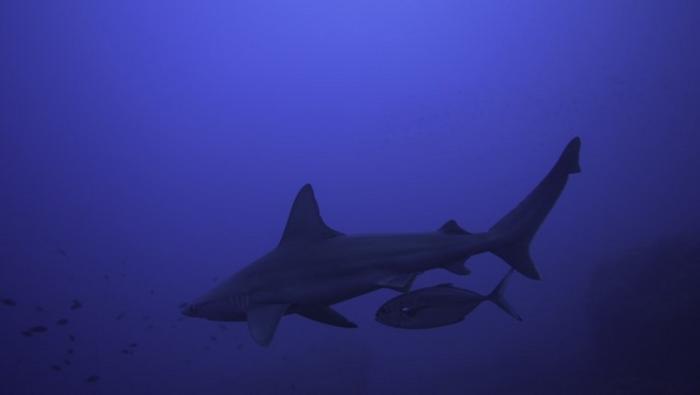
Scientists have unveiled a remarkable and previously undocumented behavior exhibited by certain fish, specifically the blue runner, which appears to engage in a strategic hunting technique by utilizing sandbar sharks as cover. This intriguing phenomenon, observed in the Mediterranean Sea, marks a significant advancement in our understanding of predator-prey interactions within marine ecosystems. The underwater footage captured by trained scientists and diving teams reveals blue runners ingeniously positioning themselves behind these formidable predators to ambush their unsuspecting prey, an adaptation that may fundamentally alter perceptions of ecological dynamics in marine environments.
In the course of a detailed study led by a team from the University of Edinburgh, researchers meticulously examined the intricate relationships between blue runners and sandbar sharks. Their findings highlight not only the complexity of these interactions but also illustrate how such relationships can drive alternative hunting strategies in oceanic realms. This breakthrough research challenges long-held assumptions about the roles different species play in marine ecosystems, opening new avenues for understanding biodiversity and species interdependence in aquatic environments.
Captured off the coast of Italy’s picturesque Lampione Island, the research team documented a total of 34 instances where blue runners employed their unique hunting strategy. In each unexpected encounter, a solitary blue runner would shadow a sandbar shark for approximately thirty seconds, allowing it to exploit the shark’s presence. This clever tactic provides the smaller fish with the concealment necessary to pursue smaller fish such as damselfish, dramatically enhancing their chances of a successful hunt. The statistics reveal that when blue runners hidden behind sharks approached, prey noticed them only about 10% of the time, which is a stunning reduction compared to the nearly 95% detection rate when they hunted in groups.
The significance of this surprising strategy is accentuated by the findings regarding energy conservation. Swimming in the slipstream created by sharks not only aids blue runners in their pursuit of prey but also allows them to conserve energy that would otherwise be expended during solitary chases. This behavioral adaptation therefore appears to serve dual purposes; it increases hunting efficacy while simultaneously enhancing survival prospects from their own predators. Thus, by harnessing the power of larger predators, blue runners exemplify a sophisticated ecological strategy that could inspire further investigations into marine evolutionary adaptations.
Moreover, the study findings raise critical implications for ecological understanding and marine conservation efforts. The special aggregation of sandbar sharks around Lampione Island presents a unique opportunity for scientific inquiry, as it may provide essential insights into the roles that top predators play in maintaining the health and functionality of marine ecosystems. The loss of such aggregations due to overfishing and habitat degradation could yield far-reaching consequences, not only for the sharks themselves but for a multitude of species reliant on these dynamic predator-prey interactions.
Professor Fabio Badalamenti, who contributed significantly to the research, emphasized that these newfound interactions illustrate the intricate web of relationships driving hunting tactics in marine environments. He stressed that by gaining insights into how various species interact, scientists can enrich our comprehension of marine biodiversity. Increased awareness of such interactions also reinforces the importance of preserving high-level predators like sharks, which serve as keystones of their ecosystems and play crucial roles in maintaining ecological balance.
Dr. Carlo Cattano, another key researcher involved in the study, reiterated the importance of sandbar shark aggregations, referring to them as essential to the structure and function of marine ecosystems. He noted that Lampione Island represents one of the rare remaining locations where such aggregations can be observed in the Mediterranean Sea, emphasizing the critical need to protect these habitats. The alarming trend of declining shark populations, often a result of unsustainable fishing practices, poses a significant threat to these ecological dynamics, making conservation efforts more pressing than ever.
As the scientific community gears up to explore the implications of these findings, the study published in the esteemed journal Ecology serves as a stepping stone for future research. The methods employed in this observational study reflect a rigorous approach to understanding complex biological phenomena, paving the way for a deeper exploration of the marine environment. The collaboration between diverse research institutions such as the Blue Marine Foundation and the National Geographic Society underscores the interdisciplinary nature of modern ecological studies, demonstrating how shared expertise can lead to unparalleled discoveries.
In essence, the remarkable behavior observed in blue runners not only enriches our understanding of their ecological role but also brings to the forefront the interconnectedness of marine species. The evolutionary advantages that arise from such strategic behaviors underline the necessity for ongoing research and conservation initiatives in oceanic environments. Researchers and conservationists alike are urged to take these findings into account as we confront the challenges posed by environmental change and human impact on marine ecosystems.
In light of the mounting evidence highlighting the ecological importance of predator-prey interactions, particularly between species as seemingly disparate as sharks and small fish, it becomes clear that the intricacies of marine life are far more complex than previously understood. The insight gained from these findings offers valuable lessons on the resilience and adaptability of marine species, as well as the overarching need for responsible stewardship of our aquatic ecosystems.
Ultimately, this groundbreaking research illuminates a new dimension of the relationship between blue runner fish and sandbar sharks, heralding a greater appreciation for the interdependent roles that species play within marine communities. As we broaden our understanding of these dynamics, we deepen our commitment to preserving the delicate balances that sustain biodiversity and the health of our planet’s oceans.
Cite Scienmag News
Margaret Porter. (March 28, 2025). Study Reveals Fish Utilize Sharks as Shields for Prey Ambush Tactics. Scienmag. https://scienmag.com/study-reveals-fish-utilize-sharks-as-shields-for-prey-ambush-tactics/
Margaret Porter. "Study Reveals Fish Utilize Sharks as Shields for Prey Ambush Tactics." Scienmag, 28 March 2025, https://scienmag.com/study-reveals-fish-utilize-sharks-as-shields-for-prey-ambush-tactics/. Accessed 4 September 2026.
Margaret Porter. "Study Reveals Fish Utilize Sharks as Shields for Prey Ambush Tactics." Scienmag. March 28, 2025. https://scienmag.com/study-reveals-fish-utilize-sharks-as-shields-for-prey-ambush-tactics/


