


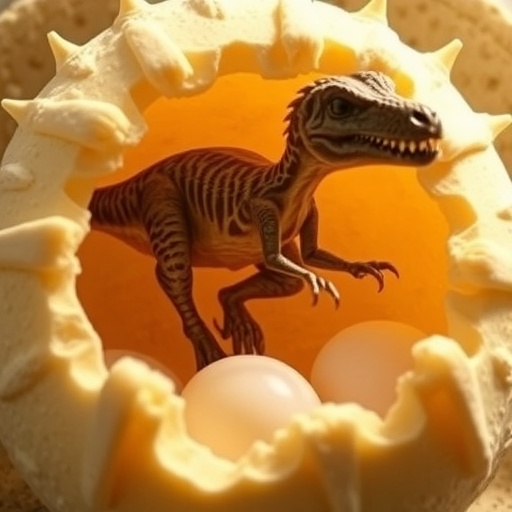
Among the diverse array of dinosaur behaviors still shrouded in mystery, the reproductive strategies of oviraptors—bird-like, yet flightless dinosaurs—have captivated paleontologists for decades. Recent cutting-edge research conducted by Taiwanese scientists has embarked on an ambitious quest to decode the incubation behavior and hatching efficiency of these enigmatic creatures. Through meticulous experiments involving life-sized oviraptor models and artificial eggs, the study elucidates the thermal dynamics of oviraptor nests, shedding light on a brooding strategy markedly different from that of modern birds.
One of the central questions the researchers set out to answer was whether oviraptors relied predominantly on environmental heat sources such as solar radiation and soil warmth—akin to crocodilians—or on direct body heat transferred from an incubating adult, similar to extant avian species. This distinction is pivotal in understanding the evolutionary trajectory of incubation mechanisms in theropod dinosaurs, the clade that ultimately gave rise to modern birds. The team’s innovative approach combined physical reconstructions with heat transfer simulations to accurately model realistic incubation scenarios.
The focal species of the study, Heyuannia huangi, inhabited what is now China during the Late Cretaceous period, approximately 70 to 66 million years ago. A relatively small theropod measuring around 1.5 meters in length and weighing approximately 20 kilograms, this dinosaur constructed semi-open nests characterized by multiple concentric rings of eggs. Such nest architectures present unique challenges for effective heat transfer, particularly when considering the spatial positioning of the brooding adult and the heterogeneity of ambient environmental conditions.
To recreate a biomechanically and thermally representative incubator, the scientific team engineered a model oviraptor whose skeletal frame was assembled using polystyrene foam and wood. To mimic soft tissue mass, materials such as cotton, bubble wrap, and cloth were employed to ensure realistic thermal inertia and heat conduction properties. The eggs themselves were fabricated from casting resin meticulously molded to approximate the size, shape, and thermal conductivity of genuine oviraptorid eggs based on fossil evidence. Two clutch arrangements, each featuring double-ring layouts, replicated authentic nesting configurations observed in paleontological sites.
Experimentation revealed that temperature gradients within the clutch were substantially influenced by both the ambient conditions and the position of the incubating adult. Under cooler environmental temperatures, the outer ring of eggs exhibited temperature differentials of up to 6 degrees Celsius, a disparity large enough to induce asynchronous hatching, whereby some eggs hatch significantly earlier or later than others. In contrast, during warmer conditions, the temperature variation across the clutch was markedly reduced to approximately 0.6 degrees Celsius, implying that external heat sources like the sun played a significant role in moderating clutch temperature, thereby affecting hatch synchrony.
This nuanced understanding challenges prior assumptions that large-bodied dinosaurs like oviraptors sat directly on their clutches to provide body heat, much as contemporary birds do. Instead, the findings underscore the probable reliance on solar irradiation and soil warmth as supplementary heat sources. Given that oviraptor nests were semi-open and exposed to the air, rather than buried like those of some modern reptiles, the contribution of environmental heat was likely critical in sustaining the developmental temperatures necessary for embryogenesis.
The investigation further compared the incubation efficiency of oviraptors with that of modern birds, whose brooding strategies involve thermoregulatory contact incubation (TCI). TCI entails the adult maintaining continuous, direct contact with all eggs, serving as the primary heat source while regulating temperature within a narrow optimal range to ensure synchronous hatching. Oviraptors, however, failed to satisfy the three key TCI prerequisites: full clutch egg contact, dominance as a heat source, and tight temperature control within the entire clutch.
Consequently, the research suggests that oviraptors may have engaged in a co-incubation system, combining intermittent adult brooding with heat derived from the environment. While this dual-source incubation strategy may be less efficient than the TCI observed in extant avifauna, it exemplifies an evolutionary intermediate stage reflecting nesting adaptations during the transition from predominantly buried nests to those exposed in open or semi-open configurations.
The implications of this study extend beyond academic curiosity, offering profound insights into the evolutionary biology of dinosaur reproduction. It bridges paleontological evidence with empirical physics-based modeling, enriching our understanding of how environmental and behavioral factors orchestrated the development of early avian ancestors. Moreover, it illustrates the diversity of incubation strategies in the dinosaur lineage, highlighting that modern birds’ highly efficient brooding behaviors are but one end point on a spectrum rather than a universal gold standard.
Notably, the researchers caution that their findings are constrained by the fact that experimental models and ambient climate conditions cannot perfectly replicate those of the Late Cretaceous epoch. Therefore, actual incubation dynamics in prehistoric ecosystems, which featured different temperature regimes and atmospheric compositions, may have varied somewhat. Additionally, oviraptors likely experienced longer incubation periods relative to modern birds, an aspect not fully captured in the current experimental setup.
This investigation represents a milestone in the application of multi-disciplinary methodologies combining paleontology, materials science, and thermodynamics. By translating fossil records into tangible, testable models, the study opens new avenues for exploring evolutionary questions once inaccessible due to methodological limitations. Beyond its scientific contributions, the research underscores the value of student involvement—reflecting the participation of high school researcher Chun-Yu Su—in pioneering discoveries and inspiring future generations, particularly in locales like Taiwan, which lack direct dinosaur fossil evidence.
Ultimately, the research reframes our understanding of dinosaur reproduction, elucidating a complex interplay between behavior, environment, and physiology during incubation. It emphasizes adaptation to prevailing ecological conditions rather than an inherent progression toward the avian incubation archetype. Such revelations enrich the narrative of dinosaur life history and nurture a deeper appreciation for the diverse evolutionary pathways that have shaped life on Earth.
Cite Scienmag News
Drew Townsend. (March 17, 2026). Study Reveals Dinosaurs Hatched Eggs Less Efficiently Than Modern Birds. Scienmag. https://scienmag.com/study-reveals-dinosaurs-hatched-eggs-less-efficiently-than-modern-birds/
Drew Townsend. "Study Reveals Dinosaurs Hatched Eggs Less Efficiently Than Modern Birds." Scienmag, 17 March 2026, https://scienmag.com/study-reveals-dinosaurs-hatched-eggs-less-efficiently-than-modern-birds/. Accessed 4 September 2026.
Drew Townsend. "Study Reveals Dinosaurs Hatched Eggs Less Efficiently Than Modern Birds." Scienmag. March 17, 2026. https://scienmag.com/study-reveals-dinosaurs-hatched-eggs-less-efficiently-than-modern-birds/


