


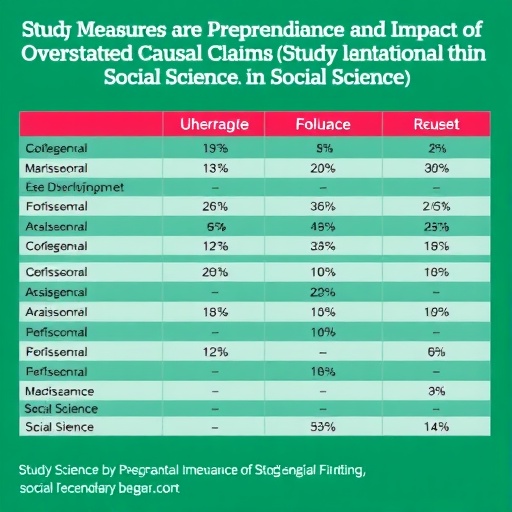
A new study in Nature Human Behaviour is putting a deceptively simple question under the microscope: how often do social-science papers claim that one thing causes another when their evidence can support only an association? The answer matters far beyond academic wording. Causal claims shape public policy, influence clinical and educational interventions, guide media coverage and determine which social problems receive funding. When those claims stretch beyond the underlying research design, a correlation can quickly become a headline, a recommendation or a political argument. In “Quantifying the prevalence and impact of overreaching causal claims in social science,” researchers Christian Isch, Tobias Dörr, Nadine Fasching and colleagues examine how frequently this leap occurs and what consequences it may have for the interpretation of evidence.
The distinction between correlation and causation is central to nearly every empirical science, but it is especially difficult in social research. Researchers cannot randomly assign people to poverty, discrimination, loneliness, political beliefs or years of education in the same way that a laboratory scientist can control a chemical reaction. Much of social science therefore relies on observational data: researchers measure characteristics as they exist in the real world and examine whether they vary together. If people who sleep less report poorer mental health, for example, the association may reflect a causal effect of sleep deprivation. But it could also be explained by stress, illness, work schedules, economic conditions or a feedback loop in which mental distress disrupts sleep. Statistical adjustment can reduce some alternative explanations, yet it cannot automatically transform observational evidence into experimental proof.
The new research focuses on what happens when language outruns design. A study may report that two variables are “associated,” while its abstract, discussion or public-facing summary describes one as producing, driving or influencing the other. Such wording can introduce a causal interpretation that was not established by the analysis itself. The problem is not merely semantic. Causal language implies a counterfactual: it suggests that if the presumed cause were changed, the outcome would change as a result. Establishing that counterfactual generally requires randomization, a credible natural experiment, longitudinal evidence with strong assumptions or a carefully justified causal-inference framework. Without those safeguards, the direction of an effect may be reversed, a third factor may explain both variables, or the relationship may be more complicated than a one-way chain.
Isch and colleagues treat overreaching causal claims as a measurable feature of the scientific literature rather than as a handful of isolated mistakes. Their work asks how prevalent these claims are, where they appear and how much they can alter a reader’s understanding of a study. This approach shifts attention from whether an individual sentence is technically defensible to whether the overall presentation encourages an interpretation stronger than the evidence warrants. The authors’ central concern is that causal overstatement can occur at several stages of scientific communication, including titles, abstracts, conclusions and summaries intended for non-specialist audiences. Each stage offers an opportunity for uncertainty to be compressed or lost.
The technical challenge is substantial because causal meaning is conveyed not only through explicit verbs such as “cause” or “lead to,” but also through context. Phrases such as “the effect of,” “the impact of,” “increasing,” “protecting against” or “reducing” may imply a causal relationship even when a paper’s statistical model estimates only an association. Conversely, some analyses can support causal conclusions despite using non-randomized data if they rely on a transparent identification strategy and clearly stated assumptions. A rigorous assessment must therefore connect the language of a claim to the design of the study, the timing of measurements, the statistical model and the assumptions required to interpret the estimate causally. That makes the task more demanding than simply searching articles for a list of forbidden words.
The study’s importance lies in measuring impact as well as frequency. An overstated causal claim can change the apparent meaning of an effect without changing a single data point. Readers may interpret an association as evidence that an intervention will work, even though the original study never tested an intervention. Policymakers may assume that modifying one social condition will produce a predictable improvement in another. Journalists may turn cautious findings into a simple narrative with a clear villain, cure or solution. In public-health settings, the consequences can be particularly serious: resources may be directed toward plausible but ineffective strategies, while the real causes of a problem remain underexamined. A stronger causal impression can also make a finding appear more actionable, more certain and more newsworthy than it truly is.
The researchers’ framing also highlights a subtle feature of scientific error: overclaiming does not necessarily require fabricated data, incorrect calculations or deliberate deception. A paper can use appropriate measurements and sound statistical procedures while still presenting its results too confidently. The gap may emerge during interpretation, when authors move from “these variables were related in this sample” to “changing this factor would change the outcome.” It can widen further as findings pass through press releases, news stories, social media posts and policy briefings. In that chain, each retelling may remove qualifications about sampling, uncertainty, confounding or study limitations. The final message can therefore be substantially more causal than the original evidence.
This does not mean that social scientists should avoid causal questions or retreat into purely descriptive research. On the contrary, identifying causes is essential for designing effective interventions. The lesson is that causal conclusions should be matched to the inferential tools used to obtain them. Researchers can strengthen causal reasoning through preregistered analyses, longitudinal designs, randomized experiments where feasible, natural experiments, instrumental variables, mediation analysis and explicit causal diagrams. Directed acyclic graphs, for instance, help investigators distinguish confounders from mediators and clarify which variables should or should not be statistically controlled. Sensitivity analyses can show how strong an unmeasured confounder would need to be to eliminate an observed association. None of these methods is magical, but each makes the assumptions behind a causal claim more visible.
For readers, the study offers a practical warning whenever a social-science result appears in viral form: ask what was actually measured, whether the presumed cause occurred before the outcome, what alternative explanations remain and whether the study changed anything experimentally. A striking association may be real and important without being causal. The responsible question is not whether a finding is “just correlation,” as though correlation were worthless, but what the correlation can legitimately tell us. By quantifying how often causal claims overreach and how much that overreach changes interpretation, the researchers argue for a more disciplined scientific vocabulary—one that preserves the difference between observing a pattern and demonstrating a mechanism. In an era when a single sentence can travel from a journal to millions of screens within hours, that distinction may be one of the most consequential forms of scientific accuracy.
Cite Scienmag News
Courtney Benton. (August 24, 2026). Study Measures Prevalence and Impact of Overstated Causal Claims in Social Science. Scienmag. https://scienmag.com/study-measures-prevalence-and-impact-of-overstated-causal-claims-in-social-science/
Courtney Benton. "Study Measures Prevalence and Impact of Overstated Causal Claims in Social Science." Scienmag, 24 August 2026, https://scienmag.com/study-measures-prevalence-and-impact-of-overstated-causal-claims-in-social-science/. Accessed 3 September 2026.
Courtney Benton. "Study Measures Prevalence and Impact of Overstated Causal Claims in Social Science." Scienmag. August 24, 2026. https://scienmag.com/study-measures-prevalence-and-impact-of-overstated-causal-claims-in-social-science/


