

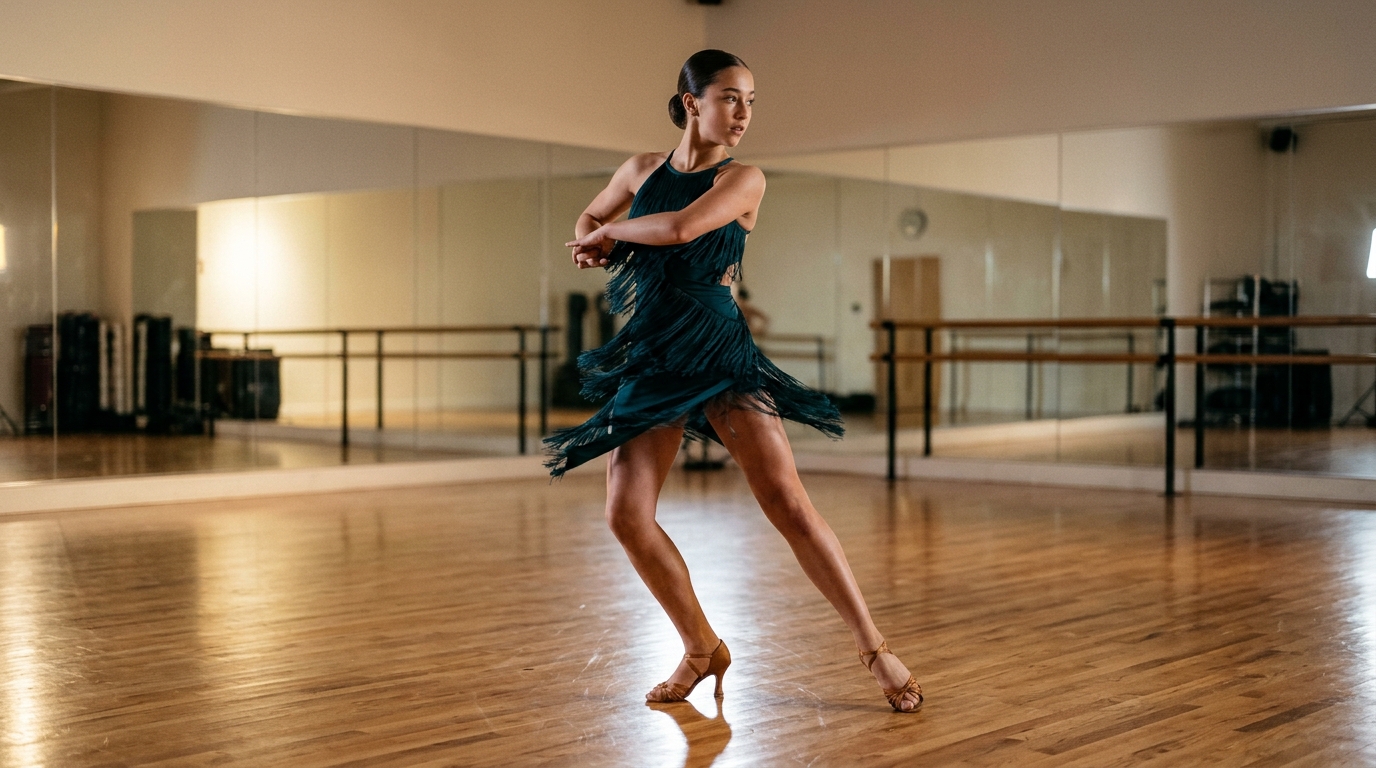
An exploratory study published in PLOS ONE has identified specific intervals during a standardised Rumba spiral turn where the kinematics of highly trained adolescent female Latin dancers consistently deviate from model-defined references. The research, conducted by Mimi Guo and colleagues, focused on localising where consistent directional deviations occur across the continuous whole-body reorientation required for the turn. While Rumba turning involves complex movement, previous discrete kinematic summaries did not pinpoint these deviations across the full rotational progress. This study aimed to map these patterns for pelvic obliquity, thoracic frontal-plane angle, and right support-foot progression angle.
The study involved fifteen dancers aged 14 to 16 years, each completing five valid trials for a total of 75 trials. Three-dimensional kinematics were recorded using a 10-camera Vicon system operating at 100 Hz. To analyse the data, the researchers used accumulated pelvic rotation to define rotational progress for each trial. The three outcome waveforms were then resampled to 101 points across 0% to 100% of the turn. By averaging the five trials from each participant point by point, the team generated 15 participant-level representative waveforms for each outcome measure.
Statistical analysis employed two-tailed one-sample statistical parametric mapping tests to identify intervals where group mean waveforms differed from corresponding Plug-in Gait model-defined 0° references. A Bonferroni-adjusted primary alpha level of 0.0167 was applied across the three outcomes to control for multiple comparisons. The results revealed distinct patterns of deviation. Pelvic obliquity showed a positive deviation between 11.3% and 47.2% of rotational progress, followed by a negative deviation from 56.5% to 97.3%. These findings indicate that the pelvic orientation does not remain neutral throughout the turn but shifts directionally at specific stages.
The thoracic frontal-plane angle exhibited a negative deviation from 13.2% to 41.9% of the turn. Subsequently, positive deviations were observed in two separate intervals: from 57.6% to 83.0% and again from 85.7% to 92.0%. This pattern suggests that the upper body orientation relative to the frontal plane changes significantly as the dancer progresses through the spiral turn. The right support-foot progression angle also displayed complex variations, showing negative deviations at the start (0.0%–4.8%) and end (56.2%–100.0%) of the turn, with a positive deviation in the middle section from 10.4% to 49.1%.
Sensitivity analyses were conducted without the additional across-outcome Bonferroni adjustment to test the robustness of the findings. These analyses preserved the principal directional patterns, with only modest changes in cluster extent and continuity. This confirms that the identified deviations are consistent features of the movement pattern in this group of dancers. The study explicitly states that these findings identify where measured segmental orientations departed from model-defined references, without implying normative targets of optimal dance technique.
The research contributes to the understanding of dance kinematics by providing a rotational-progress-dependent view of segmental orientation. It highlights the importance of continuous analysis over discrete summaries in capturing the nuances of complex dance movements. The findings are specific to highly trained adolescent female Latin dancers performing a standardised Rumba spiral turn.
Subject of Research: Kinematic analysis of Rumba spiral turns in adolescent Latin dancers
Article Title: Rotational-progress-dependent pelvic, thoracic, and support-foot kinematics during a standardised Rumba spiral turn in highly trained adolescent female Latin dancers
Article References: Guo, M., Ismail, M. H. B., Abdul Ghani, D. Z. B., Liang, Q., & Gao, Y. (2026). Rotational-progress-dependent pelvic, thoracic, and support-foot kinematics during a standardised Rumba spiral turn in highly trained adolescent female Latin dancers. PLOS One, 21(10), e0361699. https://doi.org/10.1371/journal.pone.0361699
Image Credits: AI Generated
DOI: 10.1371/journal.pone.0361699
Keywords: Rumba, Kinematics, Latin Dance, Adolescent Dancers, Biomechanics, Pelvic Obliquity, Thoracic Angle, Foot Progression, PLOS ONE, Movement Analysis, Rotational-progress-dependent, pelvic
Cite Scienmag News
Scienmag. (November 8, 2026). Study Maps Kinematic Deviations in Adolescent Rumba Turns. https://scienmag.com/study-maps-kinematic-deviations-in-adolescent-rumba-turns/
Scienmag. "Study Maps Kinematic Deviations in Adolescent Rumba Turns." Scienmag, 8 November 2026, https://scienmag.com/study-maps-kinematic-deviations-in-adolescent-rumba-turns/. Accessed 11 November 2026.
Scienmag. "Study Maps Kinematic Deviations in Adolescent Rumba Turns." Scienmag. November 8, 2026. https://scienmag.com/study-maps-kinematic-deviations-in-adolescent-rumba-turns/




