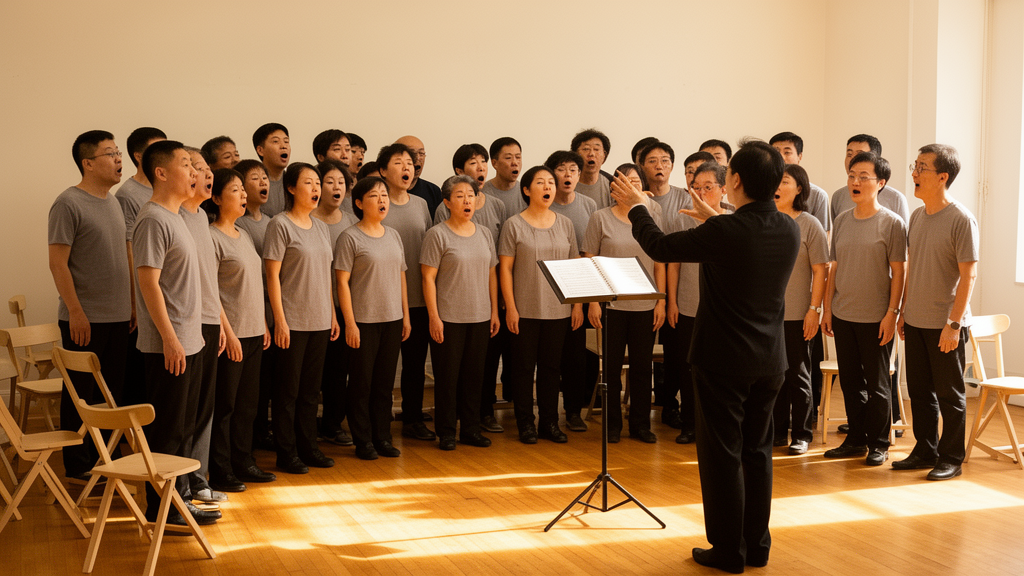
A nonexperimental study of 612 singers in 38 amateur choirs in mainland China found that musical emotional expression was associated with group cohesion through a sequential pathway involving behavioral synchrony and shared affect. Expressive singing predicted tighter coordination of breathing and rhythmic entries, which predicted greater convergence in singers’ momentary emotions and, in turn, stronger task and social cohesion. The proposed sequence fit better than models in which the mediators were reversed or operated in parallel, but the authors emphasized that the design cannot establish causality or exclude reciprocal effects over a rehearsal season.
The study examined how feelings expressed during organized choral rehearsal may become social bonds, rather than focusing only on individual emotional responses or a choir’s overall sense of belonging. The sample included 326 singers in 20 choirs from three inland prefecture-level cities in Shandong Province and 286 singers in 18 choirs from two coastal metropolitan cities in the Pearl River Delta. The regions were selected to provide variation in individualism–collectivism, not to represent two national cultures. The researchers therefore measured cultural value orientation in each singer instead of assigning it according to location, and they used region as a stratification variable and covariate.
Musical emotional expression was divided into three related components. Emotional arousal referred to the intensity of feeling activated by the music; emotional congruence described whether members converged on a similar affective interpretation of a passage; and expressive alignment concerned the perceived temporal fit of their expressive behavior, such as whether phrasing rose and fell together. These were self-reported constructs. Behavioral synchrony was kept conceptually and methodologically separate: trained raters who did not see the questionnaires scored recordings for the alignment of respiratory cycles and rhythmic onsets across singers. Shared affect was represented by convergence among members’ concurrent emotion ratings, with less dispersion indicating greater sharing. Group cohesion combined task cohesion, meaning commitment to a common objective, with social cohesion, meaning interpersonal attraction among members.
Measurements were spread across three points in time. Personality and cultural value orientation were assessed at baseline, on average 14 days before the recorded rehearsal and no fewer than 10 days beforehand. Musical emotional expression was measured immediately after the recorded session, while momentary affect was rated during two pauses within that same rehearsal. Group cohesion was assessed within 48 hours. This ordering matched the proposed sequence of expression, synchrony, shared affect and cohesion, and it reduced some common-method concerns, but no factor was manipulated. The authors therefore treated the temporal arrangement and model comparisons as support for a plausible pathway rather than experimental proof that one variable caused the next.
To make the behavioral measurements comparable, each choir rehearsed two required pieces: a slow homophonic setting sung largely in unison at approximately 60–72 beats per minute and a four-part polyphonic setting at a moderate tempo. Two cameras recorded each section from the front and side at 50 frames per second, and clip microphones on four to six members captured breath sounds. Respiratory cycles were identified through visible thoracic and abdominal movement, audible inhalation and breath marks in the score. Rhythmic onsets were phrase entries and final-consonant releases, with a 120-millisecond tolerance fixed after pilot coding. Four postgraduate raters annotated events in ELAN, and 1,184 of 4,736 eight-second windows were double-coded. Agreement for the synchrony measure was ICC(2,k) = 0.82, with a 95% confidence interval of 0.74–0.88.
The analysis used multilevel structural equation modeling because singers were nested within choirs and several variables had meaningful between-choir variation. The reported path coefficients were 0.43 for musical emotional expression predicting behavioral synchrony, 0.48 for synchrony predicting shared affect and 0.45 for shared affect predicting cohesion, each with p < 0.001. The serial indirect effect was 0.093, with a 95% Monte Carlo confidence interval of 0.051–0.144. The total effect of expression on cohesion was 0.327, while the direct effect was 0.140, indicating partial rather than complete mediation in the model. The three indirect routes together accounted for 57% of the total effect: 0.061 through synchrony alone, 0.033 through shared affect alone and 0.093 through the serial route.
The sequential model had lower Akaike information criterion and Bayesian information criterion values than the reversed-order model, which placed shared affect before behavioral synchrony. The parallel-mediator model fit less well than the proposed sequence but better than the reversed model. Adding choir tenure, education and rehearsal frequency as covariates left the serial indirect effect essentially unchanged, moving from 0.093 to 0.089. These comparisons favor the proposed ordering within the observed data, although they do not show that the sequence is irreversible. Cohesion formed earlier in a rehearsal season could plausibly make breathing and rhythmic alignment easier, and the study did not follow the choirs longitudinally across such a period.
Personality moderated the first segment of the pathway. The interaction between emotional expression and extraversion was 0.15, with p < 0.01, and the expression-by-agreeableness interaction was 0.12, with p < 0.05. At one standard deviation above the mean for extraversion, the expression-to-synchrony slope was 0.58, compared with 0.28 one standard deviation below the mean. The corresponding agreeableness slopes were 0.49 and 0.25. The authors interpret extraversion as potentially supporting greater sensitivity to and expression of social cues, while agreeableness may support accommodation to the section. Those distinct mechanisms were not directly tested, however; the study established the estimated moderation of the path rather than its psychological cause.
Cultural value orientation moderated the later conversion of shared affect into cohesion. The shared-affect-by-culture interaction was 0.16, with p < 0.01. The shared-affect-to-cohesion slope was 0.61 among singers one standard deviation above the mean on the collectivistic end of the scale and 0.29 among singers one standard deviation below it. Thus, at a given level of shared affect, cohesion was more strongly associated with that shared feeling among collectivistically oriented singers. Conditional indirect effects were largest when extraversion and collectivistic orientation were both high, reaching 0.170, and smallest when both were low, at 0.039. Both Monte Carlo intervals excluded zero, though the low-low interval was relatively narrow.
Precision varied across the moderation tests. Monte Carlo power simulations based on the realized design estimated power of 0.73 for the extraversion index, 0.72 for the cultural-orientation index and 0.61 for the agreeableness index. The simulation suggested that about 50 choirs would be needed to exceed the conventional power threshold for the first two indices and about 60 for all three, making the agreeableness interaction the least securely estimated. The study also involved only 38 ensembles, all in mainland China, so its regional contrast cannot represent the full range of cultural variation. Synchrony was coded for only two pieces, and three of the four main constructs relied on self-report, although temporal separation, behavioral coding and a marker-variable analysis addressed some shared-method concerns. The results offer testable guidance for understanding cohesion in organized choral rehearsal, not a causal prescription for producing it.
Subject of Research: How musical expression, personality and cultural values relate to cohesion in amateur choir rehearsals
Article Title: How personality traits and cultural value orientation moderate the pathway from musical emotional expression to group cohesion in choral rehearsal
Article References: Dong, S., & Li, R. (2026). How personality traits and cultural value orientation moderate the pathway from musical emotional expression to group cohesion in choral rehearsal. Frontiers in Psychology, 17, Article 1905573. https://doi.org/10.3389/fpsyg.2026.1905573
Image Credits: AI Generated
DOI: 10.3389/fpsyg.2026.1905573
Keywords: choral singing, group cohesion, emotional expression, behavioral synchrony, shared affect, personality traits, cultural values, social identity, multilevel modeling, amateur choirs, personality, traits
Cite Scienmag News
Glenn Wilkins. (October 26, 2026). Study links choral expression, synchrony and cohesion in Chinese amateur choirs. Scienmag. https://scienmag.com/study-links-choral-expression-synchrony-and-cohesion-in-chinese-amateur-choirs/
Glenn Wilkins. "Study links choral expression, synchrony and cohesion in Chinese amateur choirs." Scienmag, 26 October 2026, https://scienmag.com/study-links-choral-expression-synchrony-and-cohesion-in-chinese-amateur-choirs/. Accessed 26 October 2026.
Glenn Wilkins. "Study links choral expression, synchrony and cohesion in Chinese amateur choirs." Scienmag. October 26, 2026. https://scienmag.com/study-links-choral-expression-synchrony-and-cohesion-in-chinese-amateur-choirs/