


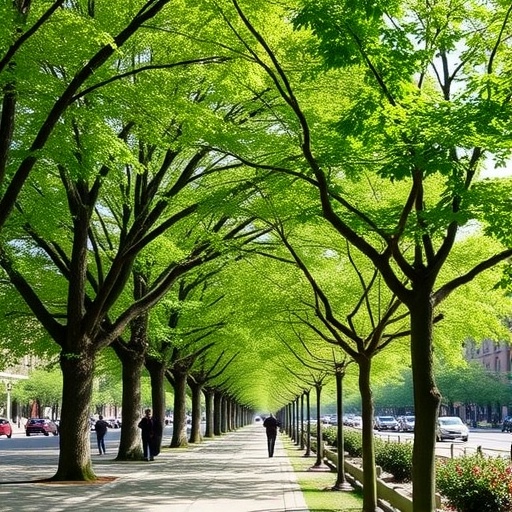
Pedestrian safety within urban environments remains a pressing public health concern, particularly when addressing outdoor falls which contribute substantially to injury-related emergencies each year. A groundbreaking study led by Columbia University’s Mailman School of Public Health reveals that increased tree canopy cover along sidewalks and streets plays a critical role in preventing injurious pedestrian falls. This novel research underscores the significance of urban greenery not only as an aesthetic enhancement but also as a vital environmental factor contributing to public safety.
While the dynamics of indoor falls have been extensively studied, outdoor falls—which account for approximately half a million injury-related incidents annually in the United States—have historically received far less scientific scrutiny. This investigation focused explicitly on outdoor pedestrian falls during the warmer months, discovering that locations shaded by trees demonstrated a markedly lower incidence of serious injuries sustained from falls. The cooling shade provided by tree canopies is believed to mediate environmental factors that contribute to trip hazards and physiological vulnerabilities in pedestrians.
Dr. Katie Burford, lead author and postdoctoral research scientist at Columbia University, detailed the ongoing debate surrounding urban tree planting programs. Although enhancing greenery in cityscapes is widely advocated for its myriad benefits, opposition often stems from concerns surrounding damage to sidewalks caused by tree roots, potentially increasing fall risk. This study directly addresses those concerns by providing empirical evidence that shaded walkways may in fact mitigate injury risk, thereby supporting the case for urban forestry as a public health intervention.
The methodology involved a meticulous location-based case-control study where researchers analyzed Emergency Medical Services (EMS) data documenting injurious pedestrian falls between April and September 2019. A total of 497 fall locations were compared against 994 control sites matched by neighborhood characteristics and pedestrian activity proxies. The assessment of tree canopy cover—conducted using the nationally recognized 2019 National Land Cover Database—revealed that fall sites had a significantly lower average canopy cover (8%) compared to control sites (14%). This inverse relationship remained robust even after accounting for socioeconomic and pedestrian volume variables.
One of the critical insights from the research is the environmentally mediated mechanisms that increase fall risk. Ambient heat can exacerbate human physiological stress responses, impairing balance and reaction times. Moreover, elevated temperatures soften asphalt and destabilize sidewalk pavers, creating physical tripping hazards. The shading provided by tree canopies counteracts this by reducing surface temperatures and maintaining infrastructural integrity, thereby contributing to a safer pedestrian environment.
Senior author Dr. Andrew Rundle emphasized that outdoor falls differ fundamentally from indoor falls, which are often associated with individual health conditions such as balance disorders or medication effects. In contrast, outdoor falls are primarily shaped by environmental exposures. The study’s findings suggest that urban design incorporating sufficient tree canopy can serve as a non-pharmacological, low-cost strategy to reduce fall-related injuries by modifying microclimate conditions and structural hazards simultaneously.
This research also introduces a methodological innovation by utilizing EMS response data to track patterns of pedestrian injury at a granular spatial scale. Such data integration allows public health scientists to move beyond generalized injury statistics and investigate place-based risk factors. This approach has significant implications for urban planning, offering a data-driven foundation for decisions regarding sidewalk maintenance, tree planting, and pedestrian infrastructure investments.
The protective role of tree canopy cover may catalyze a paradigm shift in how municipalities and stakeholders approach urban greenery. Beyond the well-documented benefits of trees on air quality, carbon sequestration, and mental wellbeing, this study adds injury prevention to the roster of public health benefits. Consequently, programs that strategically increase tree cover in high pedestrian traffic areas could simultaneously optimize environmental conditions and enhance safety.
Further research is warranted to elucidate the specific physiological pathways by which shade and cooler temperatures influence fall risk. For example, studies involving on-site temperature monitoring, pedestrian gait analysis, and biomechanical assessments could deepen our understanding of how environmental factors interact with human movement patterns. Additionally, examining seasonal variations and different urban contexts will help generalize findings and tailor interventions more precisely.
The interdisciplinary nature of this study—melding epidemiology, urban environmental science, emergency medical data analytics, and public health policy—exemplifies the collaborative effort necessary to tackle complex health challenges. The involvement of experts from institutions such as Northwestern University, Brown University, and the USDA highlights the broad relevance and potential impact of these findings across multiple sectors.
Ultimately, this research underscores a vital public health narrative: urban trees are not merely ornamental fixtures but essential components of injury prevention infrastructure. As climate change drives more frequent and intense heat events, integrating tree canopy into urban design may become a critical adaptive strategy to safeguard pedestrian health and safety.
News Publication Date: October 14, 2025
Web References:
American Journal of Epidemiology – DOI: 10.1093/aje/kwaf231
Cite Scienmag News
Ophelia Keating. (October 14, 2025). Study Finds Tree Canopy Cover Reduces Risk of Pedestrian Falls. Scienmag. https://scienmag.com/study-finds-tree-canopy-cover-reduces-risk-of-pedestrian-falls/
Ophelia Keating. "Study Finds Tree Canopy Cover Reduces Risk of Pedestrian Falls." Scienmag, 14 October 2025, https://scienmag.com/study-finds-tree-canopy-cover-reduces-risk-of-pedestrian-falls/. Accessed 4 September 2026.
Ophelia Keating. "Study Finds Tree Canopy Cover Reduces Risk of Pedestrian Falls." Scienmag. October 14, 2025. https://scienmag.com/study-finds-tree-canopy-cover-reduces-risk-of-pedestrian-falls/


