


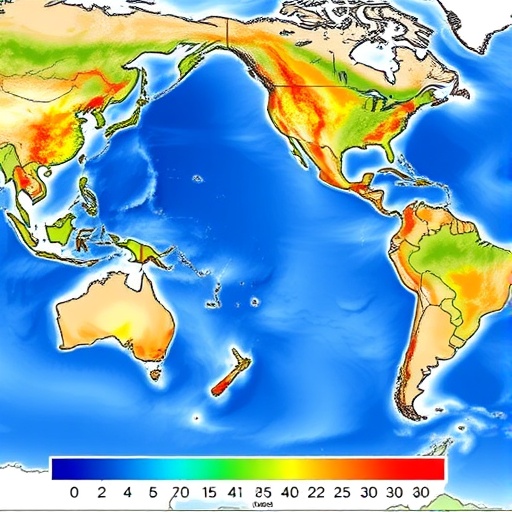
In a groundbreaking study that revisits ancient climate dynamics in a critical tropical zone, researchers from Brown University have unveiled new insights into the temperature history of Colombia’s Bogotá Basin, highlighting a previously underestimated scale of warming in tropical terrestrial regions during periods of elevated carbon dioxide. Drawing on sediment cores that trace environmental change through millions of years, this work challenges existing paradigms about the relationship between atmospheric CO₂ levels and regional climate responses, suggesting dire implications for the future warming of highland tropical environments.
The Bogotá Basin, home to over 11 million people and situated in the eastern branch of the Andes, serves as a natural laboratory for examining terrestrial climate history. The basin’s geological record preserves sediments dating back to the Pliocene epoch, roughly 5.2 to 2.5 million years ago—the last interval in Earth’s history when atmospheric CO₂ concentrations matched contemporary levels. This temporal parallel provides a unique analog for projecting future climate scenarios, especially in regions where the interaction between land elevation and climate drivers remains poorly understood.
Utilizing an extensive 585-meter sediment core extracted decades ago but newly analyzed with advanced modern techniques, the team harnessed state-of-the-art uranium-lead zircon geochronology to refine the temporal framework of sediment deposition. Zircons—robust minerals capable of encapsulating uranium—offer reliable radiometric ages, marking the chronology of stratified volcanic ash layers interspersed within the sedimentary sequence. This precise dating enabled reconstruction of temperature dynamics spanning approximately 3.7 million years, embedding a continuous terrestrial climate record within a well-constrained geological timeline.
Thermometric reconstructions relied on brGDGTs (branched glycerol dialkyl glycerol tetraethers), bacterial membrane lipids whose molecular structures chemically adapt to ambient temperatures. These biomarkers, preserved across epochs in anaerobic depositional environments, function as proxies to infer paleotemperatures with high temporal resolution. Analysis revealed a startling finding: Pliocene terrestrial temperatures in the Bogotá Basin averaged 4.8 degrees Celsius warmer than those of the subsequent Pleistocene epoch, a difference substantially exceeding prior theoretical expectations derived from oceanic temperature proxies.
This marked amplification of terrestrial warming diverges from conventional climate models, which typically predict a proportional relationship between sea surface temperature increases and overlying land warming in tropical latitudes, with a factor around 1.4. However, the findings indicate that terrestrial air temperatures in this high-altitude tropical environment increased by nearly twice the magnitude suggested by sea surface temperature shifts. Such pronounced regional warming implies that existing climate models may inadequately account for elevation-dependent feedback mechanisms or regional ocean-atmosphere interactions that modulate terrestrial temperatures beyond oceanic signals.
The study’s authors speculate on several potential drivers for this anomalous warming trend. One hypothesis points to enhanced temperature sensitivity at high elevations: mountain regions like the Andes might exhibit non-linear warming responses under elevated greenhouse gas forcing. Yet, modeling suggests that orographic effects alone cannot fully explain the magnitude observed. Another possibility implicates persistent changes in Pacific Ocean circulation dynamics during the Pliocene, akin to prolonged or intensified El Niño-like conditions, which might have boosted regional warming through altered moisture and atmospheric circulation patterns impacting the Andes.
The amplification of terrestrial temperatures at high-altitude tropical sites revealed by this research carries far-reaching implications for predicting localized climate change impacts. Populations residing in mountainous basins such as Bogotá are directly exposed to health risks, ecological shifts, and infrastructure vulnerabilities associated with regional temperature anomalies that global or ocean-based temperature proxies fail to adequately represent. Consequently, this study underscores the urgent necessity of integrating terrestrial paleoclimate data at regional scales into climate risk assessments and adaptation planning frameworks.
Beyond its immediate climatological insights, the study demonstrates the transformative value of revisiting historic geological archives with contemporary analytical tools. The legacy sediment core, originally drilled in the late 1980s, offered an untapped reservoir of environmental data that only now, through enhanced biochemical proxies and geochronological precision, could elucidate complex terrestrial climate patterns. This exemplifies a fruitful synergy between paleontology, geochemistry, and climate science, driving advances that enrich understanding of Earth system processes and greenhouse gas feedbacks.
Importantly, the work advocates for a paradigm shift in how climate reconstructions integrate terrestrial data, emphasizing the heterogeneity of climate responses across latitudinal, elevational, and regional gradients. As atmospheric CO₂ continues its upward trajectory, the lessons gleaned from ancient climate analogs suggest more pronounced and perhaps unforeseen warming impacts on human-inhabited mountainous tropical regions than previously acknowledged by global climate models focused primarily on oceanic or polar datasets.
The implications extend to policy and public awareness, calling attention to the fact that the lived experience of climate change is inherently local and shaped by complex terrain interactions. By improving paleoclimate reconstructions at the regional and continental scales, scientists can furnish policymakers with more accurate scenarios that reflect not only global averages but also the intense variability that affects vulnerable populations in megacities such as Bogotá and comparable environments worldwide.
In a climate context increasingly dominated by uncertainties surrounding feedback loops and regional variability, this study stands as a critical reminder of the necessity to ground climate projections in data that embrace the full complexity of Earth’s environmental history. The robust application of geochemical proxies like brGDGTs, coupled with high-fidelity radiometric dating methods, establishes a promising pathway for future research aimed at unraveling the intricacies of terrestrial climate amplification particularly in equatorial mountainous realms.
As the global community confronts the accelerating pace of climate warming, studies like this illuminate the urgent need for comprehensive datasets and refined models that capture the nuanced interplay of elevation, atmospheric chemistry, and ocean-driven climate variability. The Bogotá Basin example is a compelling case illustrating that terrestrial landscapes, especially in tropical mountain zones, may warm more drastically than oceanic systems alone suggest, necessitating tailored mitigation and adaptation strategies that account for such amplified terrestrial climatic shifts.
This novel research, published in the prestigious Proceedings of the National Academy of Sciences, not only recounts Earth’s climatic past with unprecedented clarity but also serves as a clarion call highlighting the intricate vulnerabilities of tropical terrestrial environments in an era of ongoing global climate transformation. It galvanizes the scientific community to deepen efforts in regional paleoclimatology, elevating terrestrial records to a central role in understanding and combating the multifaceted challenges posed by future climate change.
News Publication Date: 2-Feb-2026
Web References: http://dx.doi.org/10.1073/pnas.2520191123
Cite Scienmag News
Russell Cooper. (February 3, 2026). Study Finds Some Tropical Regions May Warm More Than Anticipated as CO2 Levels Climb. Scienmag. https://scienmag.com/study-finds-some-tropical-regions-may-warm-more-than-anticipated-as-co2-levels-climb/
Russell Cooper. "Study Finds Some Tropical Regions May Warm More Than Anticipated as CO2 Levels Climb." Scienmag, 3 February 2026, https://scienmag.com/study-finds-some-tropical-regions-may-warm-more-than-anticipated-as-co2-levels-climb/. Accessed 3 September 2026.
Russell Cooper. "Study Finds Some Tropical Regions May Warm More Than Anticipated as CO2 Levels Climb." Scienmag. February 3, 2026. https://scienmag.com/study-finds-some-tropical-regions-may-warm-more-than-anticipated-as-co2-levels-climb/


