


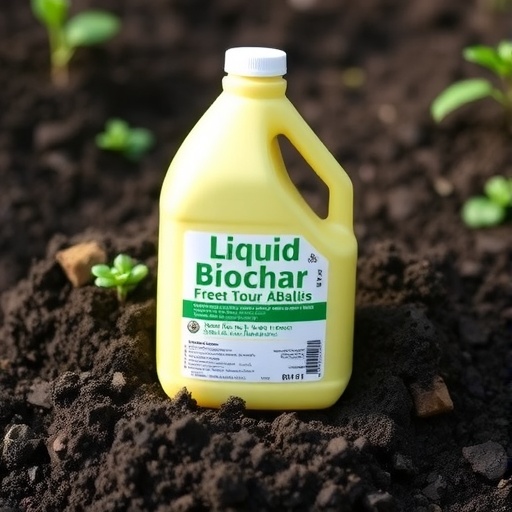
A groundbreaking advancement in sustainable agriculture has emerged through the development of liquid biochar mineral complex fertilizers, which demonstrate unprecedented efficacy in enhancing crop yields, improving nutrient use efficiency, and generating significant economic benefits for farmers. This innovative class of fertilizers leverages the unique physicochemical properties of biochar combined with essential mineral nutrients in a liquid formulation that optimizes nutrient availability and uptake by crops, heralding a transformative moment in modern fertilization practices.
Biochar, a carbon-rich material produced through the pyrolysis of biomass, has long been studied for its soil conditioning properties, primarily due to its porous structure and high surface area which improve soil water retention and microbial environments. However, its integration into fertilization regimes as a liquid complex with mineral nutrients represents a novel approach that addresses fundamental inefficiencies in nutrient delivery. The study, conducted in a pasture cropping system, rigorously tested various liquid biochar formulations to evaluate their effects on crop productivity, soil nutrient balance, microbial dynamics, and farm economics under real-world agricultural conditions.
The research introduced four distinct liquid biochar mineral complexes: a baseline formulation without nutrient enrichment, a phosphorus-enriched variant, a nitrogen-enriched product, and a hybrid approach applied with supplemental conventional fertilizers. Each variant was meticulously applied and monitored through multi-season field trials, revealing nuanced differences in performance related to nutrient dynamics and ecological interactions. A particular highlight was the nitrogen-enriched liquid biochar fertilizer, which dramatically surpassed expectations by doubling pasture yields compared to untreated controls and exceeding those achieved through conventional fertilization methods.
This leap in productivity is underpinned by the enhanced bioavailability of nutrients provided by the liquid biochar complexes. Unlike traditional granular fertilizers, which often suffer from inefficient uptake due to nutrient immobilization or loss via leaching and runoff, the liquid form facilitates immediate nutrient mobility and targeted delivery to the root rhizosphere. The biochar matrix further stabilizes nutrients, mitigating environmental losses and ensuring a more sustained nutrient release. This dual mechanism not only maximizes crop nutrient assimilation but also fortifies the soil against nutrient depletion, a crucial factor for long-term agricultural sustainability.
Importantly, the nitrogen-enriched liquid biochar variant achieved positive balances of both nitrogen and phosphorus in the soil-plant system, indicating a net gain rather than depletion of soil nutrient reserves. This aspect is critical because conventional fertilization frequently results in the mining of soil nutrients, undermining soil health and productivity over time. The positive balance observed suggests that these biochar-based fertilizers supply nutrients directly to crops with minimal environmental leakage, thereby reducing the ecological footprint traditionally associated with intensive fertilization.
To assess sustainability beyond immediate plant and soil nutrient dynamics, the study also examined the impact of liquid biochar applications on soil microbial communities. Soil microbes are integral to nutrient cycling and overall soil ecosystem functioning. Interestingly, short-term application of these formulations did not significantly disrupt microbial populations, which implies that such fertilizers support ecological stability within the soil biome. Maintaining microbial diversity and activity is essential, as these microorganisms drive processes critical to nutrient transformation, organic matter decomposition, and soil structure enhancement.
From an economic perspective, the analysis revealed compelling returns on investment. Benefit-cost ratios ranged between 1.9 and 2.5 across all tested liquid biochar formulations, denoting that financial gains from yield improvements and input reductions consistently outweighed the costs of fertilizer procurement and application. This financial viability aligns with a growing need for economically sustainable agricultural inputs that simultaneously address environmental concerns. The reduced requirement for additional conventional fertilizers when employing the nitrogen-enriched liquid biochar translates to lower labor demands and operational expenses, making it an attractive option for resource-limited farmers.
The success of these formulations hinges on their finely milled particle size combined with the liquid carrier medium, optimizing nutrient transport and root zone nutrient availability. By bypassing some of the constraints imposed by solid fertilizers—such as uneven soil distribution and delayed dissolution—the liquid biochar fertilizers enable a more precise and expedient nutrient supply mechanism. This not only accelerates plant nutrient uptake and growth but also curbs the environmental hazards of nutrient runoff that underpin eutrophication and water quality degradation worldwide.
Broader implications of this research are profound, especially in the context of mounting global challenges such as climate change, degradation of arable soils, and escalating input costs. Innovations like liquid biochar fertilizers epitomize integrated strategies that enhance agricultural resilience by boosting productivity and resource use efficiency while safeguarding environmental health. By seamlessly embedding carbon-rich biochar into nutrient management frameworks, this technology advocates a circular economy ethos, simultaneously sequestering carbon and promoting soil fertility.
The findings underscore a paradigm shift in fertilizer technology, moving from purely chemical formulations toward multifunctional bio-enhanced inputs that synergistically improve agronomic and environmental outcomes. The scalability and adaptability of these liquid biochar formulations across diverse cropping systems forecast wide-ranging benefits for global agriculture, from pasturelands to intensive row crops. As the agricultural sector grapples with the imperatives of sustainability, the adoption of such biochar-based fertilizers can catalyze progress toward more regenerative farming systems.
In conclusion, the study not only evidences the remarkable agronomic potential of liquid biochar mineral complex fertilizers but also redefines how sustainable intensification can be actualized. These formulations embody an intersection of advanced material science, soil ecology, and nutrient management that could revolutionize fertilizer use patterns worldwide. Continued research and development, alongside efforts to disseminate these technologies to farmers, promise to unlock new frontiers in crop production that harmonize economic profitability with environmental stewardship.
News Publication Date: 22-Apr-2026
Web References:
DOI: 10.1007/s42773-026-00600-4
References:
Omidvar, N., Joseph, S., Dissanayake, L. et al. Distinct forms of liquid biochar mineral complex fertilisers differently increase crop yield, nutrient balance and economic return. Biochar 8, 94 (2026).
Cite Scienmag News
Alan Morgan. (April 22, 2026). Study Finds Liquid Biochar Fertilizers Enhance Crop Yields and Promote Soil Sustainability. Scienmag. https://scienmag.com/study-finds-liquid-biochar-fertilizers-enhance-crop-yields-and-promote-soil-sustainability/
Alan Morgan. "Study Finds Liquid Biochar Fertilizers Enhance Crop Yields and Promote Soil Sustainability." Scienmag, 22 April 2026, https://scienmag.com/study-finds-liquid-biochar-fertilizers-enhance-crop-yields-and-promote-soil-sustainability/. Accessed 4 September 2026.
Alan Morgan. "Study Finds Liquid Biochar Fertilizers Enhance Crop Yields and Promote Soil Sustainability." Scienmag. April 22, 2026. https://scienmag.com/study-finds-liquid-biochar-fertilizers-enhance-crop-yields-and-promote-soil-sustainability/


