


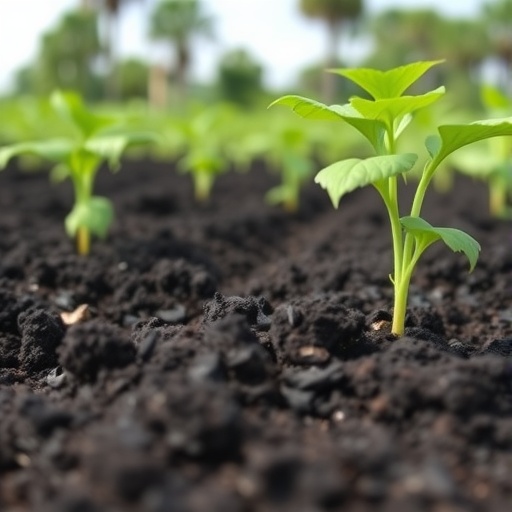
In the fertile black soil regions of Northeast China, a groundbreaking long-term field study has unveiled pivotal insights into the role of biochar in enhancing soil health and agricultural productivity. This research underscores the intricate balance necessary when applying biochar, a carbon-rich byproduct derived from biomass pyrolysis, to degraded soils. Notably, it demonstrates that optimal application rates can invigorate microbial stability, improve the composition of dissolved organic matter (DOM), and ultimately boost crop yields, while excessive doses may induce negative effects.
Black soils, known scientifically as Mollisols, rank among the most agriculturally productive globally due to their rich organic matter content and high fertility. However, decades of intensive cultivation and inadequate land management have precipitated significant soil degradation, characterized by losses in organic matter, reduced microbial diversity, and soil acidification. The implications are dire, as these soils support major grain-producing regions critical for food security. Therefore, interventions that restore and sustain soil health are urgently needed.
Biochar has emerged as a promising soil amendment with the potential to reverse such degradation. Its porous structure and high carbon content improve soil physical properties and nutrient retention, while its chemical complexity influences microbial habitats. Yet, despite anecdotal evidence of its benefits, scientific understanding of biochar’s long-term effects on soil microbial assemblies and DOM chemistry remained incomplete until now.
Over a rigorous six-year experimental period, researchers meticulously evaluated the impact of varying biochar application rates on soil chemistry and microbial ecosystem dynamics. Employing advanced fluorescence spectroscopy, they characterized the molecular composition and stability of DOM—a critical factor influencing nutrient cycling and soil fertility. Concurrently, high-throughput DNA sequencing techniques were applied to unravel shifts in the composition and network complexity of microbial communities residing within the soil matrix.
The study revealed that a medium biochar dose, specifically 31.5 metric tons per hectare (t ha⁻¹), significantly enhanced soil organic matter stability. Fluorescence signatures indicated increased formation of humic substances, complex aromatic compounds that contribute to long-term carbon sequestration and improve nutrient availability. These changes fostered a conducive environment stimulating the proliferation of beneficial bacterial taxa, prominently Proteobacteria and Acidobacteria, groups known for their ecological roles in organic matter decomposition and nutrient mobilization.
Microbial community analyses displayed an enriched diversity and complexity under moderate biochar supplementation. Network models illuminated more robust microbial interactions, suggesting enhanced resilience and functional redundancy. Such traits are fundamental for soil ecosystems to withstand environmental stresses and sustain vital biogeochemical cycles. Importantly, these microbial enhancements were directly linked to a measurable 7.11% increase in crop yields over the control plots, illustrating a tangible benefit to agricultural productivity.
Conversely, the study cautioned against unregulated biochar application. When applied at an excessively high rate of 47.25 t ha⁻¹, soil microbial community stability deteriorated, and diversity declined. This disruption likely stems from altered soil chemistry, such as pH imbalances or nutrient imbalances prompted by over-application, which can inhibit sensitive microbial taxa and disrupt established symbiotic relationships. Such outcomes highlight the crucial need for precision in biochar management to avoid inadvertently compromising soil functions.
Structural equation modeling further clarified the pathways through which biochar influences crop performance. Rather than a direct effect, biochar’s benefits manifested indirectly by modifying DOM characteristics and bolstering microbial community structure. This nuanced understanding advances the paradigm from simplistic amendments toward integrated soil ecological management, linking chemical, biological, and agronomic domains.
Dr. Lilong Yan, a lead researcher in this study, emphasized the importance of microbial mediation in the biochar-soil-crop nexus: “Our findings illuminate how biochar creates favorable niches that sustain functional microbes instrumental in decomposing organic residues and facilitating nutrient cycling. This microbial stability and diversity underpin healthier soils and heightened crop productivity.”
Dr. Dan Wei noted the broader implications, stating, “This research provides a scientific foundation for calibrated biochar applications that can enhance soil resilience, particularly relevant for regions grappling with degraded soils and the looming challenges of climate variability.”
The research benefited from robust funding support by the National Key Research and Development Program of China and the Chinese Academy of Sciences, underscoring the strategic priority accorded to sustainable soil management practices. As climate change intensifies pressures on agricultural systems, the prospects of harnessing biochar to bolster soil carbon stocks and microbial health position it as a critical tool in global food security efforts.
Collectively, this comprehensive investigation delivers compelling evidence that biochar’s efficacy hinges on dosage optimization to harness soil microbial ecology and DOM chemistry synergistically. It calls for extension services, agronomists, and policymakers to integrate scientific insights when recommending biochar applications, ensuring long-term sustainability rather than short-term gains.
By bridging molecular-level analyses with ecosystem-scale outcomes, this study marks a significant advance in biochar science. It paves the way for precision soil amendments tailored to local soil conditions, promoting healthy microbial networks and stable organic matter pools. Ultimately, such approaches can transform degraded black soils from liability into assets, securing productivity for future generations.
News Publication Date:
23-Jun-2025
Web References:
DOI: 10.1007/s42773-025-00473-z
References:
Hu, Y., Li, Y., Liu, K. et al. Improving the stability of black soil microbial communities through long-term application of biochar to optimize the characteristics of DOM components. Biochar 7, 84 (2025).
Keywords
Microbial ecology, Ecology, Microbiology, Soil chemistry, Soil science
Cite Scienmag News
Alan Morgan. (September 18, 2025). Study Finds Biochar Enhances Black Soil Health and Increases Crop Yields. Scienmag. https://scienmag.com/study-finds-biochar-enhances-black-soil-health-and-increases-crop-yields/
Alan Morgan. "Study Finds Biochar Enhances Black Soil Health and Increases Crop Yields." Scienmag, 18 September 2025, https://scienmag.com/study-finds-biochar-enhances-black-soil-health-and-increases-crop-yields/. Accessed 4 September 2026.
Alan Morgan. "Study Finds Biochar Enhances Black Soil Health and Increases Crop Yields." Scienmag. September 18, 2025. https://scienmag.com/study-finds-biochar-enhances-black-soil-health-and-increases-crop-yields/


