


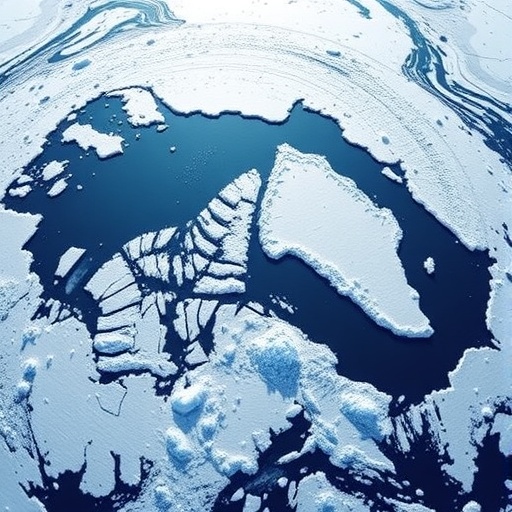
A new study is drawing attention to an overlooked force shaping the Arctic’s rapidly changing sea-ice system: not only how many cyclones enter the far north, but whether they arrive one after another in tightly packed sequences. Published in Nature Communications, the research examines the relevance of “serial cyclone clustering” for Arctic sea ice, suggesting that storms may exert their greatest influence when the atmosphere delivers repeated disturbances before the ice has time to recover.
Arctic cyclones are large, rotating areas of low atmospheric pressure that can span thousands of kilometres. They are common features of the polar climate, particularly during summer and autumn, when the sea-ice cover is already vulnerable to melting and mechanical stress. A single cyclone can bring powerful winds, cloud cover, precipitation, warmer air, and turbulent ocean conditions. When several storms follow the same region in succession, however, their effects can overlap and amplify, creating a compound episode that differs fundamentally from an isolated storm.
The concept of serial clustering focuses on the timing and sequence of these events. A cyclone does not necessarily need to be exceptionally intense to cause major disruption if another storm arrives soon afterward. The first system may fracture or disperse the ice, open leads, and redistribute floes. A second cyclone can then act on this weakened cover, widening gaps, increasing wave exposure, and pushing fragmented ice into warmer waters. The result may be a cumulative impact that is difficult to identify when storms are studied individually.
This distinction matters because Arctic sea ice is not a static sheet. It is a mobile, deformable layer composed of floes that collide, raft, fracture, and drift under the influence of wind and ocean currents. Thick, compact ice can absorb some atmospheric forcing, but thinner or heavily fragmented ice responds more rapidly. Once a storm creates open water, sunlight can penetrate the ocean and increase heat absorption during the bright Arctic season. This process, known as the ice–albedo feedback, can accelerate melting because dark seawater reflects far less solar energy than bright snow-covered ice.
The study by Lena Aue, Sebastian Tiedeck, Paolo Finocchio and colleagues investigates how this succession of storms relates to sea-ice variability. Its central question is whether cyclone sequences provide information that is lost when researchers count storms separately or summarize them using seasonal averages. In climate analysis, the number of cyclones, their average intensity, and their total duration are often treated as key indicators. Serial clustering introduces another dimension: the interval between storms and the degree to which one event alters the conditions encountered by the next.
The researchers’ focus reflects a broader shift in climate science toward studying compound and sequential extremes. Conventional assessments often ask whether an individual event crossed a threshold, such as a particular wind speed or pressure minimum. But natural systems frequently respond to accumulated stress. In the Arctic, the condition of the ice before a cyclone may be as important as the storm’s peak intensity. A moderate system moving over newly fractured ice could produce greater change than a stronger cyclone encountering a compact, resilient cover.
The atmospheric effects of clustered cyclones can also be complex. Storms transport heat and moisture into the high Arctic, modify cloud formation, and alter surface radiation. Their strong winds can drive ice away from coastlines, generate divergence that opens leads, or compress floes into ridges in other areas. At the same time, ocean mixing beneath the ice may bring relatively warm water toward the surface. These processes can operate simultaneously, meaning that a storm sequence may reduce ice in one part of the Arctic while temporarily concentrating it in another.
Understanding these mechanisms is increasingly important as the Arctic sea-ice cover becomes thinner and younger. Multiyear ice, which survives at least one summer melt season, has declined dramatically over recent decades, leaving a larger proportion of seasonal ice that forms and disappears within a single year. Younger ice is generally thinner and more vulnerable to wind-driven deformation. This changing baseline means that the same series of cyclones may have a different effect today than it would have had when the Arctic contained a more extensive reservoir of thick multiyear ice.
The findings could influence how scientists interpret sudden periods of ice loss and how forecasting systems assess risk. If storm sequences are a significant driver, models may need to represent not only the frequency and strength of cyclones but also their spacing, pathways, and interaction with the evolving ice cover. Better treatment of clustering could improve short-term predictions of navigation conditions, support search-and-rescue planning, and help explain why sea-ice changes sometimes occur abruptly after relatively ordinary weather events. It may also refine projections of future Arctic change, where a warmer atmosphere and thinner ice are expected to reshape the relationship between storms and the ocean surface.
The study does not reduce Arctic sea-ice decline to cyclones alone. Rising temperatures, ocean heat, changing winds, altered snow conditions, and long-term shifts in atmospheric circulation remain central factors. Instead, it highlights how the order and timing of weather events can determine the scale of their consequences. In a region where the ice is becoming increasingly fragile, the next cyclone may matter not only because of what it brings, but because of what the previous one has already left behind.
Cite Scienmag News
Violet Maxwell. (August 5, 2026). Study examines how serial cyclone clustering affects Arctic sea ice. Scienmag. https://scienmag.com/study-examines-how-serial-cyclone-clustering-affects-arctic-sea-ice/
Violet Maxwell. "Study examines how serial cyclone clustering affects Arctic sea ice." Scienmag, 5 August 2026, https://scienmag.com/study-examines-how-serial-cyclone-clustering-affects-arctic-sea-ice/. Accessed 3 September 2026.
Violet Maxwell. "Study examines how serial cyclone clustering affects Arctic sea ice." Scienmag. August 5, 2026. https://scienmag.com/study-examines-how-serial-cyclone-clustering-affects-arctic-sea-ice/


