

Thursday, September 3, 2026
Science
No Result
View All Result
  • Login
  • HOME
  • SCIENCE NEWS
  • CONTACT US
  • HOME
  • SCIENCE NEWS
  • CONTACT US
No Result
View All Result
Scienmag
No Result
View All Result
Home Science News Technology and Engineering

Study by TU Graz shows that abrasion emissions from trains are not negligible

July 23, 2024
in Technology and Engineering
Denise Maddox
By Denise Maddox Scienmag Editorial Profile - Mechanical Engineering
Reading Time: 3 mins read
0
Study by TU Graz shows that abrasion emissions from trains
68
SHARES
617
VIEWS
Share on FacebookShare on Twitter
ADVERTISEMENT

In addition to exhaust emissions, abrasion emissions from tyres and brakes have become increasingly important when assessing the environmental impact of traffic. However, the focus here was on road vehicles; rail was hardly considered. In a study commissioned by the German Centre for Rail Transport Research (DZSF), researchers from the Institute of Thermodynamics and Sustainable Propulsion Systems at Graz University of Technology (TU Graz) have now been able to prove that so-called non-exhaust emissions from rail transport also have a relevant influence on air quality and soil pollution.

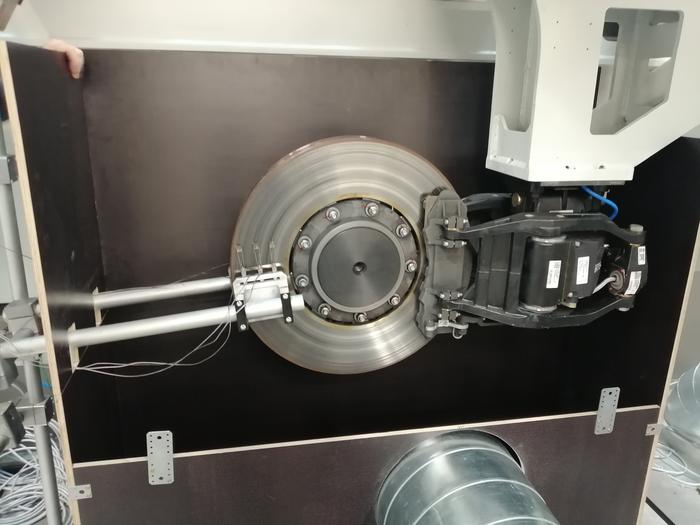
Abrasions emission test

Credit: ITnA – TU Graz

In addition to exhaust emissions, abrasion emissions from tyres and brakes have become increasingly important when assessing the environmental impact of traffic. However, the focus here was on road vehicles; rail was hardly considered. In a study commissioned by the German Centre for Rail Transport Research (DZSF), researchers from the Institute of Thermodynamics and Sustainable Propulsion Systems at Graz University of Technology (TU Graz) have now been able to prove that so-called non-exhaust emissions from rail transport also have a relevant influence on air quality and soil pollution.

Half of the daily particulate matter limit due to trains alone

This applies especially to areas along railway line sections where there is increased braking; this includes station approaches and sections with speed limits. The abrasion emissions from rail vehicles alone reached values of up to 25 micrograms of particulate matter in the PM10 category (particles with a diameter of less than ten micrometres) per cubic metre as a daily average in Augsburg along the railway lines investigated for the study. This already corresponds to half of the permissible limit of 50 micrograms per cubic metre.

With increasing distance from the railway lines – from about ten metres – the pollution from the abrasion of the rail vehicles decreases rapidly, but the fine particulate matter also enters the soil and water and is deposited there. The proportion of heavy metals in railway emissions is significantly higher than in other modes of transport, which is reflected in more heavily polluted deposits. DZSF chemists involved in the project were able to detect these residues in bodies of water.

Contribution to closing the data gap

In order to determine the composition and source of the abrasion particles, the components involved were analysed in various laboratories. Daniel Fruhwirt and his team tested several brake pads in the new brake test rig for rail vehicles at TU Graz. At the Politecnico di Milano, researchers analysed the abrasion of the contact wire and the pantograph in order to be able to classify the fine dust emissions from trains on overhead lines. And at DB Systemtechnik in Berlin, the team scrutinised the wheel-rail contact. The resulting data made it possible to allocate the emissions to air, soil and water to the rail vehicles.

“Based on our study, we can clearly say that non-exhaust emissions from rail are not negligible,” explains Daniel Fruhwirt from the Institute of Thermodynamics and Sustainable Propulsion Systems at TU Graz. “Before we did this study, there was a huge gap in the data on abrasion emissions from rail vehicles and we were able to make a significant contribution to closing it. Although emissions do not single-handedly cause pollutant limits to be exceeded, they certainly play a role in the overall mix. It is therefore important that efforts are made to also assess emissions behaviour in the future when certifying brakes.”


Journal

Transportation Research

DOI

10.1016/j.trd.2024.104181

Method of Research

Experimental study

Subject of Research

Not applicable

Article Title

Characterization of emissions from axle-mounted rail disc brakes

Article Publication Date

29-May-2024

Subject of Research: Technology and Engineering

Article Title: Study by TU Graz shows that abrasion emissions from trains are not negligible

Article References: Original research article

Image Credits: AI Generated

DOI: Not provided

Keywords: Not provided

Cite Scienmag News

Denise Maddox. (July 23, 2024). Study by TU Graz shows that abrasion emissions from trains are not negligible. Scienmag. https://scienmag.com/study-by-tu-graz-shows-that-abrasion-emissions-from-trains-are-not-negligible/

Denise Maddox. "Study by TU Graz shows that abrasion emissions from trains are not negligible." Scienmag, 23 July 2024, https://scienmag.com/study-by-tu-graz-shows-that-abrasion-emissions-from-trains-are-not-negligible/. Accessed 3 September 2026.

Denise Maddox. "Study by TU Graz shows that abrasion emissions from trains are not negligible." Scienmag. July 23, 2024. https://scienmag.com/study-by-tu-graz-shows-that-abrasion-emissions-from-trains-are-not-negligible/

Share27Tweet17
Previous Post

Heat-sensitive trees move uphill seeking climate change respite

Next Post

HIV vaccines tested in PrEPVacc fail to reduce infections

Related Posts

New framework optimizes dynamic task allocation across edge-fog-cloud crowdsensing systems
Technology and Engineering

New framework optimizes dynamic task allocation across edge-fog-cloud crowdsensing systems

September 3, 2026
Deep Learning Models Compared for Multi-Touch Attribution in Online Advertising
Technology and Engineering

Deep Learning Models Compared for Multi-Touch Attribution in Online Advertising

September 3, 2026
Bayesian optimization enables layered adaptive control for soft ankle exoskeletons
Technology and Engineering

Bayesian optimization enables layered adaptive control for soft ankle exoskeletons

September 3, 2026
Deep Reinforcement Learning Optimizes Drone-Mounted Smart Surfaces for Edge Computing
Technology and Engineering

Deep Reinforcement Learning Optimizes Drone-Mounted Smart Surfaces for Edge Computing

September 3, 2026
Study reveals what drives smartwatch and fitness band acceptance
Technology and Engineering

Study reveals what drives smartwatch and fitness band acceptance

September 3, 2026
Digital transformation in Central European construction: AI adoption, performance, barriers
Technology and Engineering

Digital transformation in Central European construction: AI adoption, performance, barriers

September 3, 2026
Next Post
HIV vaccines tested in PrEPVacc fail to reduce infections

HIV vaccines tested in PrEPVacc fail to reduce infections

  • Mothers who receive childcare support from maternal grandparents show more optimized

    Mothers who receive childcare support from maternal grandparents show more parental warmth, finds NTU Singapore study

    27656 shares
    Share 11059 Tweet 6912
  • University of Seville Breaks 120-Year-Old Mystery, Revises a Key Einstein Concept

    1061 shares
    Share 424 Tweet 265
  • Bee body mass, pathogens and local climate influence heat tolerance

    682 shares
    Share 273 Tweet 171
  • Researchers record first-ever images and data of a shark experiencing a boat strike

    546 shares
    Share 218 Tweet 137
  • Groundbreaking Clinical Trial Reveals Lubiprostone Enhances Kidney Function

    531 shares
    Share 212 Tweet 133
Science

Embark on a thrilling journey of discovery with Scienmag.com—your ultimate source for cutting-edge breakthroughs. Immerse yourself in a world where curiosity knows no limits and tomorrow’s possibilities become today’s reality!

RECENT NEWS

  • New framework optimizes dynamic task allocation across edge-fog-cloud crowdsensing systems
  • Deep Learning Models Compared for Multi-Touch Attribution in Online Advertising
  • Benzophenone-Grafted Acrylic Adhesives Quadruple Shear Strength Through Post-Polymerization Modification
  • Statistical Model Powers Release of New High-Yield Wheat Variety in Ethiopia

Categories

  • Agriculture
  • Anthropology
  • Archaeology
  • Athmospheric
  • Biology
  • Biotechnology
  • Blog
  • Bussines
  • Cancer
  • Chemistry
  • Climate
  • Earth Science
  • Editorial Policy
  • Marine
  • Mathematics
  • Medicine
  • Pediatry
  • Policy
  • Psychology & Psychiatry
  • Science Education
  • Social Science
  • Space
  • Technology and Engineering

Subscribe to Blog via Email

Enter your email address to subscribe to this blog and receive notifications of new posts by email.

Join 5,151 other subscribers

© 2025 Scienmag - Science Magazine

Welcome Back!

Login to your account below

Forgotten Password?

Retrieve your password

Please enter your username or email address to reset your password.

Log In
No Result
View All Result
  • HOME
  • SCIENCE NEWS
  • CONTACT US

© 2025 Scienmag - Science Magazine

Discover more from Science

Subscribe now to keep reading and get access to the full archive.

Continue reading