When two undergraduate students sat down to build a mathematical equation describing how bacteria multiply, they did something that education researchers had rarely captured in detail: they connected scientific ideas to mathematical ones not only within their own heads, but across the table. A new case study published in Disciplinary and Interdisciplinary Science Education Research documents how blended sensemaking, the practice of linking scientific understanding of a phenomenon with mathematical understanding of an equation, can unfold as a genuinely collaborative act between two people rather than a purely individual one.
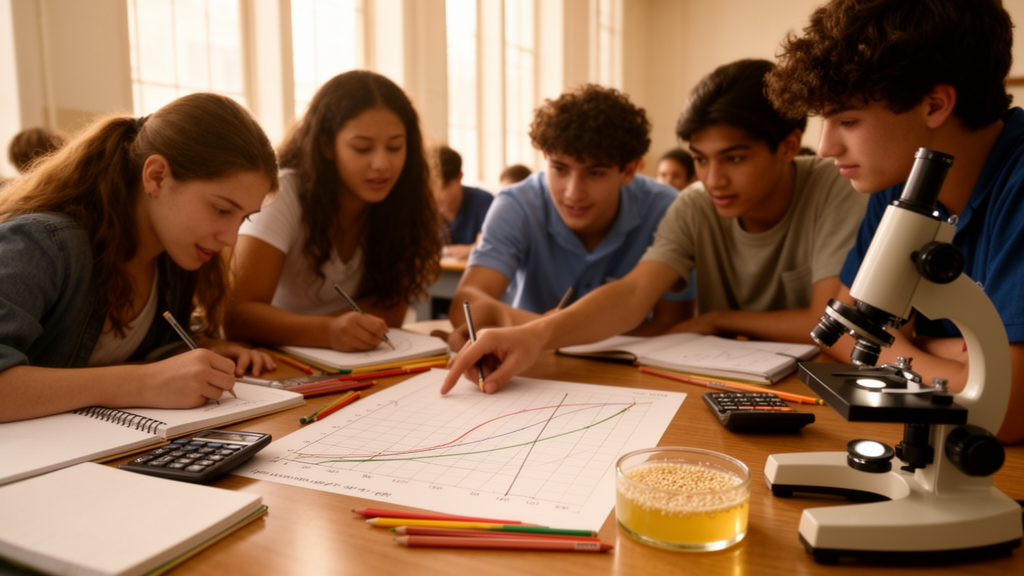
During a three-hour lesson on population growth, groups of ten to fifteen students, randomly assigned by orientation coordinators, worked through a biological puzzle: under shaken culture conditions, only smooth colony-forming bacteria appeared, while under static conditions a second type, wrinkly spreaders, emerged alongside the smooth bacteria. Students received graphs and data tables showing bacterial numbers at different time points, along with open-ended worksheet questions designed to guide their reasoning.
From nine consenting, audio-recorded groups, the researchers selected one pair based on four criteria: audible recordings throughout, a homogeneous gender composition to avoid the conversation dominance documented in mixed-gender groups, roughly equal contributions of science and mathematics sensemaking from both members, and a comparatively high number of utterances that appeared to contain blended sensemaking. The choice was deliberate. The researchers wanted a group likely to share and build on each other’s thinking in both disciplines, making the pair an ideal window into how such connections develop socially.
The analytical backbone of the study was the Sci-Math Sensemaking Framework, developed by Zhao and Schuchardt from a systematic literature review. It distinguishes four types of science sensemaking, Sci-Label, Sci-Description, Sci-Pattern, and Sci-Mechanism, and five types of mathematics sensemaking, Math-Procedure, Math-Rule, Math-Structure, Math-Relation, and Math-Concept, ordered theoretically to represent increasing depth of understanding.
Blended episodes themselves were identified with a second round of independent coding, reaching a Krippendorff’s alpha of 0.82. An episode counted as blended only when a connector, a word or phrase such as “because,” “so,” or “yeah, and,” explicitly linked the science and mathematics sensemaking in a way that indicated support or explanation. When coders disagreed about whether a connector clearly signaled such a link, the disagreement was resolved by not counting the instance as blended. The researchers distinguished two forms. Individual Blended Sensemaking occurred within a single conversational turn when one student’s science sensemaking was connected to their own mathematics sensemaking. Shared Blended Sensemaking required at least two turns, with one student contributing mathematics sensemaking and the other science sensemaking, joined by a connector. The authors also noted that blending could be delayed, resurfacing when a student connected back to an earlier episode after intervening conversation.
The Build task, which lasted fifteen minutes, asked the pair to construct an equation representing growth of the smooth bacteria in shaken culture and to draw a pictorial representation on poster paper. After the groups presented their work, the instructor facilitated a class consensus equation, N = N0 2t/F, where N is the number of bacteria, N0 the starting population, t the elapsed time, F the time for binary fission, and the constant 2 the number of bacteria produced by each bacterium. Analysis of the pair’s transcript during the Build task identified ten instances of blended sensemaking, all of them Individual. Seven of the ten involved Sci-Mechanism sensemaking connected to some form of mathematics sensemaking. Notably, the pair engaged in no blended sensemaking between the lower levels of the framework, such as Sci-Label or Sci-Description linked to Math-Procedure or Math-Rule.
The students used these individual episodes for distinct conversational purposes. Azmi presented her equation with the justification “2 to the X [be]cause X is bacteria divided every hour,” and later explained the mechanism of cell division to support the quantitative relationship that after one hour there would be two bacteria, and after two hours, four. Individual Blended Sensemaking also served to summarize ideas spanning several turns and to propose resolutions. Near the end of the task, Lia offered a resolution grounded in calculation and mechanism, reasoning that two to the zero is always one and two to the one is two because the bacteria divide after the first hour, so after the first hour both cells split and there are four. Testing their equation against the data table also led the pair to notice that their model fit the shaken condition but not the static one, prompting speculation about mechanisms such as competition or reduced oxygen.
The Build-Modify task doubled the discussion time to thirty minutes and produced roughly ten times as much blended sensemaking: fifty-three instances, of which twenty-seven were Individual and twenty-six were Shared. This was the only task in which Shared Blended Sensemaking appeared. The pair modified the consensus equation to represent two bacterial populations growing in the same static culture, ultimately writing total number of bacteria = (N0 + WS) 2t/(F+µ), where WS is the initial number of wrinkly spreader bacteria and µ an unknown additional amount of time for them to divide. As in the first task, only one instance of blending involved the lower levels of the framework, and the balance between higher-level and transitional blending was similar for both Individual and Shared forms.
Shared Blended Sensemaking served three purposes in this task: expanding on ideas the pair already agreed on, deciding between alternative mathematical representations of a shared scientific idea, and jointly summarizing resolutions. In one exchange, Lia asked whether the growth rate of the two bacterial types was actually different, a Sci-Pattern question. Azmi answered that she thought the rate was different, defining rate as bacteria per hour, and Lia responded “Yeah, and” with the mathematical observation that the rate jumped from 0.3 to 1.1 million bacteria in two hours. Azmi then accepted that example and used the pattern to argue that the structure of the equation needed to change. The authors highlighted that both students contributed both science and mathematics sensemaking across this excerpt, agreeing with and building on each other’s ideas.
A second exchange centered on how to represent the observation that bacteria in the static culture took longer to divide. The pair agreed on the scientific pattern but debated the operator: Azmi raised whether to add versus multiply by F, Lia proposed multiplying F by a variable, and Lia later suggested simply adding to F. Lia’s eventual resolution linked the choice of operator to two competing ideas about the phenomenon, that static fission might always be a fixed multiple longer, or might vary with unidentified environmental factors. The authors noted candidly that this resolution presented a false dichotomy and did not accurately capture the conceptual differences between multiplication and addition, yet it made sense to Azmi, and the pair proceeded with the structure “F plus a variable.” In a final excerpt, as the pair wrote their modified equation on poster paper, question-and-response exchanges such as “Wait, is this the fission time?” and the answer “Just Mu plus” illustrated shared blending during the co-construction of their final representation.
In the discussion, the authors positioned these findings against prior work. Earlier studies had either treated blended sensemaking as an individual resource, often in interview settings, or as a property of the group, without characterizing how it was distributed across students. The case study also echoed established patterns of peer interaction, in which ideas are presented, accepted, problematized, or resolved. Individual Blended Sensemaking tended to accompany presenting and summarizing, often to justify an idea, while Shared Blended Sensemaking tended to accompany expansion of a peer’s idea, a form of acceptance, or discussion of alternatives, a form of problematizing. The authors suggested that the co-construction of final representations indicated that at least some blended sensemaking had become a genuinely shared cognitive resource.
The contrast between the two tasks may reflect task features and familiarity. In the Build task, the students were familiar with exponential growth of a single population and focused on justifying how familiar mathematical structures, such as exponents, represented known mechanisms. In the Build-Modify task, the unfamiliar and more complex scenario of two populations growing at different rates required them to co-construct understanding of the pattern before representing it mathematically, which likely prompted shared blending. Importantly, although the types of sensemaking connected shifted between tasks, the levels of blending did not differ, and the pair showed no obvious progression along the learning-progression hierarchy proposed by Kaldaras and Wieman, whose model was developed from interviews with individuals solving problems with computer simulations.
The authors were explicit about the limits of the study. It is a case study of two students, chosen partly because their recordings were audible and their contributions balanced, and no attempt was made to characterize every way blended sensemaking can be used. Audio recording could not capture gestures, so some connections were likely missed. Generalizability to other groups and the impact of task design await future studies. Even so, the authors argue that the findings have practical value, suggesting that instructors could guide student discussions during mathematical modeling tasks more effectively by recognizing when students are presenting, expanding, problematizing, or resolving ideas across the science-mathematics boundary.
Subject of Research: How two undergraduate students distributed blended science and mathematics sensemaking during collaborative mathematical modeling of bacterial population growth
Article Title: Characterizing blended sensemaking in group discussions: a case study on mathematical modeling of population growth
Article References: Desi, D., & Schuchardt, A. (2026). Characterizing blended sensemaking in group discussions: a case study on mathematical modeling of population growth. Disciplinary and Interdisciplinary Science Education Research, 8(1), Article 32. https://doi.org/10.1186/s43031-026-00178-8
Image Credits: AI Generated
DOI: 10.1186/s43031-026-00178-8
Keywords: blended sensemaking, mathematical modeling, population growth, science education, peer discussion, undergraduate biology, Sci-Math Sensemaking Framework, collaborative learning, quantitative reasoning, case study, group work, bacterial growth
Cite Scienmag News
Courtney Benton. (October 27, 2026). Students Blend Science and Math Sensemaking Together While Modeling Population Growth. Scienmag. https://scienmag.com/students-blend-science-and-math-sensemaking-together-while-modeling-population-growth/
Courtney Benton. "Students Blend Science and Math Sensemaking Together While Modeling Population Growth." Scienmag, 27 October 2026, https://scienmag.com/students-blend-science-and-math-sensemaking-together-while-modeling-population-growth/. Accessed 28 October 2026.
Courtney Benton. "Students Blend Science and Math Sensemaking Together While Modeling Population Growth." Scienmag. October 27, 2026. https://scienmag.com/students-blend-science-and-math-sensemaking-together-while-modeling-population-growth/