

Saturday, May 2, 2026
Science
No Result
View All Result
  • Login
  • HOME
  • SCIENCE NEWS
  • CONTACT US
  • HOME
  • SCIENCE NEWS
  • CONTACT US
No Result
View All Result
Scienmag
No Result
View All Result
Home Science News Technology and Engineering

Structural engineering unlocks potent tumor treatment with dual-function magnetite nanozymes

May 29, 2024
in Technology and Engineering
Reading Time: 2 mins read
0
Structural Engineering Unlocks Potent Tumor Treatment with Dual-Function Magnetite Nanozymes
67
SHARES
608
VIEWS
Share on FacebookShare on Twitter
ADVERTISEMENT

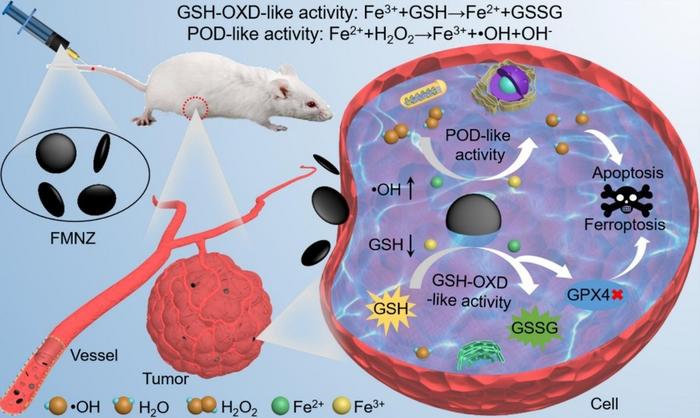
According to a recent study published in Chemical Engineering Journal, a collaborative research team led by Professor WANG Hui from High Magnetic Field Laboratory, Hefei Institutes of Science of Chinese Academy of Sciences developed magnetite nanozyme (MNZs) with dual enzymatic activities through structural engineering, and proved its structure-dependent behavior in the process of tumor treatment.

Structural Engineering Unlocks Potent Tumor Treatment with Dual-Function Magnetite Nanozymes

Credit: QIAN Yong

According to a recent study published in Chemical Engineering Journal, a collaborative research team led by Professor WANG Hui from High Magnetic Field Laboratory, Hefei Institutes of Science of Chinese Academy of Sciences developed magnetite nanozyme (MNZs) with dual enzymatic activities through structural engineering, and proved its structure-dependent behavior in the process of tumor treatment.

MNZs, as a substitute for natural enzymes, has been widely studied in the field of tumor catalytic therapy. However, the catalytic efficiency of traditional MNZs in tumor microenvironment (TME) is often limited, which is mainly due to the low production rate of hydroxyl radical (·OH).

In this study, the team developed MNZs with dual enzyme activity using solvothermal method.

“We prepared MNZs with three different shapes: flakes, ellipses and spheres,” said Prof. WANG hui, “and this allowed us to check out how the shapes affect the treatment and reveal the potential mechanism both in vitro and in vivo.”

The novel MNZs exhibit two important functions: They imitate glutathione, which is an antioxidant in cells. This helps to reduce the consumption of harmful hydroxyl radicals; and they act as peroxidases, breaking down hydrogen peroxide and generating highly toxic hydroxyl radicals. This self-cascade reaction disrupts the balance of reactive oxygen species in cells, enhancing the therapeutic effect on tumors.

This progress not only provides a new strategy for tumor catalytic therapy, but also opens up possibilities for the future application of nano-materials in the biomedical field, according to the team.


Journal

Chemical Engineering Journal

Article Title

Structural engineering of magnetite nanozymes for enhanced chemodynamic cancer therapy

Article Publication Date

7-May-2024

Share27Tweet17
Previous Post

Reverse electrodialysis heat engine with helium-gap diffusion distillation: Energy efficiency analysis

Next Post

Research to uncover the impact of water use in the Colorado River Basin

Related Posts

Early Detection of Keratoconus Enhanced by Light Polarization and AI — Technology and Engineering
Technology and Engineering

Early Detection of Keratoconus Enhanced by Light Polarization and AI

May 2, 2026
SNU Researchers Create Battery-Free, Skin-Conforming Wearable Technology — Technology and Engineering
Technology and Engineering

SNU Researchers Create Battery-Free, Skin-Conforming Wearable Technology

May 1, 2026
Strategies to Prevent Supply Chain Disruptions Amid the Rapid Growth of Drone and Robot Manufacturing — Technology and Engineering
Technology and Engineering

Strategies to Prevent Supply Chain Disruptions Amid the Rapid Growth of Drone and Robot Manufacturing

May 1, 2026
Dan M. Frangopol Wins Third ASCE Wellington Prize for Pioneering Infrastructure Resilience Research — Technology and Engineering
Technology and Engineering

Dan M. Frangopol Wins Third ASCE Wellington Prize for Pioneering Infrastructure Resilience Research

May 1, 2026
Allied Health Impact on Preterm Infant Nutrition — Technology and Engineering
Technology and Engineering

Allied Health Impact on Preterm Infant Nutrition

May 1, 2026
Cu-Ion Crosslinked Membranes Boost High-Temp Fuel Cells — Technology and Engineering
Technology and Engineering

Cu-Ion Crosslinked Membranes Boost High-Temp Fuel Cells

May 1, 2026
Next Post
Landon Marston

Research to uncover the impact of water use in the Colorado River Basin

  • Mothers who receive childcare support from maternal grandparents show more parental warmth, finds NTU Singapore study

    Mothers who receive childcare support from maternal grandparents show more parental warmth, finds NTU Singapore study

    27639 shares
    Share 11052 Tweet 6908
  • University of Seville Breaks 120-Year-Old Mystery, Revises a Key Einstein Concept

    1042 shares
    Share 417 Tweet 261
  • Bee body mass, pathogens and local climate influence heat tolerance

    677 shares
    Share 271 Tweet 169
  • Researchers record first-ever images and data of a shark experiencing a boat strike

    540 shares
    Share 216 Tweet 135
  • Groundbreaking Clinical Trial Reveals Lubiprostone Enhances Kidney Function

    527 shares
    Share 211 Tweet 132
Science

Embark on a thrilling journey of discovery with Scienmag.com—your ultimate source for cutting-edge breakthroughs. Immerse yourself in a world where curiosity knows no limits and tomorrow’s possibilities become today’s reality!

RECENT NEWS

  • Paul and Shelia Schlosberg Family Foundation Advances Military Brain Health with Pioneering $3 Million Grant
  • Early Detection of Keratoconus Enhanced by Light Polarization and AI
  • Improving Hip Fracture Care in Frail Elders
  • SLC38A4 Boosts Kupffer Cells, Halts Liver Tumors

Categories

  • Agriculture
  • Anthropology
  • Archaeology
  • Athmospheric
  • Biology
  • Biotechnology
  • Blog
  • Bussines
  • Cancer
  • Chemistry
  • Climate
  • Earth Science
  • Editorial Policy
  • Marine
  • Mathematics
  • Medicine
  • Pediatry
  • Policy
  • Psychology & Psychiatry
  • Science Education
  • Social Science
  • Space
  • Technology and Engineering

Subscribe to Blog via Email

Success! An email was just sent to confirm your subscription. Please find the email now and click 'Confirm Follow' to start subscribing.

Join 5,146 other subscribers

© 2025 Scienmag - Science Magazine

Welcome Back!

Login to your account below

Forgotten Password?

Retrieve your password

Please enter your username or email address to reset your password.

Log In
No Result
View All Result
  • HOME
  • SCIENCE NEWS
  • CONTACT US

© 2025 Scienmag - Science Magazine
