

Monday, August 24, 2026
Science
No Result
View All Result
  • Login
  • HOME
  • SCIENCE NEWS
  • CONTACT US
  • HOME
  • SCIENCE NEWS
  • CONTACT US
No Result
View All Result
Scienmag
No Result
View All Result
Home Science News Chemistry

Reverse electrodialysis heat engine with helium-gap diffusion distillation: Energy efficiency analysis

May 29, 2024
in Chemistry
Reading Time: 2 mins read
0
Reverse electrodialysis heat engine with helium-gap diffusion distillation: Energy efficiency
66
SHARES
599
VIEWS
Share on FacebookShare on Twitter
ADVERTISEMENT

The depletion of energy resources poses a significant threat to the development of human society. Specifically, a considerable amount of low-grade heat (LGH), typically below 100 °C, is currently being wasted. However, if harnessed effectively, it has the potential to significantly improve overall energy utilization efficiency and subsequently reduce carbon dioxide emissions.

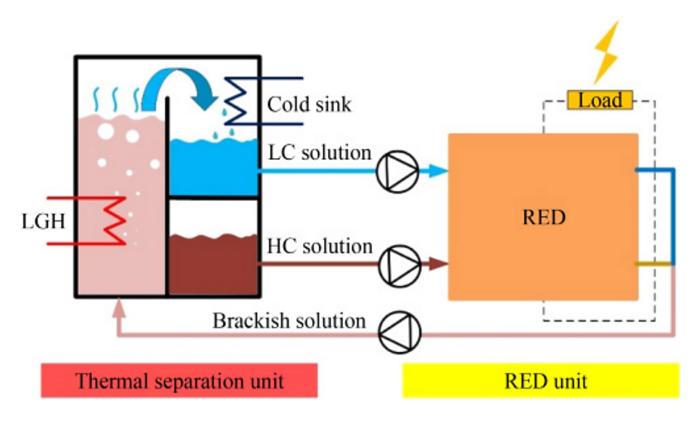
Schematic diagram of REDHE

Credit: HIGHER EDUCATION PRESS

The depletion of energy resources poses a significant threat to the development of human society. Specifically, a considerable amount of low-grade heat (LGH), typically below 100 °C, is currently being wasted. However, if harnessed effectively, it has the potential to significantly improve overall energy utilization efficiency and subsequently reduce carbon dioxide emissions.

A research group of Junyong Hu from Taiyuan University of Technology has concentrated on developing a new type of reverse electrodialysis heat engine (REDHE). It can efficiently convert LGH into electricity and has emerged as a promising technology in recent years. REDHE incorporates helium-gap diffusion distillation (HGDD) as the thermal separation (TS) unit. The team employed a validated mathematical model to analyze the impact of various operational and structural parameters on the performance of REDHE.

It was found that maintaining a moderate molality of the cold stream, increasing the inlet temperatures of hot and cold streams, lengthening the channels for hot and cold streams, and minimizing the thickness of helium gaps can significantly improve the performance of REDHE. Especially, the REDHE achieved a maximum energy conversion efficiency of 2.96% by reducing the thickness of helium gaps to 3 mm and extending the length of the stream channels to 5 m.

This research is significant as it provides a new technological approach to the effective utilization of low-grade heat energy. The development of the novel REDHE not only helps alleviate energy shortages but also reduces carbon emissions, offering substantial practical application value and environmental benefits for promoting sustainable energy development.


Journal

Frontiers in Energy

DOI

10.1007/s11708-024-0947-3

Method of Research

Experimental study

Subject of Research

Not applicable

Article Title

Reverse electrodialysis heat engine with helium-gap diffusion distillation: Energy efficiency analysis

Article Publication Date

30-Apr-2024

Share26Tweet17
Previous Post

Polymeric films protect anodes from sulfide solid electrolytes!

Next Post

Structural engineering unlocks potent tumor treatment with dual-function magnetite nanozymes

Related Posts

KAIST discovers pathway to faster-charging, longer-lasting electric vehicle batteries
Chemistry

KAIST discovers pathway to faster-charging, longer-lasting electric vehicle batteries

August 23, 2026
Scientists uncover design rules for high-performance thermoelectric materials
Chemistry

Scientists uncover design rules for high-performance thermoelectric materials

August 22, 2026
Bringing Optical Fibre Materials to Photonic Chips
Chemistry

Bringing Optical Fibre Materials to Photonic Chips

August 22, 2026
Nanoscience and Liquid Crystals Unite in Functional Hybrids With Transformative Applications
Chemistry

Nanoscience and Liquid Crystals Unite in Functional Hybrids With Transformative Applications

August 22, 2026
Designing Better Biomedical Hydrogels Through Molecular Building Blocks and Hierarchical Structures
Chemistry

Designing Better Biomedical Hydrogels Through Molecular Building Blocks and Hierarchical Structures

August 22, 2026
University of Oklahoma Researchers Chosen for Department of Energy’s Genesis Mission
Chemistry

University of Oklahoma Researchers Chosen for Department of Energy’s Genesis Mission

August 22, 2026
Next Post
Structural engineering unlocks potent tumor treatment with dual-function magnetite nanozymes

Structural engineering unlocks potent tumor treatment with dual-function magnetite nanozymes

  • Mothers who receive childcare support from maternal grandparents show more

    Mothers who receive childcare support from maternal grandparents show more parental warmth, finds NTU Singapore study

    27656 shares
    Share 11059 Tweet 6912
  • University of Seville Breaks 120-Year-Old Mystery, Revises a Key Einstein Concept

    1061 shares
    Share 424 Tweet 265
  • Bee body mass, pathogens and local climate influence heat tolerance

    682 shares
    Share 273 Tweet 171
  • Researchers record first-ever images and data of a shark experiencing a boat strike

    546 shares
    Share 218 Tweet 137
  • Groundbreaking Clinical Trial Reveals Lubiprostone Enhances Kidney Function

    531 shares
    Share 212 Tweet 133
Science

Embark on a thrilling journey of discovery with Scienmag.com—your ultimate source for cutting-edge breakthroughs. Immerse yourself in a world where curiosity knows no limits and tomorrow’s possibilities become today’s reality!

RECENT NEWS

  • Cochrane Map Reveals Major Evidence Gaps in Dengue Prevention Research
  • Study reveals surge in type 2 diabetes among people under 20
  • KAIST discovers pathway to faster-charging, longer-lasting electric vehicle batteries
  • Hamel’s Variational Integrators Reveal Orbital Evolution of Two Binary Asteroid Systems

Categories

  • Agriculture
  • Anthropology
  • Archaeology
  • Athmospheric
  • Biology
  • Biotechnology
  • Blog
  • Bussines
  • Cancer
  • Chemistry
  • Climate
  • Earth Science
  • Editorial Policy
  • Marine
  • Mathematics
  • Medicine
  • Pediatry
  • Policy
  • Psychology & Psychiatry
  • Science Education
  • Social Science
  • Space
  • Technology and Engineering

Subscribe to Blog via Email

Enter your email address to subscribe to this blog and receive notifications of new posts by email.

Join 5,150 other subscribers

© 2025 Scienmag - Science Magazine

Welcome Back!

Login to your account below

Forgotten Password?

Retrieve your password

Please enter your username or email address to reset your password.

Log In
No Result
View All Result
  • HOME
  • SCIENCE NEWS
  • CONTACT US

© 2025 Scienmag - Science Magazine

Discover more from Science

Subscribe now to keep reading and get access to the full archive.

Continue reading
