


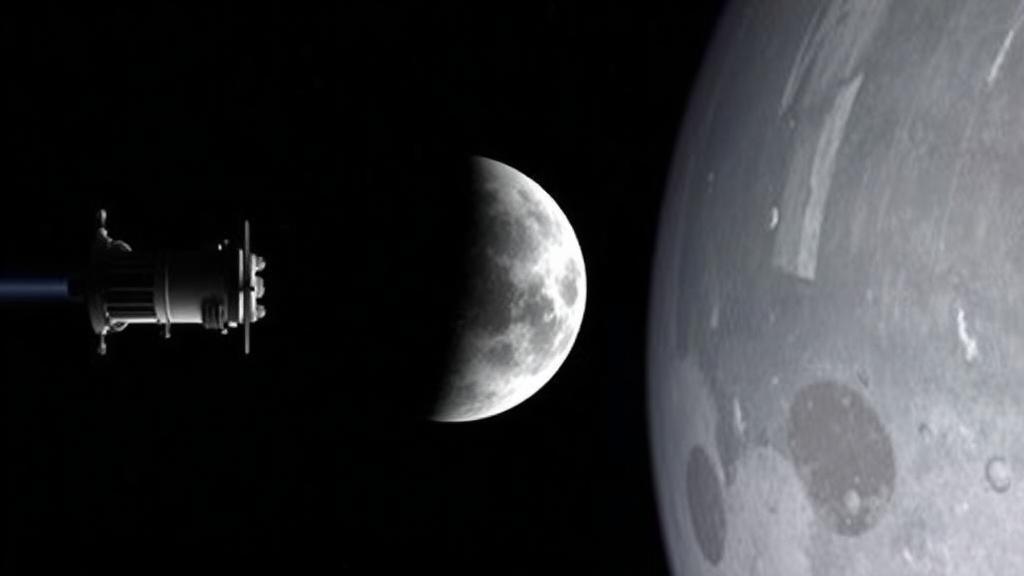
Southwest Research Institute hardware is on the verge of beginning its long-awaited science campaign at the innermost planet of the solar system. Strofio, a compact neutral mass spectrometer designed, fabricated and tested under SwRI leadership, rides aboard the European Space Agency’s Mercury Planetary Orbiter, one half of the ambitious BepiColombo mission. After nearly a decade of travel through interplanetary space, the spacecraft has completed one of the most delicate operations of its entire voyage, and scientists on Earth are now preparing for the flood of data that will follow.
Last week, the BepiColombo spacecraft achieved a major milestone on the road to Mercury orbit insertion, releasing the two orbiters from the transfer module that had carried them across hundreds of millions of kilometers. The mission consists of two distinct spacecraft: the European Space Agency’s Mercury Planetary Orbiter, known as the MPO, and the Japan Aerospace Exploration Agency’s Mercury Magnetospheric Orbiter, the MMO. SwRI led the design and fabrication of NASA’s Strofio instrument, which is mounted on the MPO. When the orbiters separated from the transfer module, the protective covers were removed from Strofio, exposing the instrument’s sensors to space for the final leg of the journey. The start of the science mission is expected early next year.
Strofio is a neutral mass spectrometer specially designed to sample the sparse exosphere that surrounds Mercury, measuring the particles that emanate directly from the planet’s surface. The instrument is remarkably small for the science it promises: it is roughly the size of a basketball and weighs just over seven pounds. Despite its modest dimensions, Strofio is expected to give scientists a substantially better understanding of the surface composition and the space environment of Mercury, the smallest of the solar system’s rocky planets and the one that orbits closest to the Sun. The instrument is part of the SERENA suite of instruments aboard BepiColombo, a collection of sensors dedicated to studying the exchange of particles between the planet’s surface and its tenuous atmosphere.
Getting a spacecraft into orbit around Mercury is one of the most demanding feats of orbital mechanics ever attempted, and BepiColombo will be only the second mission to accomplish it, following NASA’s MESSENGER spacecraft, which operated at Mercury from 2011 to 2015. The difficulty stems from a fundamental property of the inner solar system: as a spacecraft travels toward the Sun, solar gravity relentlessly accelerates it. Without intervention, a probe falling sunward would arrive at Mercury’s vicinity moving far too fast for the planet’s weak gravity to capture it into orbit. Multiple gravitational assists from Earth, Venus and Mercury itself are therefore needed to bleed off that excess energy and slow the craft down.
The consequences of this celestial braking maneuver are striking. Rather than the four to five months a simple flyby mission would require, an orbiting mission to Mercury takes almost ten years along a looping trajectory to achieve the precise speed needed for orbital insertion. Mission planners and commentators have long noted the counterintuitive comparison: it is in some respects easier to orbit Jupiter, a giant planet hundreds of millions of kilometers farther away, than Mercury. The BepiColombo mission, launched in 2018, is expected to enter orbit around Mercury in November 2026 and will achieve its final science orbit in early 2027, closing out an eight-year voyage across the inner solar system.
Dr. Frederic Allegrini, a staff scientist at SwRI, will help analyze the data that Strofio collects during its mission. He emphasizes the challenges posed by Mercury’s close proximity to the Sun, which make the orbital sampling approach not just convenient but essential. The surface of Mercury is so hot that landing a probe there and having it survive long-term is a formidable engineering challenge, he noted. A lander that could endure the extreme thermal environment would be fantastic from a scientific standpoint, but it would provide compositional information for only one location on the entire planet. Instead, with Strofio, the team will measure the surface composition by sampling the planet’s exosphere from orbit, an approach that yields more global knowledge of the surface rather than data from a single landing site.
The physics behind this technique is central to why Strofio exists at all. Mercury’s gravity is too weak to sustain a full, dense atmosphere like those of Earth, Venus or Mars. The planet can support only a tenuous outer atmosphere, called an exosphere, in which particles are so sparse that they rarely collide with one another and instead follow ballistic trajectories under gravity. This exosphere is not static; it is constantly replenished by processes that liberate material from the surface. Strofio will be sampling particles from the surface that get kicked up by mechanisms such as meteorite impacts and the solar wind, the continuous stream of charged particles flowing outward from the Sun. Because the exospheric particles originate at the surface, measuring their composition from orbit provides an indirect but planet-wide chemical census of the ground below.
Allegrini describes Mercury as an interesting object, kind of an oddball compared to the other planets. The planet is much denser than would otherwise be expected, and its core is disproportionately large relative to its size, a combination that has puzzled planetary scientists for decades. The team expects Strofio data to answer a significant number of scientific questions related to the planet’s surface composition, and they also suspect that some surprises await in the measurements. Any unexpected species detected in the exosphere could point to previously unrecognized surface minerals, unusual space-weathering processes, or exotic interactions between the solar wind and the airless terrain.
Allegrini will be joined in the analysis effort by Jared Schroeder, a postdoctoral researcher at SwRI, and together they will comb through the Strofio data looking for clues about Mercury’s origin story. Schroeder said the team is hoping to clear up some of the mysteries around the planet, including the composition of Mercury’s surface and how it interacts with the exosphere. The material that Strofio will measure comes directly from the surface, which makes the instrument’s observations a uniquely direct window onto the planet’s makeup. Understanding that composition, in turn, feeds into broader questions about how the innermost planet formed and evolved, and whether its outsized core reflects an unusual formation history, the loss of an early crust and mantle, or some combination of processes that shaped the young solar system.
The operational backbone of the mission spans multiple institutions on two continents. Mission operations for Strofio are based out of the University of Michigan, but SwRI will receive the data for scientific analysis, keeping the Texas-based institute at the center of the instrument’s science return. The BepiColombo spacecraft itself carries a name rich with history: it honors Giuseppe Colombo, the twentieth-century Italian scientist and mathematician who performed some of the first detailed studies of Mercury. Colombo’s calculations showed how to get a spacecraft into a solar orbit that would repeatedly encounter Mercury by using a gravity assist maneuver with Venus, an insight that underpins the very trajectory strategy the mission has now executed over its long, looping voyage. As the two orbiters settle into their final paths around the scorched little planet early next year, the basketball-sized spectrometer that spent nearly a decade in transit will finally get its chance to taste the exosphere and, through it, read the chemistry of Mercury itself.
Subject of Research: The Strofio neutral mass spectrometer aboard BepiColombo's Mercury Planetary Orbiter and its study of Mercury's exosphere and surface composition
Article Title: SwRI’s Strofio is gearing up to study Mercury’s surface
Article References: SwRI’s Strofio is gearing up to study Mercury’s surface. (n.d.). Original publication
Image Credits: AI Generated
DOI: Not provided
Keywords: Mercury, BepiColombo, Strofio, Southwest Research Institute, exosphere, mass spectrometry, Mercury Planetary Orbiter, planetary science, surface composition, solar wind, gravitational assists, ESA
Cite Scienmag News
Russell Cooper. (October 2, 2026). Strofio Prepares to Unlock Mercury’s Surface Secrets as BepiColombo Nears Orbit. Scienmag. https://scienmag.com/strofio-prepares-to-unlock-mercurys-surface-secrets-as-bepicolombo-nears-orbit/
Russell Cooper. "Strofio Prepares to Unlock Mercury’s Surface Secrets as BepiColombo Nears Orbit." Scienmag, 2 October 2026, https://scienmag.com/strofio-prepares-to-unlock-mercurys-surface-secrets-as-bepicolombo-nears-orbit/. Accessed 4 October 2026.
Russell Cooper. "Strofio Prepares to Unlock Mercury’s Surface Secrets as BepiColombo Nears Orbit." Scienmag. October 2, 2026. https://scienmag.com/strofio-prepares-to-unlock-mercurys-surface-secrets-as-bepicolombo-nears-orbit/


