


In a groundbreaking study from a coalition of top research institutions in Japan, compelling evidence has emerged illuminating the complex interplay between ocean conditions and ice sheet dynamics in East Antarctica. The research, led by Associate Professor Kohei Mizobata of the Tokyo University of Marine Science and Technology, sheds light on the dramatic impact of oceanic heat transport pathways on the Totten Glacier. This glacier, among the largest in East Antarctica, has increasingly come into the spotlight due to its susceptibility to climate-related changes. The findings reveal a worrying trend that may contribute to accelerating global sea-level rise.
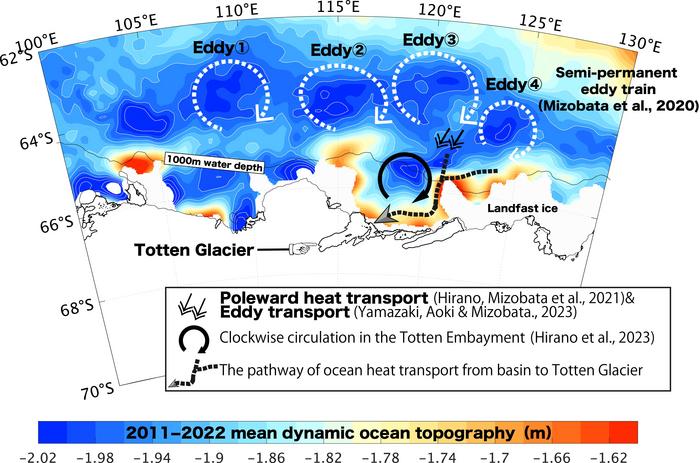
Researchers utilized an innovative approach, developing satellite-derived dynamic ocean topography data and examining sea level pressure information. This advanced methodology allowed the team to craft a comprehensive picture of ocean circulations in the coastal regions of East Antarctica, a territory significantly affected by global warming. The results unequivocally indicate that a clockwise oceanic circulation system carries warm seawater into close proximity with the region’s famed ice sheet. Moreover, the influence of strengthening westerly winds is noted as a critical factor that amplifies these oceanic movements, effectively linking atmospheric dynamics with oceanic processes.
A central theme of the research pertains to the melting ice sheet in East Antarctica, a phenomenon that has been poorly understood, yet holds vast implications for predicting future sea level rise with accuracy. While the grandeur of Antarctica’s ice sheets, which harbor approximately 90% of the planet’s freshwater ice, is commonly acknowledged, their response to rising global temperatures has become a pressing inquiry among climate scientists. This study provides clarity by illustrating that the warm ocean waters, entrained by the newly identified circulating patterns, are subject to influences from atmospheric conditions, effectively bridging two crucial components in the climate system.
This connection reveals how global warming, evidenced by the strengthening of westerly winds, can enhance oceanic circulations, leading to accelerated heat transport to the East Antarctic coastal ice sheets. As temperatures rise, warm seawater has been observed to penetrate further under glaciers, possibly undermining their structural integrity. These interactions suggest that anthropogenic climate changes are not only altering atmospheric conditions but are also reorganizing ocean currents in ways that exacerbate ice melt, thus directly affecting sea-level rise.
The research itself utilized comprehensive datasets spanning a timeframe from 2011 to 2022, filling critical gaps in knowledge regarding the spatial dynamics of ocean and atmospheric interactions. By developing a robust method to derive sea-surface height data, even in ice-laden waters, the scientists constructed an invaluable dynamic ocean topography dataset. Findings include a notable synchronization of sea surface height fluctuations across diverging geographic regions—a discovery highlighting the cohesiveness of atmospheric processes and their far-reaching impacts on oceanic conditions.
The implications of this study extend beyond disciplinary confines, resonating with global concerns regarding climate change and environmental policy. The findings demand attention from policymakers, as the results bolster the case for urgent action in mitigating climate impacts. Researchers noted that, should current trends of westerly wind intensification continue, the cascade effects on the East Antarctic ice sheet could become increasingly pronounced over coming decades. Understanding these connections is vital for forming strategies to cope with inevitable changes.
Furthermore, the statistical analyses employed in the research strengthened the argument for direct connections between atmospheric phenomena, such as changes in the Southern Annular Mode, and corresponding oceanic responses. The Southern Annular Mode has emerged as a predictor of climate variations in the Southern Hemisphere, and its influence on ocean currents in East Antarctica warrants further investigation and understanding. Indeed, this research outlines a model that not only contributes insight but also serves as a framework for predicting future responses of ice sheets amidst changing global climates.
A sense of urgency permeates the conclusions drawn by Mizobata and his team, as they emphasize the necessity for ongoing observational strategies and modeling efforts aimed at dissecting the time-variable phenomena at play. They contend that grasping these dynamics is essential for refining predictions of ice sheet responses, ultimately contributing to more accurate projections of sea-level rise. Each passing year without thorough investigation into these mechanisms could translate into heightened risk for coastal communities around the globe.
The study reinforces the understanding that the interplay between atmospheric dynamics and ocean heat transport is not merely an academic exercise but a critical component of climate science with real-world repercussions. Such interactions are emblematic of broader climate changes instigated by human activities, wherein the urgency to reassess international climate policies becomes increasingly salient. As policymakers grapple with how to respond effectively to the identified threats of climate change, insights from research such as this will play an instrumental role in shaping future interventions.
In summary, the discoveries borne from this research herald a new era of understanding regarding the relationship between the ocean and the vast Antarctic ice sheets. The alarming rate at which these ice sheets are losing volume, compounded by the influence of global warming, highlights the imperative need for concerted global efforts to mitigate climate change and protect vulnerable regions like East Antarctica. Time will reveal the accuracy of predictive models, but the research unequivocally confirms the current trend: warming seas mean melting ice—and that has implications not just for Antarctica, but for the world.
Cite Scienmag News
Violet Maxwell. (April 1, 2025). Strengthened Westerly Winds Boost Ocean Heat Transport to the East Antarctic Ice Sheet. Scienmag. https://scienmag.com/strengthened-westerly-winds-boost-ocean-heat-transport-to-the-east-antarctic-ice-sheet/
Violet Maxwell. "Strengthened Westerly Winds Boost Ocean Heat Transport to the East Antarctic Ice Sheet." Scienmag, 1 April 2025, https://scienmag.com/strengthened-westerly-winds-boost-ocean-heat-transport-to-the-east-antarctic-ice-sheet/. Accessed 3 September 2026.
Violet Maxwell. "Strengthened Westerly Winds Boost Ocean Heat Transport to the East Antarctic Ice Sheet." Scienmag. April 1, 2025. https://scienmag.com/strengthened-westerly-winds-boost-ocean-heat-transport-to-the-east-antarctic-ice-sheet/


