


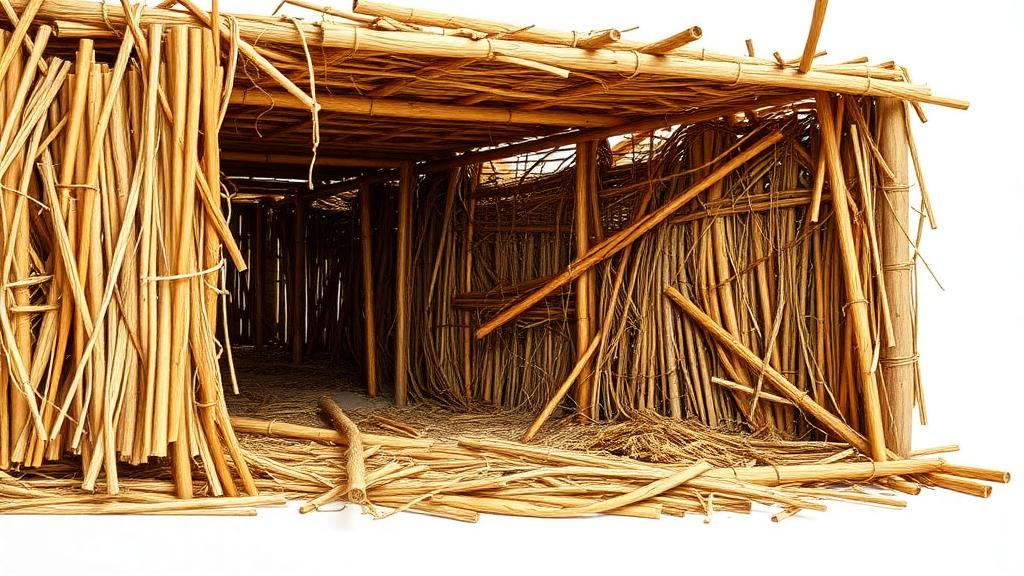
The humble straw bale, long relegated to livestock bedding and autumn decoration, may be one of the most underappreciated tools in the United Kingdom’s race to build hundreds of thousands of new homes without wrecking the climate. New research from the University of Bath suggests that the country produces far more straw than would ever be needed to construct the government’s target of up to 300,000 new homes each year, and that swapping high-carbon materials such as concrete and steel for this agricultural co-product could slash construction emissions while storing carbon in the very walls of the buildings people live in.
The study, published in the journal Buildings, arrives at a moment when the UK housebuilding sector faces a double bind. Ministers have set ambitious annual construction targets intended to ease a chronic housing shortage, yet the built environment currently accounts for roughly a quarter of the nation’s carbon emissions, with the largest share embedded in the manufacture of steel, cement and concrete. Every traditional brick-and-block estate therefore carries a substantial hidden carbon bill, paid upfront in the form of greenhouse gases released before anyone even moves in. Straw bale construction inverts that equation: rather than emitting carbon, the material locks it away for the lifespan of the building.
The scale of the available resource is striking. The UK generates around 9.9 million tonnes of straw every year as a co-product of cereal farming, and the researchers found that only about 60 percent of the straw currently left in fields would be needed to supply enough material for up to 300,000 low-rise buildings annually. Even after accounting for fluctuations in crop yields and competing demands from other sectors, the analysis showed the country holds a consistent surplus of straw relative to what construction would require. In other words, material scarcity is simply not the problem.
Charlotte Taylor, a researcher in the Department of Architecture and Civil Engineering and the study’s lead author, emphasised just how ordinary straw is in British agriculture. Straw is an incredibly common resource in the UK, she noted, used as livestock bedding and feed, ploughed back into fields to improve the soil, and diverted to energy generation, horticulture and even mushroom cultivation. Yet despite being a renewable, low-carbon and historically important building material, very little of it ends up in walls: fewer than 20 new homes a year are currently built in the UK using straw as a construction material.
The carbon mathematics are compelling. According to the study, scaling up straw construction could cut emissions from building significantly while storing between 1.8 and 3.1 million tonnes of carbon dioxide every year, effectively turning new housing stock into a distributed carbon sink. Because straw is a co-product of grain production, the crop’s primary purpose and revenue remain intact; the stalks that would otherwise be baled for bedding or burned for energy instead become a higher-value commodity. That shift could also diversify farmers’ income streams, giving rural economies a stake in the low-carbon transition rather than leaving them on its sidelines.
The technical case for straw as a building material rests on more than carbon accounting. Straw bale walls can deliver exceptional thermal insulation, outperforming many conventional wall systems, which translates into lower heating demand over a building’s lifetime. In low-rise construction, straw can serve as a structural element as well as an insulating infill, and bale walls are known for good moisture regulation and indoor air quality, qualities increasingly valued as buildings become more airtight. Earlier studies have already highlighted straw’s promise as a high-performing, low-carbon building material; the Bath team’s contribution is to quantify whether the resource base exists to make a genuine dent in national housing and emissions targets. It does.
So why are so few straw houses being built? The researchers tested multiple scenarios for redirecting the UK’s straw supply into construction, including reallocating material from bioenergy and industrial uses, and growing more cereals on currently unused land. Diverting straw from other sectors would provide enough material for up to 300,000 low-rise buildings, while expanding cultivation on unused land could supply around 163,000 homes, with diversion from other industries required to close the gap to full housing targets. Supply, in every scenario examined, proved sufficient. The real obstacles, the study concludes, are systemic rather than material.
Those systemic barriers begin with the absence of established supply chains linking farms to building sites. Unlike brick or timber, straw does not arrive through mature distribution networks with predictable pricing, quality assurance and just-in-time delivery. The pool of specialised builders familiar with straw-based construction is limited, and uptake is slowed further because builders, lenders and insurers, wary of anything unconventional, seek to minimise the risk associated with alternative materials. A house that cannot easily be mortgaged or insured is a house that will not be built at scale, regardless of how well it performs.
Economics and logistics add further friction. Some straw construction methods remain less efficient than conventional techniques, raising costs in a sector where margins are thin and procurement is fiercely price-driven. Geographically, straw production is unevenly distributed across the UK, which complicates storage and transport and can make the material abundant in one region while scarce in another. These are solvable problems, but solving them requires coordination that no single farmer, builder or developer can supply alone.
The findings point toward a clear policy agenda. The researchers argue that straw offers the UK a genuine opportunity to cut construction emissions while accelerating homebuilding, but that realising this potential depends on coordinated policy support, clearer regulation and market incentives that reward low-carbon materials. Standards and certification pathways would give lenders and insurers the confidence to treat straw buildings as mainstream products rather than exotic experiments. Investment in supply chains, training and regional processing could convert a diffuse agricultural byproduct into a reliable industrial feedstock. If those pieces fall into place, the study suggests, the material that once housed the three little pigs could help house the nation, one carbon-storing bale at a time.
Subject of Research: Resource potential of straw construction for low-carbon UK housing
Article Title: Straw houses could help UK meet housing targets while cutting emissions
Article References: Straw houses could help UK meet housing targets while cutting emissions. (n.d.). Original publication
Image Credits: AI Generated
DOI: Not provided
Keywords: straw bale construction, low-carbon building, UK housing targets, embodied carbon, University of Bath, agricultural co-products, carbon storage, sustainable construction, building materials, construction emissions, housing policy, renewable materials
Cite Scienmag News
Courtney Benton. (October 10, 2026). Straw Could Build 300,000 UK Homes a Year While Locking Away Carbon. Scienmag. https://scienmag.com/straw-could-build-300000-uk-homes-a-year-while-locking-away-carbon/
Courtney Benton. "Straw Could Build 300,000 UK Homes a Year While Locking Away Carbon." Scienmag, 10 October 2026, https://scienmag.com/straw-could-build-300000-uk-homes-a-year-while-locking-away-carbon/. Accessed 10 October 2026.
Courtney Benton. "Straw Could Build 300,000 UK Homes a Year While Locking Away Carbon." Scienmag. October 10, 2026. https://scienmag.com/straw-could-build-300000-uk-homes-a-year-while-locking-away-carbon/


