


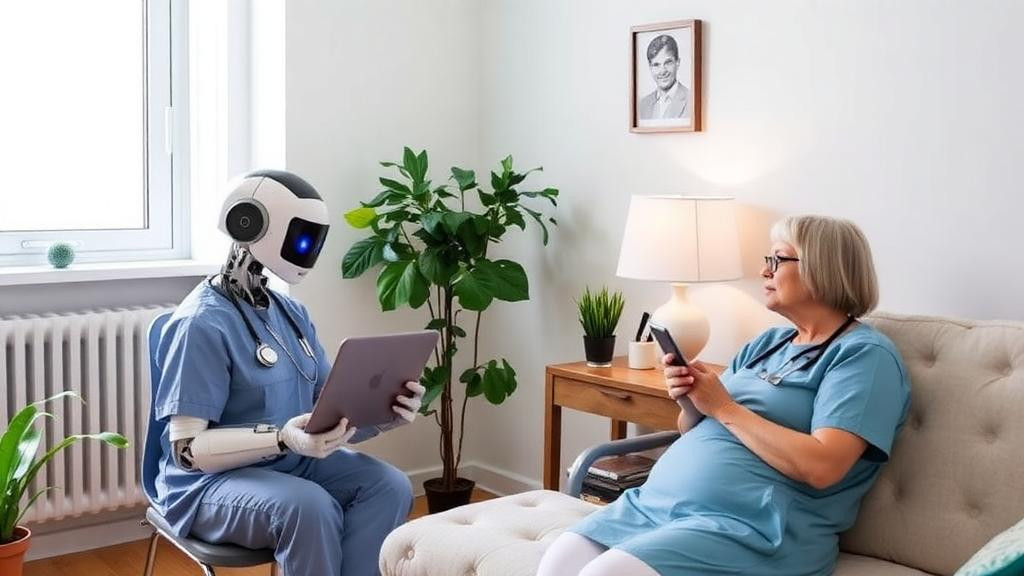
Home-visit nursing is one of the most cognitively demanding corners of modern healthcare. Unlike hospital nurses, who can turn to colleagues at the next bedside or consult a pharmacist down the corridor, home-visit nurses make clinical judgments alone, in a patient’s living room, often with nothing but a phone and their own experience. A new randomized controlled trial from Japan suggests that a carefully constrained artificial intelligence chatbot, preloaded with clinical guidelines, could meaningfully reduce the mental effort these nurses expend and boost their confidence in the answers they reach.
The study, published in BMC Nursing, was led by Takemasa Ishikawa of the Nana-r Home-visit Nursing Development Center at Tekix Corporation and Osaka Metropolitan University, together with colleagues from Hiroshima University, Shizuoka University, and Nara Medical University. The team set out to test a deceptively simple question: if a nurse working in isolation can query an AI system that answers only from trusted clinical guidelines, does that change how hard the task feels and how confident the nurse is in the result?
To find out, the researchers ran a web-based randomized controlled trial between March 9 and March 27, 2026, recruiting practicing home-visit nurses in Japan. A total of 140 nurses were randomly allocated in equal measure to one of two groups. Both groups tackled the same simulated home-visit scenario: an older adult with chronic heart failure living alone, a situation that demands careful assessment of fluid status, medication adherence, self-care capacity, and warning signs of deterioration. The scenario was deliberately chosen because heart failure is common, complex, and unforgiving of missed cues.
The intervention was a guideline-informed AI chat system built on NotebookLM, a tool that can be anchored to specific source documents. In this case, the system was preloaded with publicly available clinical guidelines, meaning its responses were grounded in vetted evidence rather than the open-ended, occasionally unreliable outputs of a general-purpose chatbot. Nurses in the AI group could query the system freely as they worked through the case. The comparison group, by contrast, was instructed not to use any external resources at all, mimicking the resource-poor conditions that home-visit nurses frequently face.
The primary outcome was perceived mental effort, measured with a single-item, 9-point rating scale based on Paas’ scale, a well-established instrument in cognitive load research. Mental effort ratings of this kind capture how much working-memory demand a person subjectively experiences during a task, a quantity that matters in clinical settings because overloaded clinicians are more prone to missed information and errors. The researchers also explored two secondary outcomes: perceived task difficulty and confidence in answer correctness.
The results were consistent across all three measures. Of the 140 randomized participants, 105 completed the task and provided post-task data, forming the complete-case analysis: 53 in the non-AI group and 52 in the AI group. Using analysis of covariance adjusted for home-visit nursing experience, non-home-visit nursing experience, and educational attainment, the AI group reported lower perceived mental effort, with an adjusted mean difference of −1.13 on the 9-point scale (95% confidence interval −1.81 to −0.45). They also rated the task as less difficult (−0.74, 95% CI −1.37 to −0.12) and reported higher confidence in the correctness of their answers (0.71, 95% CI 0.14 to 1.27).
Those effect sizes deserve a closer look. A drop of more than a full point on a 9-point mental effort scale, in a randomized comparison, is a substantial shift for an intervention as lightweight as access to a chat window. The confidence gain is equally intriguing, though it cuts both ways: confidence that is calibrated to actual performance is valuable, while confidence that outpaces competence can be dangerous. The authors are explicit that the study did not evaluate the quality, accuracy, or safety of the clinical reasoning itself, so the trial shows that the AI group felt better about their work, not that their work was demonstrably better.
The study also carries important statistical caveats. The reported estimates are complete-case analyses, not intention-to-treat estimates, meaning they include only participants who finished the task. If the 35 nurses who dropped out differed systematically from those who stayed, the true effect could differ from what was observed. The authors likewise note that the design did not isolate the independent effect of the AI system; the comparison was against a blanket prohibition on external resources, so some of the benefit might reflect access to any structured information source rather than AI specifically. Sensitivity analyses, reported in supplementary material, included unadjusted Welch’s t-tests and additional adjustments for generative AI use frequency and age group.
Methodologically, the trial was registered retrospectively on the UMIN Clinical Trials Registry (UMIN000061415) on April 30, 2026, after the study period, a detail that readers should weigh when interpreting the prespecified nature of the outcomes. The study was approved by the Tekix Inc. Research Ethics Review Committee, conducted in accordance with the Declaration of Helsinki, and funded by the 36th Research Grant from the France Bed Home Care Foundation, which played no role in the design, analysis, or decision to publish. The authors declared no competing interests and disclosed using ChatGPT for English translation and language refinement during manuscript preparation, with all outputs reviewed by the authors themselves.
Why does this matter beyond a single simulated task? The demographic pressures are unmistakable. Japan’s rapidly aging population means more older adults are being cared for at home, and more nurses are making consequential judgments in isolation. If guideline-informed AI assistants can reliably lower cognitive load without degrading reasoning quality, they could function as a kind of remote colleague, an always-available second opinion grounded in evidence rather than guesswork. The concept belongs to what researchers call intelligence augmentation: machines that extend human judgment rather than replace it. But the open questions are as important as the findings. Future studies will need to measure whether reduced mental effort translates into more accurate assessments, whether confidence gains are justified by performance, and whether the same benefits hold in real home visits, with real patients, rather than in a web-based simulation. This trial is an early, cautiously encouraging signal that the answer may be yes, and it offers a template for how to test AI tools in nursing with the rigor the stakes demand.
Subject of Research: Effects of guideline-informed AI chat access on perceived mental effort in home-visit nursing
Article Title: Guideline-informed AI chat access and perceived mental effort in a simulated home-visit nursing task: a randomized controlled trial
Article References: Ishikawa, T., Imura, H., Kitazawa, T., & Takashima, Y. (2026). Guideline-informed AI chat access and perceived mental effort in a simulated home-visit nursing task: a randomized controlled trial. BMC Nursing. https://doi.org/10.1186/s12912-026-05418-w
Image Credits: AI Generated
DOI: 10.1186/s12912-026-05418-w
Keywords: artificial intelligence, home-visit nursing, cognitive load, mental effort, randomized controlled trial, clinical guidelines, large language models, nursing research, clinical reasoning, heart failure, intelligence augmentation, evidence-informed practice
Cite Scienmag News
Ophelia Keating. (October 10, 2026). AI Chatbot Lightens the Mental Load for Nurses Working Alone in Patients’ Homes. Scienmag. https://scienmag.com/ai-chatbot-lightens-the-mental-load-for-nurses-working-alone-in-patients-homes/
Ophelia Keating. "AI Chatbot Lightens the Mental Load for Nurses Working Alone in Patients’ Homes." Scienmag, 10 October 2026, https://scienmag.com/ai-chatbot-lightens-the-mental-load-for-nurses-working-alone-in-patients-homes/. Accessed 10 October 2026.
Ophelia Keating. "AI Chatbot Lightens the Mental Load for Nurses Working Alone in Patients’ Homes." Scienmag. October 10, 2026. https://scienmag.com/ai-chatbot-lightens-the-mental-load-for-nurses-working-alone-in-patients-homes/


