


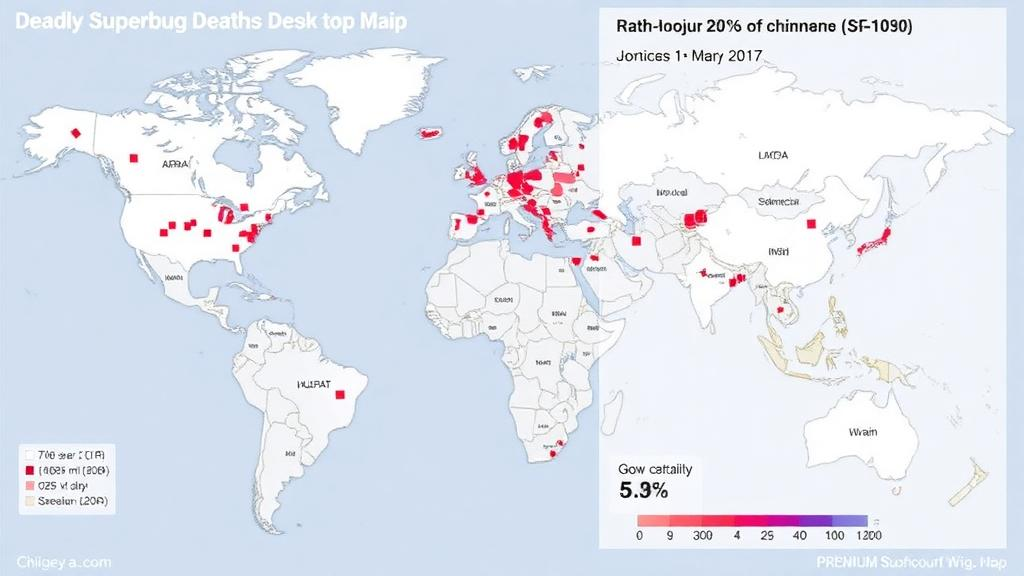
Carbapenem-resistant Gram-negative bacteria have long been described as nightmare pathogens, the last-line defenders of modern medicine having failed against them. A new modelling study published in Nature Communications now offers the most detailed long-range picture yet of how lethal these infections have become, tracking mortality across 204 countries and territories from 1990 to 2021 and separating the pandemic years from the trends that preceded them. The analysis, led by researchers at Huashan Hospital and Fudan University in Shanghai together with collaborators at Wenzhou Medical University, draws on the Global Research on Antimicrobial Resistance (GRAM) project estimates built from the Institute for Health Metrics and Evaluation’s Global Burden of Disease framework.
The headline numbers are stark. In 2021, the researchers estimate that carbapenem-resistant Gram-negative infections were associated with roughly 1.03 million deaths worldwide, with a 95 percent uncertainty interval running from 0.90 to 1.17 million. Of those, about 0.22 million deaths (0.17 to 0.27 million) were attributable specifically to the resistance itself, meaning deaths that would not have occurred had the infecting bacteria remained susceptible to carbapenem drugs. That distinction between associated and attributable mortality is the conceptual backbone of the study, and it matters enormously for how the results should be read.
Associated mortality, in this framework, is calculated against a no-infection counterfactual: how many deaths occurred among people with these resistant infections compared with a hypothetical world in which they had never been infected at all. Attributable mortality is calculated against a drug-susceptible infection counterfactual: how many additional deaths occurred because the bacteria resisted carbapenems, forcing clinicians onto less effective or more toxic alternatives, or leaving them with no options. The first metric captures the full burden of these infections; the second isolates the specific penalty imposed by resistance. A pathogen or region can look alarming on one metric and reassuring on the other, which is precisely what the study found.
To generate these estimates, the team deployed two complementary statistical techniques. Bayesian counterfactual modelling allowed them to construct the alternative scenarios, no infection and drug-susceptible infection, while propagating uncertainty through the estimates rather than collapsing it into single point values. Age-period-cohort decomposition, meanwhile, disentangled three forces that are usually tangled together in raw mortality trends: the effect of a person’s age, the effect of the calendar year in which they died, and the effect of the birth cohort they belonged to. This matters because an ageing global population can push absolute death counts upward even when age-specific risk is falling, and the decomposition lets the researchers see whether the underlying risk is genuinely rising or merely riding a demographic wave.
The long-term trend from 1990 to 2019, before COVID-19 disrupted health systems everywhere, was one of steady deterioration. Overall associated mortality rates rose by 0.82 percent per year, with a 95 percent confidence interval of 0.77 to 0.87 percent, and attributable mortality rates climbed slightly faster, at 0.90 percent per year (0.85 to 0.95 percent). The fact that the resistance-specific penalty grew faster than the overall burden suggests that carbapenem resistance was not merely spreading in step with Gram-negative infections generally but was actively worsening the outcome of the infections it touched.
Beneath the global averages, however, the geography is strikingly uneven. South Asia emerges as the region with the fastest-rising associated and attributable mortality, a finding that aligns with the well-documented proliferation of carbapenemase-producing Enterobacterales on the subcontinent and with dense, under-resourced hospital systems where infection control is difficult and antibiotic stewardship is inconsistent. High-income regions, by contrast, show declining mortality, plausibly reflecting better diagnostics, faster isolation of carriers, improved supportive care, and in some countries the arrival of newer agents active against carbapenem-resistant strains. The study thus reframes antimicrobial resistance not as a uniform global tide but as a set of divergent regional trajectories demanding different responses.
The pathogen-level picture is equally nuanced. Among the seven constituent pathogen groups analysed, Klebsiella pneumoniae shows the fastest increase in mortality rates, consistent with its role as the dominant carbapenem-resistant threat in hospitals worldwide, propelled by highly transmissible carbapenemase genes such as blaKPC and blaNDM that spread readily on plasmids between strains and even between species. Pseudomonas aeruginosa tells a different story: its associated mortality is declining, yet its attributable mortality is rising slightly. In practical terms, fewer people are dying from Pseudomonas infections overall, likely thanks to improved intensive care, but among those who are infected, resistance to carbapenems is exacting a growing toll, hinting that the resistant strains circulating now are harder to treat than their predecessors even as overall management of the species improves.
Then comes the pandemic, and with it the study’s most unexpected finding. During 2020 and 2021, overall associated mortality from carbapenem-resistant Gram-negative infections fell 4.71 percent below the counterfactual projection of what would have been expected had pre-pandemic trends continued. Attributable mortality, however, did not change significantly. The divergence is puzzling at first glance: the pandemic years saw documented surges in carbapenem-resistant infections in many intensive care units, driven by ventilated patients, overwhelmed staffing, and disrupted antimicrobial stewardship. Yet the modelled associated mortality declined relative to expectation. The authors’ dual-metric framing helps make sense of this: whatever shifted during the pandemic appears to have affected the overall burden of these infections or the outcomes of infected patients, without altering the specific excess death imposed by resistance itself. Disentangling whether this reflects changed case mix, altered healthcare contact, shifts in pathogen distribution, or pandemic-related changes in how deaths were recorded and coded will require further work, and the study is careful not to over-interpret the deviation.
Methodologically, the study is a secondary modelling analysis rather than a primary data collection effort, which carries both strengths and caveats. Its strength is scope: no single laboratory or surveillance network could assemble comparable data across 204 countries and three decades, and the GRAM project’s underlying estimates are built from systematic reviews of studies worldwide, adjusted for coverage and quality. Its caveats are inherited from that foundation: surveillance density varies enormously between countries, microbiological confirmation of resistance is far more common in high-income settings, and uncertainty intervals, which the authors report honestly throughout, widen accordingly in data-poor regions. The Bayesian framework propagates this uncertainty into the headline estimates, which is why the 2021 figures are presented as ranges rather than precise counts.
The practical message the authors draw is a call for targeted, dual-metric surveillance and intervention strategies. Tracking only overall deaths from resistant infections, they argue, can mask a worsening resistance penalty, as the Pseudomonas case demonstrates, while tracking only resistance-specific deaths can miss a growing total burden. Interventions, meanwhile, need to follow the geography: the accelerating crisis in South Asia demands investment in laboratory capacity, infection prevention, and affordable access to novel beta-lactam-beta-lactamase inhibitor combinations, whereas high-income countries must consolidate their gains and guard against complacency. With roughly a million deaths a year now associated with these pathogens and the resistance-specific share of them still climbing, the three-decade trajectory documented here is less a historical record than a forecast, and one whose direction, the data suggest, is still being decided region by region.
Subject of Research: Global spatiotemporal trends in mortality from carbapenem-resistant Gram-negative bacterial infections, 1990–2021
Article Title: Global spatiotemporal dynamics of mortality from carbapenem-resistant Gram-negative infections over the past three decades
Article References: Chen, Z., Zhong, M., Wu, J., Ye, X., Li, Z., Wang, J., Tian, Y., Li, S., Zhou, L., Ni, J., Jin, J., & Zhang, W. (2026). Global spatiotemporal dynamics of mortality from carbapenem-resistant Gram-negative infections over the past three decades. Nature Communications. https://doi.org/10.1038/s41467-026-77197-6
Image Credits: AI Generated
DOI: 10.1038/s41467-026-77197-6
Keywords: antimicrobial resistance, carbapenem-resistant bacteria, Gram-negative infections, mortality, Global Burden of Disease, Klebsiella pneumoniae, Pseudomonas aeruginosa, Bayesian modelling, age-period-cohort analysis, South Asia, COVID-19 pandemic, epidemiology
Cite Scienmag News
Kristina Jarvis. (October 10, 2026). Deadly Superbug Deaths Map Reveals Three Decades of Shifting Global Mortality. Scienmag. https://scienmag.com/deadly-superbug-deaths-map-reveals-three-decades-of-shifting-global-mortality/
Kristina Jarvis. "Deadly Superbug Deaths Map Reveals Three Decades of Shifting Global Mortality." Scienmag, 10 October 2026, https://scienmag.com/deadly-superbug-deaths-map-reveals-three-decades-of-shifting-global-mortality/. Accessed 10 October 2026.
Kristina Jarvis. "Deadly Superbug Deaths Map Reveals Three Decades of Shifting Global Mortality." Scienmag. October 10, 2026. https://scienmag.com/deadly-superbug-deaths-map-reveals-three-decades-of-shifting-global-mortality/


