


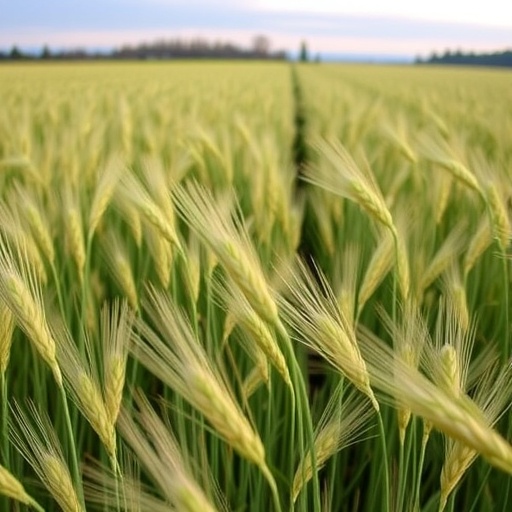
As one of humanity’s most vital staple crops, wheat holds a unique place in global food security, nourishing billions and serving as a cornerstone of agricultural economies—China being no exception. Over recent decades, China’s advancements in agronomy and technology have propelled wheat yields to new heights, yet this progress is shadowed by mounting challenges. Excessive fertilizer use, soil degradation, and escalating carbon emissions threaten not only environmental sustainability but also the long-term viability of wheat production in one of the world’s largest agricultural markets. Striking a balance between maximizing yield and minimizing ecological footprint has become a critical focus for researchers and policymakers alike.
In groundbreaking research led by Associate Professor Xinglong Dai from the Agronomy College of Shandong Agricultural University, a novel quantitative design theory coupled with an innovative technical pathway has been presented, aiming to enhance winter wheat yield while simultaneously elevating nitrogen use efficiency and curtailing environmental impacts. This pioneering approach offers a fresh paradigm for sustainable intensification in cereal crop production, moving beyond conventional practices that have often prioritized output over sustainability. The findings were recently detailed in the prestigious journal Frontiers of Agricultural Science and Engineering (DOI: 10.15302/J-FASE-2025631).
The foundation of this research rests on the historical development of wheat production in China, succinctly summarized by Academician Songlie Yu’s influential “Three-Stage Theory.” According to this framework, the transition from low to medium wheat yields hinges on improved soil fertility, while the leap from medium to high yield requires harmonizing the growth dynamics between plant populations and individual plants. The final stage—advancing from high to super high yield—demands resolving complex internal physiological challenges such as the source-sink relationship and the balance of carbon and nitrogen metabolism. Today, Chinese winter wheat cultivation encounters persistent bottlenecks, including intra-population competition that diminishes resource use efficiency, reduced post-flowering dry matter accumulation impairing grain filling, and deteriorating soil conditions that inhibit root development.
To confront these constraints, the research team crafted an integrative optimization framework centered on the “soil-crop system,” embedding precise, quantifiable technical indicators to guide management decisions. For example, they advocate population structures tuned to specific wheat varieties: a density of 330 to 375 plants per square meter for large panicle cultivars, and 225 to 270 plants per square meter for medium panicle variants. These densities are calibrated to maximize effective ear numbers while mitigating excessive plant competition that would otherwise stifle growth and efficiency.
Soil health improvement is a linchpin of this framework, tackled through an innovative rotation methodology dubbed the “straw return + rotary tillage and deep tillage” regime. The strategy involves two consecutive years of rotary tillage followed by a year of deep tillage, which effectively lowers soil bulk density in the upper 20 centimeters, enhances organic matter content beyond 20 grams per kilogram, and crucially, reduces the carbon footprint by approximately 1.87 metric tons of CO₂ equivalent per hectare. This method optimizes soil structure and nutrient availability, enabling more robust root development and better water infiltration, foundational for sustaining high yields over time.
Planting techniques have also been refined to address competition challenges inherent in dense cropping. The adoption of wide-row strip sowing technology, which utilizes a sowing band width between 6 and 8 centimeters, mitigates the deleterious effects found in traditional narrow-row schemes. By increasing inter-row spacing, wheat roots can distribute more uniformly within the soil matrix, enhancing nitrogen uptake from deeper layers and maintaining high photosynthetic light interception—exceeding 90 percent during the critical grain-filling phase. This approach, combined with a moderately delayed sowing schedule, fortifies nitrogen use efficiency within the grains themselves and enhances stem lodging resistance, securing both yield and crop stability.
At the heart of this research lies the “comprehensive management of the soil-crop system” model, which does not simply compile individual best practices but strategically synchronizes plant population dynamics, soil conditions, and root-crown interactions to optimize resource allocation. In rigorous field trials conducted across the Huang-Huai-Hai wheat region—a key agricultural zone in China—this system outperformed conventional farmer practices, culminating in a 22.5% rise in winter wheat yield, a striking 49.2% leap in nitrogen use efficiency, and measurable reductions in residual inorganic nitrogen and greenhouse gas emissions within the soil.
This work exemplifies a harmonious fusion of theoretical insight and practical application. By furnishing clear, quantifiable targets, it empowers farmers to tailor interventions based on site-specific conditions, steering away from the oft-criticized “one-size-fits-all” methodology prevalent in many large-scale agricultural programs. It lays the groundwork for variable-rate inputs and adaptive management, which stand as vital strategies in contemporary precision agriculture and sustainable intensification.
Looking ahead, the research team advocates for deeper exploration into the adaptability of these methods across diverse ecological regions—recognizing that climatic, soil, and varietal differences may necessitate further refinement. Additionally, they highlight the importance of comprehensively quantifying the carbon footprint and economic returns throughout the entire cropping cycle, aiming to provide robust, lifecycle-based assessments that can inform policy and guide sustainable agricultural investments nationally and beyond.
The integration of this quantitative design and green technology represents a transformative stride toward the future of wheat production, where sustainability and productivity go hand-in-hand. As global food systems come under increasing strain from population growth, climate variability, and environmental degradation, such innovations offer a beacon of hope, promising a resilient and efficient path forward for one of humanity’s most indispensable crops.
In summary, the work spearheaded by Associate Professor Dai and colleagues encapsulates a multifaceted strategy that addresses the intertwined challenges of yield, nitrogen use efficiency, and environmental stewardship. By rooting their approach in empirical data, physiological insight, and technological innovation, they have opened new avenues for sustainable intensification of wheat production that could serve as a model for other cropping systems worldwide.
News Publication Date: 16-Jul-2025
Web References: DOI: 10.15302/J-FASE-2025631
Cite Scienmag News
Alan Morgan. (August 15, 2025). Strategies for Attaining Green High Yields in Winter Wheat Cultivation. Scienmag. https://scienmag.com/strategies-for-attaining-green-high-yields-in-winter-wheat-cultivation/
Alan Morgan. "Strategies for Attaining Green High Yields in Winter Wheat Cultivation." Scienmag, 15 August 2025, https://scienmag.com/strategies-for-attaining-green-high-yields-in-winter-wheat-cultivation/. Accessed 4 September 2026.
Alan Morgan. "Strategies for Attaining Green High Yields in Winter Wheat Cultivation." Scienmag. August 15, 2025. https://scienmag.com/strategies-for-attaining-green-high-yields-in-winter-wheat-cultivation/


