


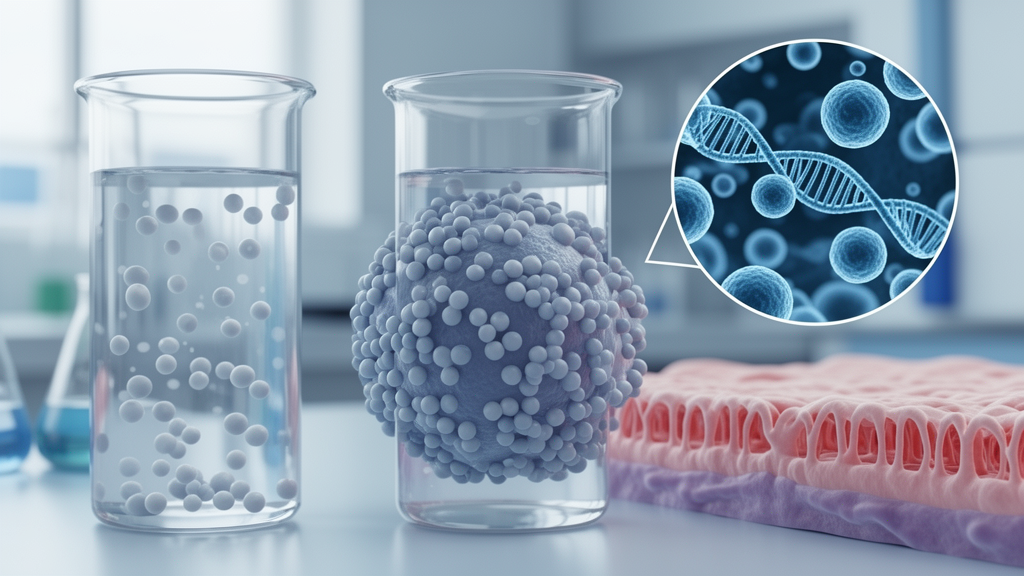
Researchers at the University of Texas at Austin, working with Eli Lilly and Boston University, found that the type and concentration of storage buffer can alter the structure and cellular delivery performance of lipid nanoparticles carrying messenger RNA. In laboratory experiments reported in ACS Nano , the Tris buffer improved the condition and mRNA-delivery activity of the nanoparticles after freezing and thawing, whereas citrate performed better during refrigerated storage but did not protect the particles during freezing. The findings show that buffer selection can affect both the stability of an mRNA medicine during distribution and its behavior when delivered to cells.
Lipid nanoparticles are small lipid carriers that package genetic instructions and deliver them into cells, where the mRNA can be turned into protein. The platform is used in COVID-19 vaccines and is being developed for other treatments, including gene-editing therapies. Although lipid nanoparticles are described as the leading approach for delivering therapeutic RNA, they remain sensitive to changes in size, uniformity and the integrity of their mRNA cargo.
Storage is a critical part of manufacturing medicines that may be transported over long distances and kept frozen for extended periods. For the study, the team examined how three storage buffers—Tris, histidine and citrate—affected mRNA lipid nanoparticles at different concentrations. The researchers assessed particle stability through freezing and thawing, changes in internal structure, and the efficiency with which the nanoparticles delivered mRNA into cells.
Their experiments indicated that storage conditions did more than determine whether the particles remained physically intact. Buffer choice also influenced structural changes associated with delivery, linking the chemical environment surrounding the nanoparticles with their ability to transfer RNA into cells. Citrate buffer supported more efficient mRNA delivery when the nanoparticles were stored in a refrigerator, but it did not preserve their performance during freezing.
In contrast, the Tris buffer improved potency after a freeze–thaw cycle by helping maintain nanoparticle stability, the desired internal organization and delivery of the cargo. The supplied research release did not provide a separate performance result for histidine, although it was among the buffers evaluated. The comparison shows that a buffer favorable under one storage temperature cannot automatically be assumed to perform equally well under another.
The collaboration gave the researchers access to tools and pharmaceutically relevant samples, allowing them to scale up nanoparticle synthesis and test the formulations across four human cell lines. These were laboratory experiments using cell lines, not a clinical trial, and the results do not establish how much any particular vaccine or therapy would improve in people. The release noted that roughly 5% to 10% of mRNA is properly delivered to its target in current systems, presenting an opportunity to improve delivery without simply giving more material.
The researchers said that more efficient nanoparticles could eventually permit the same therapeutic effect at a lower dose, potentially reducing adverse effects, but the study itself did not test that outcome in patients. According to the research team, this mechanistic information can support more robust formulations intended to withstand storage and international shipment. The central result is that a storage solution is not merely a passive ingredient: it can change nanoparticle structure and function in ways that affect mRNA delivery, making systematic buffer selection an important consideration in developing RNA medicines for real-world distribution.
Subject of Research: Effects of storage buffers on the structure and delivery performance of mRNA lipid nanoparticles
Article Title: An improvement on the gold standard for delivering RNA therapeutics
Article References: An improvement on the gold standard for delivering RNA therapeutics. Original publication (Bibliographic details unavailable.)
Image Credits: AI Generated
DOI: Not provided
Keywords: mRNA therapeutics, lipid nanoparticles, storage buffers, RNA delivery, vaccines, freeze–thaw stability, drug formulation, cell lines, Eli Lilly, ACS Nano, improvement, gold
Cite Scienmag News
Juliet Wilcox. (October 25, 2026). Storage buffers alter mRNA delivery in lipid nanoparticles. Scienmag. https://scienmag.com/storage-buffers-alter-mrna-delivery-in-lipid-nanoparticles/
Juliet Wilcox. "Storage buffers alter mRNA delivery in lipid nanoparticles." Scienmag, 25 October 2026, https://scienmag.com/storage-buffers-alter-mrna-delivery-in-lipid-nanoparticles/. Accessed 25 October 2026.
Juliet Wilcox. "Storage buffers alter mRNA delivery in lipid nanoparticles." Scienmag. October 25, 2026. https://scienmag.com/storage-buffers-alter-mrna-delivery-in-lipid-nanoparticles/


