

Sunday, October 25, 2026
Science
No Result
View All Result
  • Login
  • HOME
  • SCIENCE NEWS
  • CONTACT US
  • HOME
  • SCIENCE NEWS
  • CONTACT US
No Result
View All Result
Scienmag
No Result
View All Result
Home Science News Technology and Engineering

A sensitive rutin sensor based on Chi/PCN222-Fe3O4/MWCNTs-CTAB/GCE for traditional Chinese medicine

October 25, 2026
in Technology and Engineering
Denise Maddox
By Denise Maddox Scienmag Editorial Profile - Mechanical Engineering
Reading Time: 3 mins read
0
A sensitive rutin sensor based on Chi/PCN222-Fe3O4/MWCNTs-CTAB/GCE for traditional Chinese medicine

A sensitive rutin sensor based on Chi/PCN222-Fe3O4/MWCNTs-CTAB/GCE for traditional Chinese medicine

65
SHARES
587
VIEWS
Share on FacebookShare on Twitter
ADVERTISEMENT

A modified glassy carbon electrode detected rutin, a flavonoid glycoside found in plants, at concentrations as low as 1.75 nanomolar in an analytical study published in the Journal of Materials Science. The electrochemical sensor produced a linear measurement range from 0.02 to 8 micromolar and was applied successfully to three traditional Chinese medicines: Flos Sophorae Immaturus, Folium Mori and dandelion. Its results showed good agreement with measurements obtained by traditional high-performance liquid chromatography.

The study, published on 31 August 2026, focused on developing an enzyme-like sensor for detecting rutin in medicinal plant materials. Rutin is described in the source as a naturally occurring flavonoid glycoside distributed among various plant species. It also has documented antioxidant, antidiabetic and vascular-endothelium-protective activities. Those pharmacological properties provide the stated rationale for developing an efficient detection method, but the reported work concerns chemical analysis rather than the treatment of disease or the clinical effects of rutin.

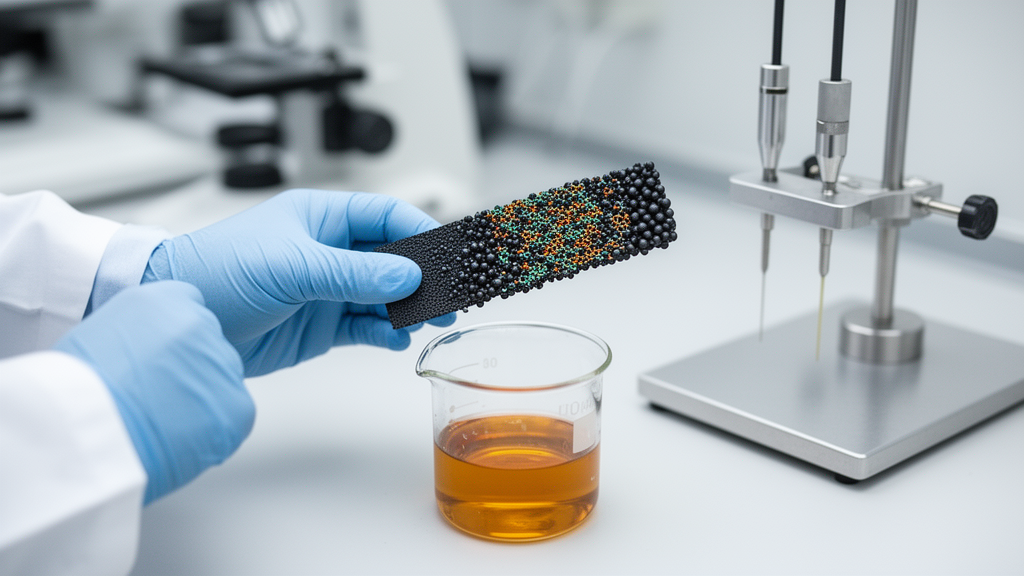
For the sensor, the researchers modified a glassy carbon electrode with a composite containing chitosan, PCN222, Fe₃O₄ nanoparticles, multi-walled carbon nanotubes and cetyltrimethylammonium bromide. PCN222 is identified as metal–organic framework MOF-545. Square wave voltammetry was used to evaluate the sensor’s analytical response, while scanning electron microscopy, cyclic voltammetry and electrochemical impedance spectroscopy were among the methods used to analyze the modified materials and electrodes. The available abstract does not describe the complete electrode-fabrication procedure or establish the separate contribution of each composite component to the measured signal.

The reported limit of detection was 1.75 nM, below the stated linear range of 0.02–8 µM. In units of nanomolar, that range extends from 20 to 8,000 nM. The researchers also report that the sensor maintained high sensitivity and selectivity when various coexisting interfering substances were present in the detection system. However, the supplied source does not identify those substances or provide their concentrations, so the scope of the interference experiments cannot be assessed from the abstract alone.

Testing with Flos Sophorae Immaturus, Folium Mori and dandelion showed that the electrochemical method could detect rutin in these herbal products, with results described as having very good accuracy relative to traditional high-performance liquid chromatography. That agreement supports the reported analytical performance of the modified electrode in the tested samples. The evidence provided does not include replicate numbers, recovery values, batch-to-batch precision, storage stability or results for additional matrices, and it does not establish how the method performs outside the conditions and samples examined. The central findings are therefore the 1.75 nM detection limit, the 0.02–8 µM linear range, resistance to tested interferents and agreement with chromatography for three traditional Chinese medicines.

Subject of Research: Electrochemical detection of rutin in traditional Chinese medicines using a nanocomposite-modified glassy carbon electrode

Article Title: A sensitive rutin sensor based on Chi/PCN222-Fe3O4/MWCNTs-CTAB/GCE for traditional Chinese medicine

Article References: Nie, W., Tong, G.-H., Xu, C.-Y., Zheng, H.-X., Zhang, F.-Y., Liu, T., Zhang, Y.-D., Abdalbagemohammedabdalsadeg, S., Hong, J., & Xiao, B.-L. (2026). A sensitive rutin sensor based on Chi/PCN222-Fe3O4/MWCNTs-CTAB/GCE for traditional Chinese medicine. Journal of Materials Science, 61(40), 30752-30767. https://doi.org/10.1007/s10853-026-13587-x

Image Credits: AI Generated

DOI: 10.1007/s10853-026-13587-x

Keywords: rutin detection, electrochemical sensor, glassy carbon electrode, traditional Chinese medicine, metal-organic framework, chitosan, carbon nanotubes, square wave voltammetry, high-performance liquid chromatography, plant analysis, sensitive, rutin

Cite Scienmag News

Denise Maddox. (October 25, 2026). A sensitive rutin sensor based on Chi/PCN222-Fe3O4/MWCNTs-CTAB/GCE for traditional Chinese medicine. Scienmag. https://scienmag.com/a-sensitive-rutin-sensor-based-on-chi-pcn222-fe3o4-mwcnts-ctab-gce-for-traditional-chinese-medicine/


Denise Maddox. "A sensitive rutin sensor based on Chi/PCN222-Fe3O4/MWCNTs-CTAB/GCE for traditional Chinese medicine." Scienmag, 25 October 2026, https://scienmag.com/a-sensitive-rutin-sensor-based-on-chi-pcn222-fe3o4-mwcnts-ctab-gce-for-traditional-chinese-medicine/. Accessed 25 October 2026.

Denise Maddox. "A sensitive rutin sensor based on Chi/PCN222-Fe3O4/MWCNTs-CTAB/GCE for traditional Chinese medicine." Scienmag. October 25, 2026. https://scienmag.com/a-sensitive-rutin-sensor-based-on-chi-pcn222-fe3o4-mwcnts-ctab-gce-for-traditional-chinese-medicine/

Tags: carbon nanotubesChi/PCN222-Fe3O4/MWCNTs-CTAB compositechitosanelectrochemical sensorenzyme-like detection of plant flavonoidsflavonoid glycoside detectionglassy carbon electrodehigh-performance liquid chromatographyhigh-performance liquid chromatography comparisonmetal-organic frameworkmodified glassy carbon electrodeMOF-545 in electrochemical sensorsnanomaterial-based biosensornanostructured electrochemical sensing platformplant analysisplant-derived antioxidant compoundsrutinrutin detectionSensitiveSensitive rutin electrochemical sensorsquare wave voltammetry for rutinsquare-wave voltammetrytraditional Chinese medicinetraditional Chinese medicine analysis
Share26Tweet16
Previous Post

B7-H3 antibody-drug conjugate cuts death risk 54% in relapsed small-cell lung cancer

Next Post

Retrospective cohort links high viral load to later suppression in southern Ethiopia

Related Posts

Explainable AI framework blends calibrated models to predict heart disease risk
Technology and Engineering

Explainable AI framework blends calibrated models to predict heart disease risk

October 25, 2026
2026 Medical Innovation Forum Reports Organ Freezing, Preclinical Cancer Therapy and AI
Technology and Engineering

2026 Medical Innovation Forum Reports Organ Freezing, Preclinical Cancer Therapy and AI

October 25, 2026
Smoke lowers RNA methylation enzyme WTAP, stabilizing pIgR to curb lung inflammation in mice
Technology and Engineering

Smoke lowers RNA methylation enzyme WTAP, stabilizing pIgR to curb lung inflammation in mice

October 25, 2026
From Electrons to Biorefineries: How Multiscale Modeling and Machine Learning Are Rewiring Plant-Based Chemistry
Technology and Engineering

From Electrons to Biorefineries: How Multiscale Modeling and Machine Learning Are Rewiring Plant-Based Chemistry

October 25, 2026
Hybrid domain adaptation method defends deep learning models against multi-targeted adversarial examples
Technology and Engineering

Hybrid domain adaptation method defends deep learning models against multi-targeted adversarial examples

October 25, 2026
Graded graphene fabric sensor detects pressure from air to underwater
Technology and Engineering

Graded graphene fabric sensor detects pressure from air to underwater

October 25, 2026
Next Post
Retrospective cohort links high viral load to later suppression in southern Ethiopia

Retrospective cohort links high viral load to later suppression in southern Ethiopia

  • Mothers who receive childcare support from maternal grandparents show more optimized

    Mothers who receive childcare support from maternal grandparents show more parental warmth, finds NTU Singapore study

    27656 shares
    Share 11059 Tweet 6912
  • University of Seville Breaks 120-Year-Old Mystery, Revises a Key Einstein Concept

    1061 shares
    Share 424 Tweet 265
  • Bee body mass, pathogens and local climate influence heat tolerance

    682 shares
    Share 273 Tweet 171
  • Researchers record first-ever images and data of a shark experiencing a boat strike

    546 shares
    Share 218 Tweet 137
  • Groundbreaking Clinical Trial Reveals Lubiprostone Enhances Kidney Function

    531 shares
    Share 212 Tweet 133
Science

Embark on a thrilling journey of discovery with Scienmag.com—your ultimate source for cutting-edge breakthroughs. Immerse yourself in a world where curiosity knows no limits and tomorrow’s possibilities become today’s reality!

RECENT NEWS

  • Engagement algorithms may trap consumers in cultural overfamiliarity
  • Narrative review maps recombinant BNP effects and uncertain clinical outcomes
  • Retrospective cohort links high viral load to later suppression in southern Ethiopia
  • A sensitive rutin sensor based on Chi/PCN222-Fe3O4/MWCNTs-CTAB/GCE for traditional Chinese medicine

Categories

  • Agriculture
  • Anthropology
  • Archaeology
  • Athmospheric
  • Biology
  • Biotechnology
  • Blog
  • Bussines
  • Cancer
  • Chemistry
  • Climate
  • Earth Science
  • Editorial Policy
  • Marine
  • Mathematics
  • Medicine
  • Pediatry
  • Policy
  • Psychology & Psychiatry
  • Science Education
  • Science News
  • Social Science
  • Space
  • Technology and Engineering

Subscribe to Blog via Email

Enter your email address to subscribe to this blog and receive notifications of new posts by email.

Join 5,151 other subscribers

© 2025 Scienmag - Science Magazine

Welcome Back!

Login to your account below

Forgotten Password?

Retrieve your password

Please enter your username or email address to reset your password.

Log In
No Result
View All Result
  • HOME
  • SCIENCE NEWS
  • CONTACT US

© 2025 Scienmag - Science Magazine

Discover more from Science

Subscribe now to keep reading and get access to the full archive.

Continue reading