


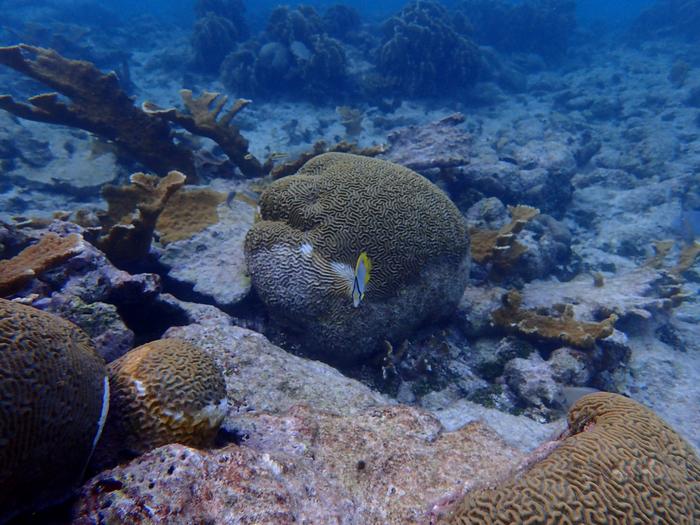
The outbreak of a deadly disease called stony coral tissue loss disease is destroying susceptible species of coral in the Caribbean while helping other, “weedier” organisms thrive — at least for now — according to a new study published today in Science Advances.

Credit: Sara Swaminathan
The outbreak of a deadly disease called stony coral tissue loss disease is destroying susceptible species of coral in the Caribbean while helping other, “weedier” organisms thrive — at least for now — according to a new study published today in Science Advances.
Researchers say the drastic change in the region’s population of corals is sure to disrupt the delicate balance of the ecosystem and threaten marine biodiversity and coastal economies.
“Some fast-growing organisms, like algae, might thrive in the short term,” said the study’s lead author, Sara Swaminathan, an environmental engineering sciences Ph.D. candidate at the University of Florida. “But the loss of the susceptible corals could have long-lasting repercussions.”
Stony coral tissue loss disease, or SCTLD, was first reported off the coast of Miami in 2014 and has since moved throughout the Caribbean, having been identified in 18 countries and territories. Scientists don’t know what causes the disease, but it is thought to be a waterborne pathogen that spreads rapidly across the surface of the coral colony until, in most cases, no living tissue remains.
The research team analyzed existing data from the U.S. Virgin Islands as well as data from other U.S. territories in the Caribbean and western Atlantic, including Florida, Puerto Rico, and Dry Tortugas. They examined the effects of stony coral tissue loss disease on fish and benthic reef communities, which comprises anything living on the sea floor, like coral, algae, and sponges.
They found that the disease not only reduces susceptible coral populations but also diminishes crustose coralline algae, the resilient pink crust that is crucial for building reef structure. Consequently, certain fast-growing, weedy species, including macroalgae, cyanobacteria, and fire coral, thrive in the absence of competitors, spreading into the vacant spaces left by the decimated corals.
Swaminathan explained that fast-growing species benefitting from the disease create a more seaweed-dominated environment compared to the rock-hard reef structures.
“Macroalgae doesn’t support as much biodiversity because it doesn’t create a hard habitat,” she said. “It might be a positive for herbivores but not for other organisms that need places to settle and grow, hide, or mate.”
In fact, the researchers found that the disease’s impact varies among types of fish, and some associations are positive. The study revealed that the rugosity of the coral — the roughness of the habitat — plays more of a factor for the fish than whether the coral is alive or dead.
“Some infectious diseases can affect entire ecosystems, but SCTLD is particularly impactful,” said Kevin Lafferty, a senior scientist with the U.S. Geological Survey and leading expert on marine diseases. “And its impacts are complex, with some winners among the losers.”
In addition to Swaminathan and Lafferty, the research team included Andrew Altieri, an assistant professor in the Herbert Wertheim College of Engineering and associate director of UF’s Center for Coastal Solutions, and Nicole Knight, a post-doctoral researcher at the University of British Columbia. The work was funded by the U.S. Geological Survey and the National Science Foundation.
Across the Caribbean, international agencies, marine biologists and conservationists are responding to the environmental crisis, working to understand the mechanisms driving stony coral tissue loss disease and developing potential treatments. Probiotics have shown promise in slowing down or stopping active lesions when applied to affected corals, and so far, the disease has not spread beyond the western Atlantic and Caribbean.
“Coral reefs are biodiversity hotspots that serve as vital habitats for countless marine species, providing food, shelter, and breeding grounds,” Altieri said. “They are natural protectors of our coastlines, and the loss of these reefs threatens the livelihoods of coastal communities dependent on fishing and tourism. We need to protect and preserve them.”
-30-
Journal
Science Advances
Article Title
Stony coral tissue loss disease indirectly alters reef communities
Article Publication Date
3-May-2024
Cite Scienmag News
Violet Maxwell. (May 3, 2024). Stony coral tissue loss disease is shifting the ecological balance of Caribbean reefs. Scienmag. https://scienmag.com/stony-coral-tissue-loss-disease-is-shifting-the-ecological-balance-of-caribbean-reefs/
Violet Maxwell. "Stony coral tissue loss disease is shifting the ecological balance of Caribbean reefs." Scienmag, 3 May 2024, https://scienmag.com/stony-coral-tissue-loss-disease-is-shifting-the-ecological-balance-of-caribbean-reefs/. Accessed 5 September 2026.
Violet Maxwell. "Stony coral tissue loss disease is shifting the ecological balance of Caribbean reefs." Scienmag. May 3, 2024. https://scienmag.com/stony-coral-tissue-loss-disease-is-shifting-the-ecological-balance-of-caribbean-reefs/

