


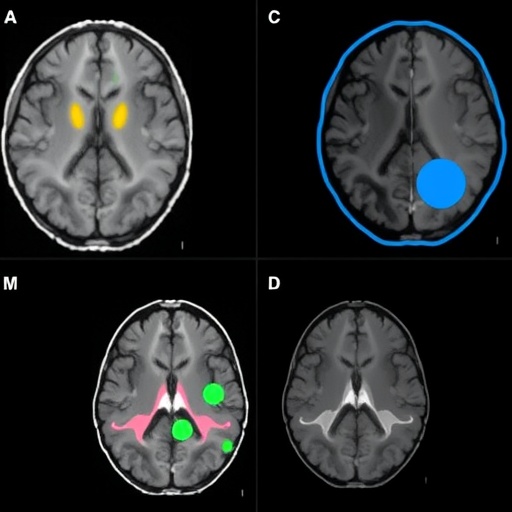
In recent years, the therapeutic landscape for Parkinson’s disease has been significantly transformed by advances in deep brain stimulation (DBS), a technique that involves delivering electrical impulses to targeted brain regions to modulate dysfunctional neural circuits. Among the various DBS targets, the subthalamic nucleus (STN) has emerged as a cornerstone in managing motor symptoms associated with Parkinson’s disease. However, the neural mechanisms underlying DBS effects, especially how different symptom profiles correlate with brain network activity, have remained elusive. A groundbreaking study published in npj Parkinson’s Disease by Santyr, Loh, Germann, and colleagues now sheds light on this intricate relationship using sophisticated functional magnetic resonance imaging (fMRI) analyses, unveiling symptom-specific neural networks activated by STN DBS.
The subthalamic nucleus, a small but pivotal structure nestled within the basal ganglia, plays a critical role in motor control and is deeply implicated in the pathophysiology of Parkinson’s disease. Targeting the STN with DBS has been shown to alleviate cardinal symptoms such as bradykinesia, rigidity, and tremor. Nevertheless, clinical responses to STN DBS can vary widely among patients, prompting neuroscientists to investigate whether distinct symptom clusters engage unique brain networks during stimulation. Santyr and colleagues’ study represents one of the most comprehensive attempts to map these networks in vivo, combining cutting-edge neuroimaging techniques with high-resolution fMRI to capture the dynamic changes elicited by DBS.
In the study, the researchers recruited a cohort of Parkinson’s patients undergoing STN DBS and employed advanced fMRI protocols optimized to record brain activity during stimulation sessions. By synchronizing the imaging with the delivery of DBS pulses, they were able to precisely capture the spatial and temporal patterns of neural activation. Crucially, rather than focusing solely on global brain changes, the analysis was finely tuned to dissect symptom-specific circuits, allowing differentiation between tremor-dominant and akinetic-rigid phenotypes. This approach marks a paradigm shift away from viewing STN DBS effects as uniformly distributed, instead emphasizing the heterogeneity of symptom-driven network modulation.
The results revealed strikingly distinct activation maps associated with different Parkinson’s symptoms. For patients presenting predominantly with tremor, DBS elicited significant activation in cerebellar-thalamo-cortical pathways. This finding aligns with a growing body of evidence implicating cerebellar circuits in tremor generation and modulation. In contrast, patients with predominant akinesia and rigidity exhibited enhanced activation in fronto-striatal networks, including motor and premotor cortices, underscoring the diverse neural substrates of various symptom dimensions. These findings not only deepen our understanding of Parkinsonian pathophysiology but also hint at tailored DBS programming strategies that could optimize therapeutic outcomes based on individual symptom profiles.
Technically, one of the challenges addressed in this study was overcoming the magnetic and electrical interference artifacts commonly associated with active DBS electrodes during MRI scanning. The research team implemented innovative artifact correction algorithms and leveraged ultra-high-field MRI scanners to achieve unprecedented image quality. By doing so, they ensured that the fMRI signals captured were robust and reliable, enabling fine-grained analyses of functionally relevant brain regions in the presence of implanted hardware. This methodological advancement opens new vistas for neuroimaging in DBS patients, facilitating real-time exploration of neuromodulation effects.
Furthermore, the investigation extended beyond mere localization of activation, employing functional connectivity analyses to elucidate how network dynamics shift in response to STN stimulation. These analyses revealed that DBS not only modulates focal regions but also orchestrates widespread network-level reconfigurations that correlate with symptom relief. For example, tremor improvement was paralleled by strengthened connectivity within cerebellar loops, while rigidity amelioration corresponded to enhanced coupling between motor cortical areas and the basal ganglia. Such insights emphasize the importance of conceptualizing DBS effects at the systems neuroscience level, integrating multiple brain regions and pathways.
Potential clinical implications of the study are profound. By identifying neural signatures specific to different symptom clusters, clinicians could personalize DBS protocols, adjusting stimulation parameters or target coordinates to maximize efficacy for each patient’s unique symptomatology. This approach could lead to better symptom control, fewer side effects, and improved quality of life. Additionally, real-time fMRI could serve as a feedback tool during DBS implantation or programming, guiding electrode placement and parameter tuning based on observed neural activation patterns, thus bridging the gap between neurophysiological mechanisms and clinical practice.
The study also sets a benchmark for future research into other movement disorders treated with DBS, such as dystonia and essential tremor. Understanding how DBS reshapes neural networks in a symptom-specific manner could unravel the mysteries of neuromodulation across various conditions, fostering the development of next-generation DBS devices equipped with closed-loop systems that adapt stimulation based on ongoing brain activity. This aligns with a broader movement in neuroscience towards precision medicine, leveraging technology and neuroimaging to tailor interventions dynamically.
Moreover, the findings fuel ongoing debates about the role of the basal ganglia and cerebellum in motor control and their interplay in disease states. Historically, these structures were studied somewhat independently, but the fMRI evidence from DBS contexts underscores their functional integration, particularly in pathological conditions. This integrated view could prompt novel hypotheses about Parkinson’s disease progression and open avenues for combinatorial therapies addressing multiple nodes within motor circuits.
Crucially, the study’s interdisciplinary methodology—merging neurosurgery, neuroimaging, computational modeling, and clinical neurology—highlights the collaborative nature of modern neuroscience research. Such convergence of expertise is vital for tackling complex neurological disorders and translating laboratory discoveries into tangible treatment gains. Santyr et al.’s work exemplifies how combining technology and clinical insight can yield transformative knowledge with direct patient impact.
From a technological perspective, the utilization of ultra-high-field 7 Tesla MRI scanners provided exceptional spatial resolution, allowing visualization of small subcortical structures and their connectivity in unprecedented detail. This level of resolution was critical for disentangling overlapping activation in densely interconnected regions like the basal ganglia, thalamus, and cerebellum. As imaging technologies continue to evolve, we can anticipate further refinements in our understanding of DBS-mediated neuromodulation at microcircuit levels.
Ethical considerations also surface when deploying invasive neurotechnologies like DBS, especially as understanding of precise brain network effects grows. Personalized DBS protocols informed by fMRI data raise questions about patient autonomy, consent, and the potential for unintended cognitive or emotional modulation. Ongoing dialogue among clinicians, researchers, bioethicists, and patients will be essential to navigate these challenges responsibly as therapy becomes increasingly sophisticated.
The study’s limitations must be acknowledged. Although the cohort size was sufficient for robust statistical analyses, larger and more diverse populations are necessary to generalize findings broadly. Furthermore, longitudinal studies tracking network changes over extended DBS use could reveal adaptive neural plasticity mechanisms and inform long-term therapy optimization. Such data would be invaluable in refining our conceptual models of Parkinson’s disease progression under neuromodulation.
In conclusion, Santyr and colleagues’ pioneering work offers a compelling window into the brain’s network-level responses to STN deep brain stimulation, unraveling symptom-specific circuits that underlie therapeutic benefit. This neuroimaging milestone paves the way for more precise, individualized, and effective neuromodulation strategies in Parkinson’s disease, heralding a new era of brain-centric treatment paradigms. As DBS technology and neuroimaging continue to advance hand in hand, the prospect of fully harnessing the brain’s plasticity for durable disease control appears increasingly within reach.
Cite Scienmag News
Cassandra Pierce. (April 28, 2026). STN DBS fMRI Uncovers Symptom-Specific Brain Networks. Scienmag. https://scienmag.com/stn-dbs-fmri-uncovers-symptom-specific-brain-networks/
Cassandra Pierce. "STN DBS fMRI Uncovers Symptom-Specific Brain Networks." Scienmag, 28 April 2026, https://scienmag.com/stn-dbs-fmri-uncovers-symptom-specific-brain-networks/. Accessed 3 September 2026.
Cassandra Pierce. "STN DBS fMRI Uncovers Symptom-Specific Brain Networks." Scienmag. April 28, 2026. https://scienmag.com/stn-dbs-fmri-uncovers-symptom-specific-brain-networks/


