


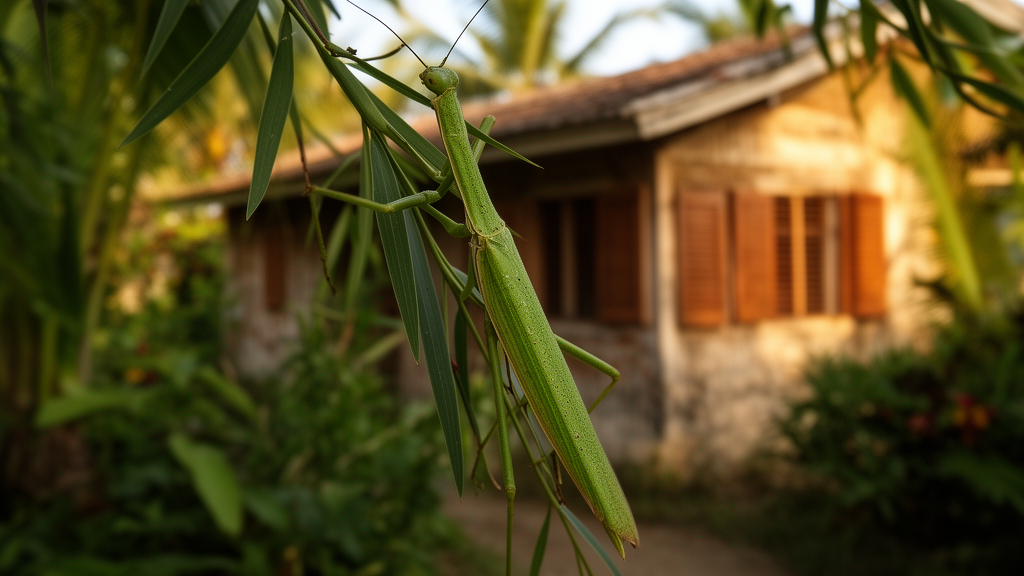
The ongoing global biodiversity crisis has prompted scientists to investigate how various species adapt to the expanding footprint of human activity. While many organisms face severe population declines due to habitat loss and fragmentation, some species appear to be surprisingly resilient to these changes. A recent study published in the Journal of Orthoptera Research offers a compelling case study of this resilience, focusing on the stick insect Clonistria guadeloupensis in the Caribbean island of Guadeloupe. The research challenges the common assumption that human disturbance invariably leads to negative demographic outcomes for insect populations, suggesting instead that certain species may find ecological advantages in anthropized environments.
Clonistria guadeloupensis is a nocturnal stick insect species that is locally common throughout Guadeloupe and its dependencies. It inhabits a wide range of environments, from wet tropical forests to xeric, degraded habitats. The species is known to feed on various wild vegetation and plant species associated with human crops, such as guava and pigeon peas. This generalist diet may contribute to its ability to persist in areas where human activity has altered the natural landscape. Understanding the demographic structure of such species is crucial for assessing the broader impacts of anthropization on insect diversity, a topic that has historically suffered from a bias toward studying vertebrates and pollinators.
The study aimed to determine how local demographics of C. guadeloupensis relate to human disturbances, including agricultural fields, roads, and urbanization. Researchers sampled the species in diverse environmental situations across the Basse Terre and Grande Terre regions of Guadeloupe. They recorded habitat characteristics and analyzed the population structure of juvenile, subadult, and adult stages. By measuring distances to the nearest road, building, and cultivated field, the team quantified the level of anthropization at each sampling spot. This approach allowed for a detailed examination of how different types of human infrastructure might influence insect population dynamics.
The results revealed a minimal impact of anthropization factors on the overall demographics of the stick insect population. Contrary to expectations of a negative impact, the species showed a tendency to be associated with habitats that had greater levels of anthropization. This pattern suggests that the insects may prefer or benefit from the more open vegetation structures found in disturbed areas. The study found that population density generally decreased with altitude, a factor that correlates with more forested and less anthropized environments. This indicates that the species is more prevalent in lower, drier, and more open habitats, which are often closer to human settlements and agricultural zones.
Further analysis of the data highlighted significant variations in local aggregation levels among the different developmental stages. Juveniles were found to be highly aggregated, often clustering closely around focal food plants. This behavior is consistent with their limited mobility and reliance on specific feeding sites. In contrast, adults exhibited lower aggregation levels, indicating a greater propensity for dispersal. The study also found a strong correlation between adult aggregation and sex ratio, suggesting that males are the primary dispersing sex in this species. This finding aligns with observations from citizen science initiatives, where male stick insects are more frequently reported, likely due to their higher mobility in search of mates.
The statistical models used in the study, including analysis of covariance, confirmed that altitude was a significant factor influencing total population size, with fewer individuals found at higher elevations. While the effects of specific anthropization factors like distance to roads or agricultural fields were often marginally significant, the general trend pointed toward a greater presence of C. guadeloupensis in proximity to anthropized areas. For instance, adult populations showed a slight increase as the distance from agricultural fields increased, but this effect was weak. The overall pattern suggests that the species is well-adapted to coexist with human disturbances, potentially utilizing the open spaces created by agriculture and urbanization for dispersal and colonization.
The implications of these findings extend beyond the specific case of C. guadeloupensis to broader conservation strategies. The study suggests that the impact of human activity on biodiversity is not uniformly negative and that some species may thrive in human-modified landscapes. This has important consequences for debates over land use, such as whether agriculture should be intensified to free up space for wildlife or made more extensive to create natural-anthropized continuums. The presence of stick insects in areas with high anthropization indicates that these habitats can support certain insect populations, provided that suitable food plants and open vegetation are available. However, the species is seldom seen in dense urban settings, likely due to the lack of appropriate food sources, highlighting the importance of maintaining green spaces and vegetation patches within human-dominated areas.
The research also underscores the need for more studies on insect dispersal and migration, particularly in the context of anthropized environments. While the study provided valuable insights into the demographic structure of C. guadeloupensis, it also highlighted gaps in our understanding of how insects move across landscapes and establish new populations. The hypothesis that active dispersal may be driven by demographic increases and local overpopulation offers an interesting avenue for future investigation. Additionally, the potential role of passive ecological migration, such as predation by birds, in driving regional population establishment remains an area that requires further exploration. Understanding these mechanisms is essential for predicting how insect populations will respond to continued anthropization and for developing effective conservation strategies that promote coexistence between humans and wildlife.
In conclusion, the study demonstrates that the stick insect Clonistria guadeloupensis exhibits a remarkable ability to cope with human disturbances in Guadeloupe. Rather than being negatively impacted by anthropization, the species appears to benefit from the open habitats created by human activity. This finding challenges the narrative of universal decline in insect populations due to human expansion and suggests that a more nuanced understanding of species-specific responses is necessary. By describing the occurrences of species across the human disturbance continuum, this research contributes to a growing body of evidence that supports the potential for biodiversity to coexist with increased human occupancy. Future studies should focus on the factors involved in adaptation to disturbance, particularly dispersal and colonization success, to better predict the effects of further anthropization on insect diversity and ecosystem health.
Subject of Research: Low impact of anthropization on the demographic structure of the stick insect Clonistria guadeloupensis in Guadeloupe
Article Title: Low impact of anthropization on the demographic structure of the stick insect Clonistria guadeloupensis in Guadeloupe
Article References: Penet, L., Roy, A., Jourdan, T., Bellanger, Y., & Lelong, P. (2025). Low impact of anthropization on the demographic structure of the stick insect Clonistria guadeloupensis in Guadeloupe. Journal of Orthoptera Research, 34(1), 69-75. https://doi.org/10.3897/jor.34.128668
Image Credits: AI Generated
Keywords: impact, anthropization, demographic, structure, stick, insect, Clonistria, guadeloupensis, Guadeloupe, scientific research
Cite Scienmag News
Gavin Prescott. (October 18, 2026). Stick Insects Thrive Near Human Habitats in Guadeloupe Study. Scienmag. https://scienmag.com/stick-insects-thrive-near-human-habitats-in-guadeloupe-study/
Gavin Prescott. "Stick Insects Thrive Near Human Habitats in Guadeloupe Study." Scienmag, 18 October 2026, https://scienmag.com/stick-insects-thrive-near-human-habitats-in-guadeloupe-study/. Accessed 18 October 2026.
Gavin Prescott. "Stick Insects Thrive Near Human Habitats in Guadeloupe Study." Scienmag. October 18, 2026. https://scienmag.com/stick-insects-thrive-near-human-habitats-in-guadeloupe-study/


