


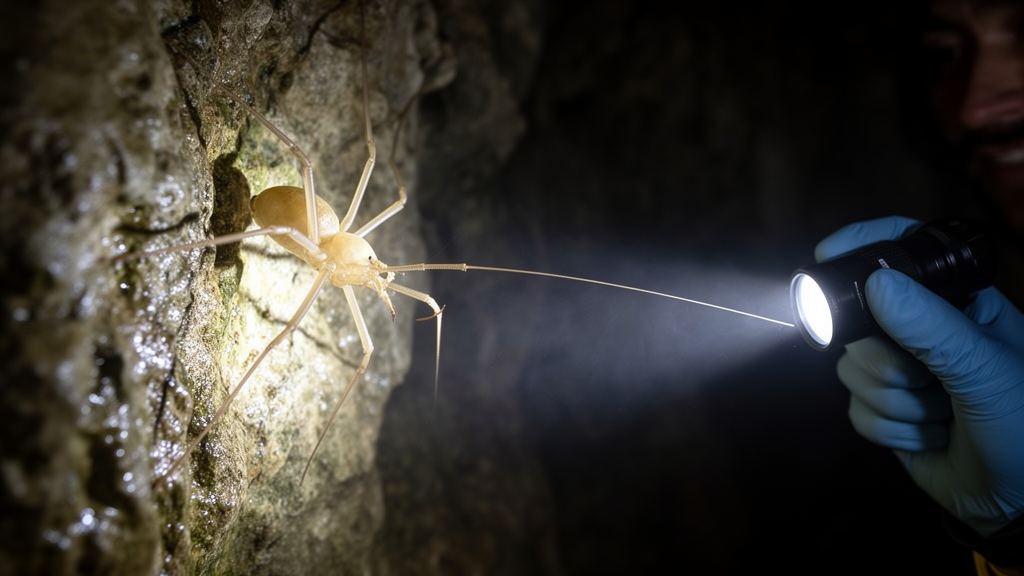
Deep inside a wet cave in the Colombian department of Santander, researchers have found an arachnid that has never been seen by science: a small, pale whip spider with no median eyes at all. The animal belongs to the genus Charinus, a group of amblypygids notorious for evolving in isolation, and it has now been formally described as Charinus santandereanus sp. nov. in the journal Subterranean Biology. The description is the centerpiece of a broader survey that examined 53 whip spider specimens from 12 Colombian caves across eight departments, and it rewrites what is known about which of these secretive predators live in the country’s subterranean ecosystems.
Amblypygids, commonly called whip spiders or tailless whip scorpions, are flat, nocturnal arachnids that hunt with raptorial pedipalps and feel their surroundings with extraordinarily elongated first legs that function as sensory antennae. They are not spiders and not scorpions, but an ancient order of their own, and they are frequent and important members of cave communities. In nutrient-limited cave food webs they sit near the top, acting as apex predators on insects and other invertebrates. Because many species occupy narrow ranges, their presence or absence can signal how healthy, or how disturbed, a fragile cave system really is.
The new species was collected in Cueva El Nitro near Villanueva, Santander, at roughly 1,776 meters above sea level, and is known only from that locality. Both type specimens are females, deposited in the collection of the Alexander von Humboldt Institute in Bogotá. The cave itself is very wet, and the animals were found only in the aphotic zone, clinging to walls close to water. Two nearby caves that are hotter and drier held no amblypygids at all, a detail that hints at how tightly these animals are bound to specific microclimates even within a single karst region.
Diagnosing a new Charinus is notoriously difficult because the genus is species-rich and highly endemic, so the authors compared the animal against all three of its Colombian congeners and against geographically close Venezuelan species that share its most striking trait: the complete absence of median eyes. Charinus santandereanus differs from its Colombian relatives by that total loss of median eyes, by having two pseudo-articles on the basitibia of leg IV rather than three, and by the shape and dentition of its first cheliceral tooth, which carries two subequal denticles on a concave dorsal margin. Against its morphologically closest Venezuelan relative, C. camachoi, it shows a different arrangement of dorsal spines on the pedipalp femur and patella, with four dorsal spines on the femur and five on the patella. It also retains well-developed lateral eyes, which separates it from the fully eyeless C. bordoni, and its pentasternum is formed of flattened platelets rather than the granular metasternum seen in C. pardillalensis.
The rest of the survey carries its own weight. The genus Heterophrynus, large phrynid ambushers, is now recorded from six Colombian caves, with H. yarigui newly documented from Tolima and, for the first time, from a hypogean microhabitat in Cueva de Los Guácharos near Cunday. H. cervinus was found in Caverna Las Cocas in Boyacá at about 2,000 meters, a new departmental record, and H. batesii turned up in caves of Serranía La Macarena/La Lindosa in Guaviare and in Caquetá, its westernmost known occurrence, extending the Amazonian species toward the Andean foothills. None of these animals show troglomorphic traits such as elongated appendages or depigmentation, which the authors read as evidence of facultative, opportunistic cave use rather than obligatory life underground.
One of the study’s quieter contributions may matter most to taxonomists. The male genital structures, or gonopods, of Heterophrynus guacharo had never been described, because the original type material was dehydrated and the delicate structures unusable for detailed comparison. Using fresh topotypic males from Cueva del Indio in Huila’s Los Guácharos National Natural Park, in the Suaza River basin, the researchers illustrated the spermatophore organ in detail, documenting the lamina medialis, fistula, dorsal and lateral lobes, and processus internus. Genital morphology is the critical character set for separating Heterophrynus species, so this description finally gives the species a usable diagnostic anchor and helps resolve a history of misidentification stretching back to the 1980s, when the animals were labeled H. cervinus.
The Caribbean islands delivered a surprise of their own. Paraphrynus laevifrons, a species widespread in Central and North America, was recorded for the first time from Providencia Island and, notably, from insular cave habitats in Colombia. Specimens came from Cueva Bat Hole on Chay Hill and from a flooded artificial tunnel at Represa Freshwater Bay, a coastal cave roughly ten meters from the shoreline whose lower section is inundated by seawater and battered by wave action. How these arachnids cope with saltwater intrusion and constant spray remains an open question, and the authors flag the population’s adaptation as unclear. The record also carries a taxonomic caution: material identified as P. laevifrons from Guatemala shows significant differences, and integrative work elsewhere has revealed cryptic diversity within the species, so the Providencia animals may repay closer study.
Phrynus araya, originally described from Venezuela, was documented from two additional Santander caves, Cueva del Nitro near La Aguada and Cueva La Catedral, while an earlier record of Phrynus pulchripes from the same cave system raises the possibility of sympatry or of a historical misidentification that only fresh material can settle. Taken together, the study compiles a full list of cave-associated amblypygids in Colombia and even provides an illustrated identification key covering all cave species in the country, from the relict monotypic Jorottui ipuanai of La Guajira, the sole New World representative of the family Paracharontidae, through the Charontidae and the three phrynid genera.
The broader pattern is intriguing. In much of South America, cave amblypygid faunas are dominated by Charinus, but in Colombia the cavernicolous record is overwhelmingly Heterophrynus, with Charinus known from only a single Caribbean cave where C. rocamadre lives alongside Heterophrynus caribensis. The authors urge caution in interpreting this dominance, since it could reflect sampling bias favoring larger animals, genuine biogeographic segregation, or undetected microhabitat partitioning between large and small species. Most records cluster in the Eastern and Central Cordillera and along the Caribbean coast, where karstic and calcareous rock prevails, plus the pseudokarstic formations of Serranía La Macarena/La Lindosa, and the authors attribute the remaining gaps partly to the Racovitzan impediment, the persistent shortfall of exploration in difficult-to-access tropical caves.
For conservation, the stakes are concrete. Subterranean ecosystems face mounting pressure from climate change and human activity, and species like the new Charinus, known from a single wet cave and apparently intolerant of the hotter, drier caves nearby, are exactly the kind of narrow-range animals most vulnerable to disturbance of a single site. The authors position their synthesis as a baseline: standardized cross-regional sampling to separate ecological patterns from collection artifacts, targeted studies of what drives facultative cave occupation in Neotropical phrynids, and species-specific dependency assessments to determine which Colombian cave arachnids truly depend on the underground world they inhabit. With 53 specimens, 12 caves, one new species, and a national key now on the table, the dark corners of Colombia’s karst have at least a starting map.
Subject of Research: Diversity and distribution of cave-dwelling whip spiders (Amblypygi) in Colombia, including a new Charinus species
Article Title: Whip spiders ( Arachnida , Amblypigi ) from Colombian Caves: A review, new records and description of a new species
Article References: Villarreal, O., Delgado-Santa, L., & Lasso, C. A. (2025). Whip spiders (Arachnida, Amblypigi) from Colombian Caves: A review, new records and description of a new species. Subterranean Biology, 52, 1-28. https://doi.org/10.3897/subtbiol.52.150357
Image Credits: AI Generated
DOI: 10.3897/subtbiol.52.150357
Keywords: Amblypygi, whip spiders, Charinus santandereanus, Colombian caves, Subterranean Biology, new species, Heterophrynus, cave ecosystems, taxonomy, Santander, troglophiles, conservation
Cite Scienmag News
Gavin Prescott. (October 18, 2026). New Blind Whip Spider Species Emerges from Colombian Cave. Scienmag. https://scienmag.com/new-blind-whip-spider-species-emerges-from-colombian-cave/
Gavin Prescott. "New Blind Whip Spider Species Emerges from Colombian Cave." Scienmag, 18 October 2026, https://scienmag.com/new-blind-whip-spider-species-emerges-from-colombian-cave/. Accessed 18 October 2026.
Gavin Prescott. "New Blind Whip Spider Species Emerges from Colombian Cave." Scienmag. October 18, 2026. https://scienmag.com/new-blind-whip-spider-species-emerges-from-colombian-cave/


