


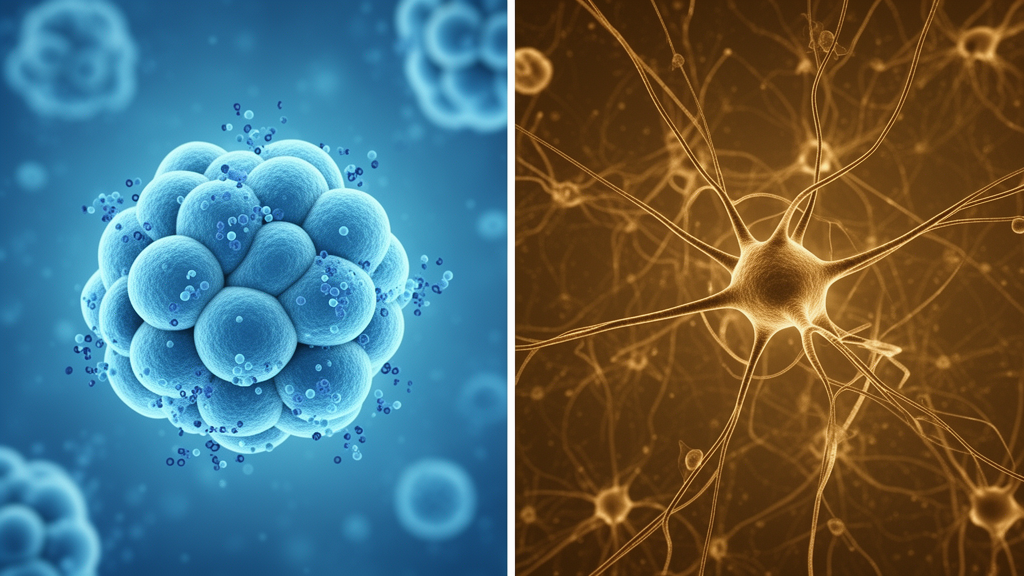
A newly published analysis in GeroScience reports a near-zero gene-level rank association between the microRNA targetome of adult hypothalamic neural stem and progenitor cells and transcriptomic patterns of hypothalamic aging. Investigating how microRNA target burden aligns with transcriptomic shifts observed across aging tissue, the research team found that the primary Spearman rank correlation between miRTarBase-weighted target burden and hypothalamic aging log fold-change in dataset GSE188646 was ρ = 0.0069, with an associated P-value of 0.784 across an evaluated sample of 1,579 genes.
The investigation addresses adult hypothalamic neural stem and progenitor cells, designated as htNSCs, which are known to exert an influence on aging processes in part through exosome-associated microRNA cargo. Despite this established biological role, the exact manner in which the broader microRNA targetome of htNSCs relates to transcriptomic changes occurring during hypothalamic aging has remained unclear. To test whether gene-level target burden directly corresponds with aging profiles, the researchers mapped htNSC-biased microRNAs onto the miRTarBase repository to establish a comprehensive target union encompassing 1,777 genes.
To determine whether this near-zero rank correlation constitutes statistical equivalence rather than an inconclusive outcome, the authors performed two one-sided equivalence testing against an equivalence margin of |ρ| = 0.10. The researchers noted that this specific equivalence margin was fixed before the statistical equivalence test was computed, but only after the near-zero correlation had already been observed in the data, rather than being formally prespecified before the study commenced. Evaluated within this boundary, the test confirmed statistical equivalence, yielding a two one-sided test P-value of 1.0 × 10⁻4 and a bootstrap 95 percent confidence interval spanning from −0.042 to 0.056.
The authors detailed critical methodological qualifications and analytical limitations that must accompany the interpretation of this equivalence result. Because the bootstrap confidence interval calculation treats individual genes as statistically independent observations, the procedure likely overstates the true precision of the estimate. Furthermore, the investigators emphasized that demonstrating statistical equivalence within this predefined numerical margin does not equate to establishing biological equivalence, nor does it rule out the presence of cell-type-specific regulatory dynamics operating within the aging hypothalamus.
The primary finding proved robust across varied analytical parameters, with the near-zero correlation remaining stable across an evaluated microRNA-selection grid. When the researchers examined functional gene groupings through descriptive Hallmark over-representation analysis, the screening recovered broad biological terms related to cellular stress and inflammation across the target gene union, reflecting generalized functional annotations rather than highly restricted molecular pathways.
To assess whether specific biological pathways exhibited statistically meaningful enrichment, the team evaluated candidate terms against five covariate-matched null distributions. Within this framework, the Apoptosis term initially demonstrated an unadjusted empirical P-value of 0.009, which corresponded to a Bonferroni-adjusted P-value of 0.045. However, the authors explained that because these five terms were selected following an initial broader Hallmark screen, and because Apoptosis failed to survive screen-wide multiple-testing correction, the finding is not reported as demonstrating true pathway specificity.
Several additional exploratory patterns and mechanistic hypotheses were noted by the researchers but explicitly categorized as unconfirmed observations. Findings regarding unadjusted absolute log fold-change attenuation and anatomical localization within the third-ventricle niche remain strictly exploratory within the study. Similarly, potential connections involving the mechanosensitive ion channel Piezo1 and low-intensity focused ultrasound, or LIFU, represent a future research hypothesis only, rather than a demonstrated functional outcome or verified intervention.
In their overall conclusions, the authors emphasized that these computational analyses describe a near-zero gene-level rank association strictly within the specific datasets examined. The findings do not demonstrate biological independence between htNSC-derived microRNAs and hypothalamic aging processes, nor do they provide independent hypothalamic replication across separate cohorts, leaving the wider regulatory architecture open to future direct investigation.
Subject of Research: Hypothalamic neural stem cell microRNA targets and aging transcriptomes
Article Title: Near-null gene-level association between the hypothalamic neural stem cell microRNA targetome and hypothalamic aging transcriptomes
Article References: Sanker, V., Constantinou, S., Desai, A., & Frantzias, J. (2026). Near-null gene-level association between the hypothalamic neural stem cell microRNA targetome and hypothalamic aging transcriptomes. GeroScience. https://doi.org/10.1007/s11357-026-02632-x
Image Credits: AI Generated
DOI: 10.1007/s11357-026-02632-x
Keywords: hypothalamus, neural stem cells, microRNA, transcriptomics, aging, miRTarBase, GSE188646, equivalence testing, Near-null, gene-level, association, between
Cite Scienmag News
Beatrice Stafford. (November 8, 2026). Stem Cell MicroRNA Targets Show Near-Zero Correlation With Hypothalamic Aging Transcriptomes. Scienmag. https://scienmag.com/stem-cell-microrna-targets-show-near-zero-correlation-with-hypothalamic-aging-transcriptomes/
Beatrice Stafford. "Stem Cell MicroRNA Targets Show Near-Zero Correlation With Hypothalamic Aging Transcriptomes." Scienmag, 8 November 2026, https://scienmag.com/stem-cell-microrna-targets-show-near-zero-correlation-with-hypothalamic-aging-transcriptomes/. Accessed 14 November 2026.
Beatrice Stafford. "Stem Cell MicroRNA Targets Show Near-Zero Correlation With Hypothalamic Aging Transcriptomes." Scienmag. November 8, 2026. https://scienmag.com/stem-cell-microrna-targets-show-near-zero-correlation-with-hypothalamic-aging-transcriptomes/




