


Osaka, Japan – Harnessing the power of the sun is vital for a clean, green future. To do so, we need optoelectronic devices, like solar cells, that can convert light into electricity efficiently. Now, a team led by Osaka University has discovered how to further improve device efficiency: by controlling how light-absorbing molecules stack together.

Credit: Osaka University
Osaka, Japan – Harnessing the power of the sun is vital for a clean, green future. To do so, we need optoelectronic devices, like solar cells, that can convert light into electricity efficiently. Now, a team led by Osaka University has discovered how to further improve device efficiency: by controlling how light-absorbing molecules stack together.
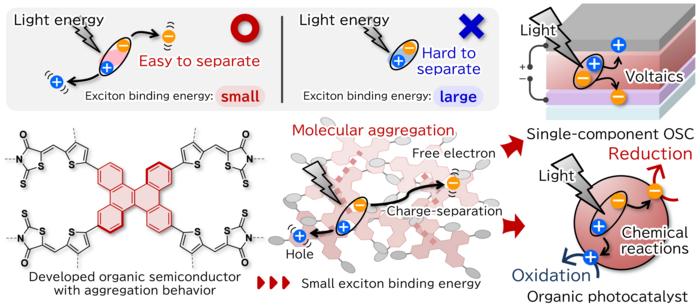
Organic optoelectronic devices, such as organic solar cells, are becoming increasingly sought after for their inherent advantages, e.g., flexibility or light weight. Their performance depends on how well their light-absorbing organic molecules convert light energy into ‘free-charge carriers’, which carry electric current. The energy needed to generate the free-charge carriers is referred to as ‘exciton-binding energy’.
The lower the exciton-binding energy, the easier it is to generate free-charge carriers, and thus the better the device performance. However, we still struggle to design molecules with low exciton-binding energy in a solid state.
Upon deeper inspection, the research team found that the exciton-binding energy of solid materials is affected by how their molecules stack together, which is referred to as aggregation.
“We synthesized two types of similar star-shaped molecules, one with a flexible center and the other with a rigid center,” explains lead author Hiroki Mori. “The individual molecules behaved similarly when they were dispersed in a solution, but quite differently when they were stacked together in thin solid films.”
The difference in behavior is due to the rigid molecules stacking together well, like plates, whereas the flexible molecules do not. In other words, when in a solid state, the rigid molecule has a much lower exciton-binding energy than the flexible molecule. To verify this, the team built a single-component organic solar cell and a photocatalyst using each molecule. The solar cell and photocatalyst made of the rigid molecule showed impressive performance because their low exciton-binding energy led to a high generation of free-charge carriers.
“Our findings, that making molecules that aggregate well can decrease the exciton-binding energy, are really exciting,” says senior author Yutaka Ie. “This could provide us with a new way to design more efficient optoelectronic devices.”
The team’s findings show that the interaction between molecules in a solid is important for device performance, and that the design of molecules for high-performance optoelectronic devices should look beyond individual molecular properties. This new way of decreasing exciton-binding energy could underpin the driving mechanisms and architecture of the next generation of optoelectronic devices.
###
The article, “A Dibenzo[g,p]chrysene-Based Organic Semiconductor with Small Exciton Binding Energy via Molecular Aggregation,” was published in Angewandte Chemie, International Edition at
About Osaka University
Osaka University was founded in 1931 as one of the seven imperial universities of Japan and is now one of Japan’s leading comprehensive universities with a broad disciplinary spectrum. This strength is coupled with a singular drive for innovation that extends throughout the scientific process, from fundamental research to the creation of applied technology with positive economic impacts. Its commitment to innovation has been recognized in Japan and around the world. Now, Osaka University is leveraging its role as a Designated National University Corporation selected by the Ministry of Education, Culture, Sports, Science and Technology to contribute to innovation for human welfare, sustainable development of society, and social transformation.
Website:
Journal
Angewandte Chemie International Edition
Method of Research
Experimental study
Subject of Research
Not applicable
Article Title
A Dibenzo[g,p]chrysene-Based Organic Semiconductor with Small Exciton Binding Energy via Molecular Aggregation
Article Publication Date
12-Jul-2024
Cite Scienmag News
Sloane Callahan. (August 6, 2024). Stacking molecules like plates improves organic solar device performance. Scienmag. https://scienmag.com/stacking-molecules-like-plates-improves-organic-solar-device-performance/
Sloane Callahan. "Stacking molecules like plates improves organic solar device performance." Scienmag, 6 August 2024, https://scienmag.com/stacking-molecules-like-plates-improves-organic-solar-device-performance/. Accessed 4 September 2026.
Sloane Callahan. "Stacking molecules like plates improves organic solar device performance." Scienmag. August 6, 2024. https://scienmag.com/stacking-molecules-like-plates-improves-organic-solar-device-performance/

