


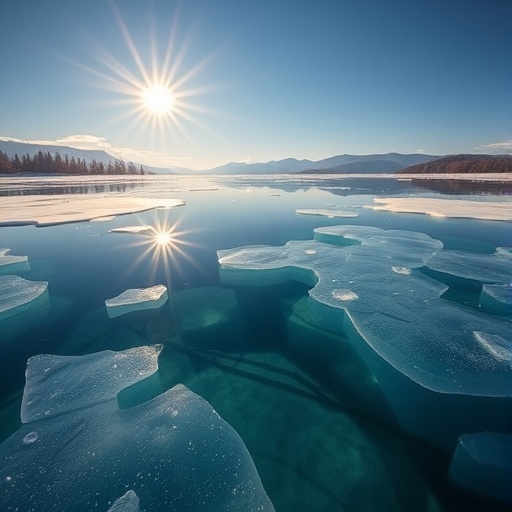
In the serene depths of Lake Akan in Hokkaido, Japan, lies an extraordinary green marvel: the marimo, scientifically known as Aegagropila brownii. This velvety, spherical algae, revered as a Special Natural Monument of Japan, is a living testament to nature’s resilience amid relentless environmental change. Yet beneath its tranquil exterior, marimo endures a perilous struggle each spring—a battle against the harsh interplay of ice melt, biting cold, and intense sunlight that threatens its very ability to photosynthesize, the fundamental process driving its survival.
Lake Akan’s marimo thrives amid dramatically fluctuating seasonal conditions. Throughout the stark winter months, when the lake’s surface remains veiled under a thick ice cover, marimo maintains a steady photosynthetic function despite the frigid temperatures and limited light penetration. This remarkable adaptability highlights the algae’s specialized physiological traits that allow survival under extreme environmental constraints. However, the springtime ushers in a pronounced challenge. As the ice melts and the chilling water remains just above freezing, the returning sunlight intensifies, exposing marimo to a combination of low temperatures and high irradiance—a dual stressor synonymous with photoinhibition.
Photoinhibition refers to the decline in photosynthetic efficiency induced by exposure to excessive light, particularly under conditions where the photosynthetic apparatus is vulnerable, such as low temperature. In marimo, this phenomenon manifests sharply just after the ice recedes in early spring. The algae’s light-harvesting complexes and electron transport chains experience damage, leading to a significant reduction in their photosynthetic capacity. This impairment prevents marimo from harnessing solar energy effectively, posing a critical threat during a period when energy acquisition is essential to kickstart its annual metabolic activity after winter dormancy.
A multidisciplinary research team from Japan’s Astrobiology Center undertook a meticulous investigation to unravel this seasonal photosynthetic vulnerability. Combining comprehensive field measurements with controlled laboratory experiments, the scientists monitored marimo’s photosynthetic performance across distinct seasonal phases. Their approach incorporated chlorophyll fluorescence techniques and oxygen evolution assays, methodologies that sensitively detect the functional state of photosystem II and overall photosynthetic rates, respectively. It was through these precise measurements that they chronicled the trajectory of marimo’s photosynthetic health from ice-covered winter through the alarming depths of spring photoinhibition, and finally to recovery.
The research unveiled that marimo sustains optimal photosynthetic efficiency during the stable conditions of summer and winter beneath thick ice. However, immediately post-ice melt, photosynthetic activity plummets, underscoring the detrimental effects of sudden exposure to intense solar irradiance at low ambient temperatures. This photoinhibitory damage is acute, yet transitory. Over a span of 20 to 30 days, marimo demonstrates a remarkable capacity for physiological repair, gradually restoring its photosynthetic machinery and regaining full photocompetence. This recovery is likely facilitated by the activation of protective mechanisms such as non-photochemical quenching and the synthesis of photoprotective pigments, though further molecular studies are needed to elucidate these processes fully.
From an ecological and conservation perspective, these findings cast spring as the critical bottleneck period when marimo faces its greatest survival risk. The transient decline in photosynthetic ability not only disrupts energy production but may also impair growth rates and reproductive success, influencing population dynamics. Recognizing this vulnerability is essential for conservation strategies aimed at preserving these emblematic algal balls, which also possess cultural significance and contribute to Lake Akan’s unique aquatic ecosystem.
The research, published in the esteemed journal Phycological Research on September 29, 2025, advances our understanding of how environmental factors intersect to affect photosynthetic organisms in cold freshwater ecosystems. It bridges classical plant physiological ecology with contemporary insights into climate-induced stress responses. Moreover, by spotlighting a photosynthetic anomaly triggered specifically by springtime environmental shifts, the study enriches the broader discourse on how climate variability may impact primary producers at the foundation of aquatic food webs.
Beyond its immediate biological implications, this work invites contemplation on the resilience strategies deployed by photosynthetic organisms under fluctuating light and temperature regimes—a subject with far-reaching relevance in photosynthesis research. Marimo’s seasonal photoinhibition-recovery cycle may serve as a natural model system to study the limits of photosynthetic plasticity and adaptive response mechanisms. It underscores the intricate balance photosynthetic systems must maintain to optimize energy capture while mitigating photodamage in dynamic habitats.
The revelation that marimo can rebound from severe springtime photoinhibition also sparks intriguing astrobiological parallels. The capacity to endure and recover from intense light stress under cold conditions could mirror survival strategies of photosynthetic life in extraterrestrial analogs, such as icy moons or polar regions of Mars. Thus, this research extends its significance beyond terrestrial ecology, informing hypotheses on life’s resilience in the broader universe.
Importantly, practical applications of these findings may emerge in environmental monitoring or biomimetic design. Understanding the biochemical and biophysical bases of marimo’s photoinhibition tolerance and recovery could inspire photoprotective technologies or guide management protocols for freshwater habitats under climatic disturbances.
In summary, the springtime interplay of Lake Akan’s changing environment poses a formidable yet temporary challenge to the marimo’s photosynthetic apparatus. The documented pattern of photoinhibition followed by recovery lays bare a nuanced survival strategy finely tuned to seasonal rhythms. This exquisite dance of damage and renewal not only embellishes marimo’s ecological story but also enriches scientific narratives about the resilience and adaptability of photosynthesis—a cornerstone of life.
News Publication Date: 29-Sep-2025
Web References: http://dx.doi.org/10.1111/pre.70013
Cite Scienmag News
Russell Cooper. (September 30, 2025). Spring Sunlight Sparks Photoinhibition and Recovery in Lake Akan Marimo Beneath the Ice. Scienmag. https://scienmag.com/spring-sunlight-sparks-photoinhibition-and-recovery-in-lake-akan-marimo-beneath-the-ice/
Russell Cooper. "Spring Sunlight Sparks Photoinhibition and Recovery in Lake Akan Marimo Beneath the Ice." Scienmag, 30 September 2025, https://scienmag.com/spring-sunlight-sparks-photoinhibition-and-recovery-in-lake-akan-marimo-beneath-the-ice/. Accessed 4 September 2026.
Russell Cooper. "Spring Sunlight Sparks Photoinhibition and Recovery in Lake Akan Marimo Beneath the Ice." Scienmag. September 30, 2025. https://scienmag.com/spring-sunlight-sparks-photoinhibition-and-recovery-in-lake-akan-marimo-beneath-the-ice/


