


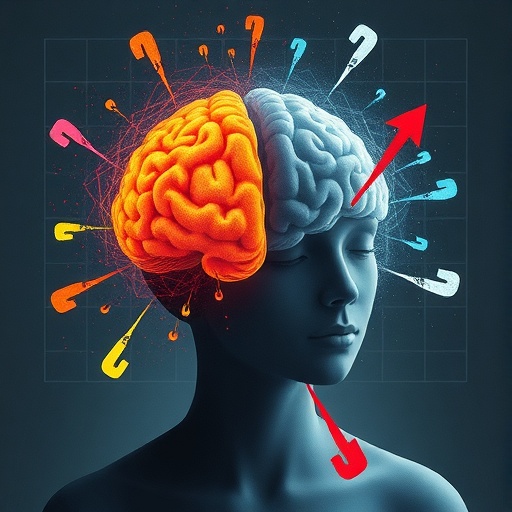
In a groundbreaking study set to reshape our understanding of human emotion and cognition, researchers have unveiled how the ebb and flow of spontaneous thoughts serve as molecular signatures of our inner affective states. The paper by Lux, Lee, Han, and colleagues, published in Communications Psychology in 2026, delves into the dynamic patterns of spontaneous cognition and their tight coupling with positive and negative affectivity.
For decades, scientists have recognized the significance of spontaneous or “mind-wandering” thought processes, yet the intricate ways these mental wanderings reflect—and potentially influence—our emotional experience have remained elusive. This research harnesses advanced computational modeling and neuroimaging data to trace moment-to-moment shifts in spontaneous thought, revealing how their temporal structure acts as a real-time fingerprint of underlying affective tone.
Utilizing a cohort of participants monitored during controlled resting states, the team combined behavioral reports with sophisticated brain scans to quantify spontaneous thought dynamics. They discovered distinct temporal signatures: individuals exhibiting more variable and fluid thought patterns tended to display elevated positive affectivity, whereas those with repetitive, rigid spontaneous thoughts were more aligned with heightened negative affect. These findings suggest that the architecture of our spontaneous thoughts could serve as a biomarker for emotional well-being.
What sets this study apart is its methodological rigor—rather than relying solely on subjective questionnaires or static neural measures, the researchers applied dynamic systems theory to decode the “thought stream” as a complex temporal evolution. By analyzing the velocity, divergence, and recurrence of mind-wandering episodes, the researchers translated qualitative mental phenomena into quantifiable data, bridging a long-standing gap between psychology and computational neuroscience.
The implications of these insights are far-reaching. Beyond enhancing fundamental knowledge of how emotions intertwine with cognition, this work lays the groundwork for developing diagnostic tools that monitor mental health via real-time thought dynamics. It also opens new therapeutic avenues, possibly enabling interventions aimed at reshaping maladaptive thought patterns to foster emotional resilience.
Experts not involved in the study have hailed the findings as a “landmark step toward decoding the brain’s internal narrative.” The ability to characterize emotional states through spontaneous cognition could revolutionize approaches to affective disorders such as anxiety and depression, which are often marked by intrusive, negative rumination.
As neuroscience continues to unravel the invisible threads connecting thought and feeling, this research highlights the promise of integrating computational methods with psychological theory. The team’s pioneering approach suggests that the flow of spontaneous thoughts is far from random; rather, it is a dynamic canvas sculpted by our emotional experiences.
In short, the study by Lux and colleagues is more than an exploration of spontaneous cognition—it is a clarion call to rethink how we measure, understand, and ultimately harness the complex rhythms of the mind for mental health innovation.
Cite Scienmag News
Glenn Wilkins. (July 9, 2026). Spontaneous Thought Patterns Reveal Positive and Negative Emotional States. Scienmag. https://scienmag.com/spontaneous-thought-patterns-reveal-positive-and-negative-emotional-states/
Glenn Wilkins. "Spontaneous Thought Patterns Reveal Positive and Negative Emotional States." Scienmag, 9 July 2026, https://scienmag.com/spontaneous-thought-patterns-reveal-positive-and-negative-emotional-states/. Accessed 3 September 2026.
Glenn Wilkins. "Spontaneous Thought Patterns Reveal Positive and Negative Emotional States." Scienmag. July 9, 2026. https://scienmag.com/spontaneous-thought-patterns-reveal-positive-and-negative-emotional-states/


