


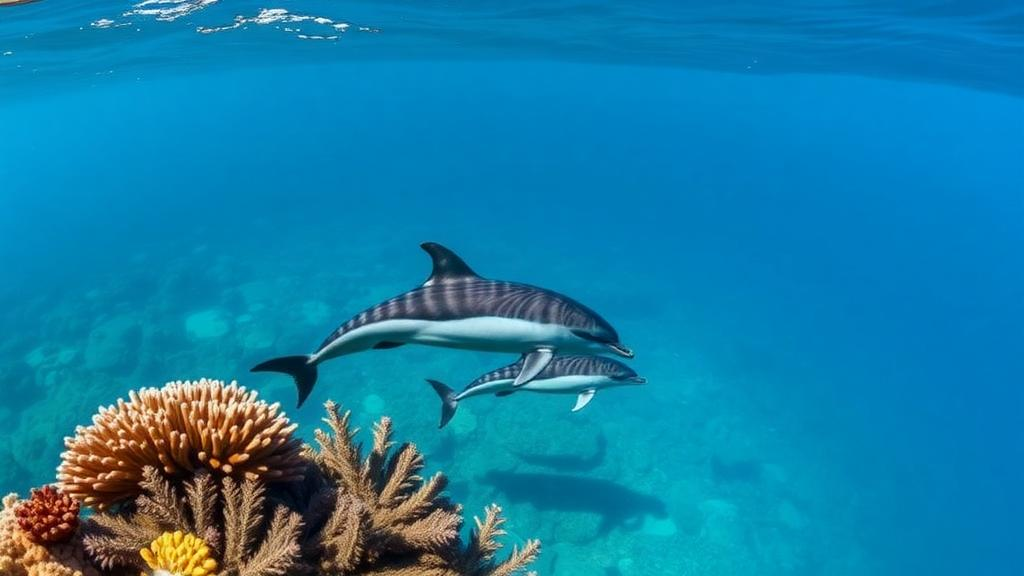
In the shallow, sunlit waters between the Hawaiian islands of Maui, Lāna’i, Moloka’i and Kaho’olawe, spinner dolphins spend their days resting, socializing and avoiding predators. Every night, they slip offshore to hunt fish, squid and shrimp in the deep scattering layers of the open ocean. That daily commute, researchers now suggest, may do far more than keep the dolphins fed. According to a new study published in Frontiers in Mammal Science, the dolphins appear to act as living nutrient pumps, carrying nitrogen harvested from pelagic foraging grounds back to the coral reefs they shelter over by day — a mechanism the authors have dubbed “the dolphin tap.”
The research, led by Grace L. Olson of the Pacific Whale Foundation together with Shannon M. Barber-Meyer and Jens J. Currie, set out to quantify something marine ecologists have long suspected but rarely measured for small cetaceans: whether dolphins, like their giant baleen cousins, can fertilize coastal ecosystems. Large whales are well documented as “nutrient vectors” — they feed at depth and release nutrient-rich fecal plumes and urine near the surface, where reduced hydrostatic pressure and higher metabolism make waste release more likely. That process, known as the whale pump, delivers bioavailable nitrogen such as ammonium to sunlit waters, stimulating the growth of phytoplankton at the base of the marine food web. Whether smaller dolphins perform a comparable service has remained largely untested.
Hawaiian spinner dolphins are unusually well suited to the role. Unlike many oceanic dolphin populations, the spinner dolphins of the main Hawaiian Islands are island-associated and genetically distinct from other Pacific populations. Their behavior follows a rigid daily rhythm: nocturnal foraging on a mesopelagic boundary community of small fish, squid and shrimp that migrates vertically and horizontally through the night, sometimes rising to within 100 meters of the surface, followed by daytime rest in sheltered, sandy-bottomed bays where they can visually detect sharks and other predators. Previous work has shown the dolphins cooperatively hunt this boundary prey community between roughly 1 and 8 kilometers from shore, diving to depths of up to 150 meters. Because they forage deep and rest shallow, every day spent inshore represents a net movement of nutrients from the open ocean into coastal waters.
To put numbers on the phenomenon, the team drew on nearly a decade of vessel-based survey data collected between February 2013 and November 2022. Over 429 surveys covering 57,300 kilometers of track line, the researchers recorded 51 encounters with spinner dolphin groups in the Maui Nui region, with encounter durations ranging from 3 to 98 minutes and a mean of 41 minutes. Group sizes ranged from 3 to roughly 200 animals, averaging 65.4 individuals. By overlaying the GPS tracks of each encounter onto geospatial maps of coral reef habitat derived from NOAA benthic surveys, the team could calculate how much of the dolphins’ daytime was actually spent above reef.
Because a research vessel’s position is only a proxy for where the dolphins actually are, the researchers buffered each track segment by the estimated spread of the dolphin group, derived from visual estimates collected between 2013 and 2016. A bootstrap analysis of 100,000 iterations yielded a median group spread of about 276 meters, and the team tested the sensitivity of their results across the 25th, 50th and 75th percentile buffer distances. The result: 25 of the 51 encounters overlapped mapped coral reef habitat around Maui and Lāna’i, and dolphins spent roughly 28 percent of their total observed time over reef — with individual encounters ranging from 1 to 60 minutes above coral.
The next step was metabolic. Using standard bioenergetic models, the researchers estimated that an adult spinner dolphin weighing about 58.5 kilograms consumes roughly 5 kilograms of prey per day. Scaling basal metabolic rate by a field metabolic multiplier, accounting for an 80 percent assimilation efficiency, a diet of roughly 7 percent crustaceans, and a prey nitrogen content of 2.5 percent, they calculated that a single dolphin deposits about 0.10 kilograms of nitrogen into the marine environment every day — around 36.6 kilograms per year. Uncertainty was propagated through a Monte Carlo simulation with 100,000 iterations, since no direct measurements of spinner dolphin field metabolic rate or prey nitrogen content exist for Hawaiian waters.
Restricting the calculation to daylight hours, when the dolphins actually rest over reefs, produced more conservative figures. A single dolphin was estimated to deposit between 0.01 and 0.02 kilograms of nitrogen per day over coral reef habitat, depending on how much of its nighttime deposition was assumed to occur inshore. Scaled up, that translates to roughly 340 kilograms of nitrogen per year from an average-sized group, and — using an illustrative population estimate of 594 dolphins from recent surveys around O’ahu — between about 3,100 and 4,600 kilograms of nitrogen per year reaching Maui Nui’s reefs. For comparison, a similar study in the Indian Ocean estimated that spinner dolphin groups in the Chagos and Maldives archipelagos contribute 288 to 1,294 kilograms of nitrogen annually to atoll lagoons.
Why does this matter for corals? Hawaiian reefs sit in some of the most nutrient-poor waters in the Pacific Ocean, and corals there depend heavily on their symbiotic zooxanthellae algae to scavenge scarce nitrogen and phosphorus. Yet a growing body of research suggests that not all nutrients are equal. Animal-derived nitrogen, delivered in episodic pulses as ammonium, appears to enhance coral growth, bolster the coral-algal mutualism, and even reduce susceptibility to bleaching and speed recovery afterward. Continuous, human-mediated nutrient inputs — typically nitrates from agricultural and urban runoff — tend to do the opposite, fueling macroalgal blooms and eutrophication that smother reefs. The punctuated, spatially scattered nature of dolphin deposition may therefore be exactly the kind of subsidy reefs evolved to exploit.
The timing of dolphin movements may amplify the effect. Spinner dolphins in Maui Nui travel between the four islands, potentially distributing nutrients across multiple reef communities rather than concentrating them in one place. Shore-based surveys at Hulopo’e Bay on Lāna’i, analyzed as part of the study, found dolphins present during 62 of 124 survey days, averaging about an hour per visit — a pattern of brief, repeated visits that mirrors the pulsed nutrient delivery corals favor. The dolphins’ inshore habitat use also overlaps mesophotic reefs and macroalgal assemblages deeper than 30 meters, which satellite mapping cannot capture but which may likewise benefit from dolphin-borne nutrients. In Brazil, reef fish have even been documented opportunistically feeding on spinner dolphin feces and vomit, hinting at additional trophic shortcuts that could speed nutrient transfer in Hawaiian waters too.
The conservation implications are stark. Spinner dolphins off Hawai’i Island are exposed to human activity for more than 82 percent of the day — among the highest rates recorded for any cetacean — and chronic disturbance from swim-with-dolphin tourism can displace them from preferred resting areas. NOAA introduced a 50-yard approach limit in 2021, but the dolphins remain vulnerable to vessel traffic, entanglement, marine debris, noise pollution and, increasingly, climate-driven stressors including wildfire runoff that followed the 2023 Maui fires. Because the number of nutrient vectors scales directly with population size, any decline in spinner dolphin numbers would shrink the dolphin tap in proportion. With Hawaiian coral reefs already battered by mass bleaching events in 2014, 2015 and 2019, and reef habitats contributing an estimated 360 million dollars annually to the local economy, the authors argue that protecting spinner dolphins is not just a matter of species conservation — it is ecosystem maintenance. The dolphins, they suggest, should be managed not merely as charismatic wildlife but as functional components of the reef itself, quietly pumping life into waters that would otherwise run on empty.
Subject of Research: Nutrient transfer from spinner dolphins to coral reef ecosystems in Maui Nui, Hawai'i
Article Title: The dolphin tap: assessing the ecosystem role of spinner dolphins in supplying nutrients to coral reefs in Maui Nui, Hawai’i
Article References: The dolphin tap: assessing the ecosystem role of spinner dolphins in supplying nutrients to coral reefs in Maui Nui, Hawai’i. (n.d.). https://doi.org/10.3389/fmamm.2025.1712553
Image Credits: AI Generated
DOI: 10.3389/fmamm.2025.1712553
Keywords: spinner dolphins, coral reefs, nutrient transfer, Maui Nui, Hawai'i, nitrogen deposition, whale pump, marine ecology, ecosystem services, cetacean conservation, mesopelagic foraging, coral bleaching
Cite Scienmag News
Gavin Prescott. (October 16, 2026). Spinner dolphins may be quietly fertilizing Hawaii’s coral reefs, study finds. Scienmag. https://scienmag.com/spinner-dolphins-may-be-quietly-fertilizing-hawaiis-coral-reefs-study-finds/
Gavin Prescott. "Spinner dolphins may be quietly fertilizing Hawaii’s coral reefs, study finds." Scienmag, 16 October 2026, https://scienmag.com/spinner-dolphins-may-be-quietly-fertilizing-hawaiis-coral-reefs-study-finds/. Accessed 16 October 2026.
Gavin Prescott. "Spinner dolphins may be quietly fertilizing Hawaii’s coral reefs, study finds." Scienmag. October 16, 2026. https://scienmag.com/spinner-dolphins-may-be-quietly-fertilizing-hawaiis-coral-reefs-study-finds/


