


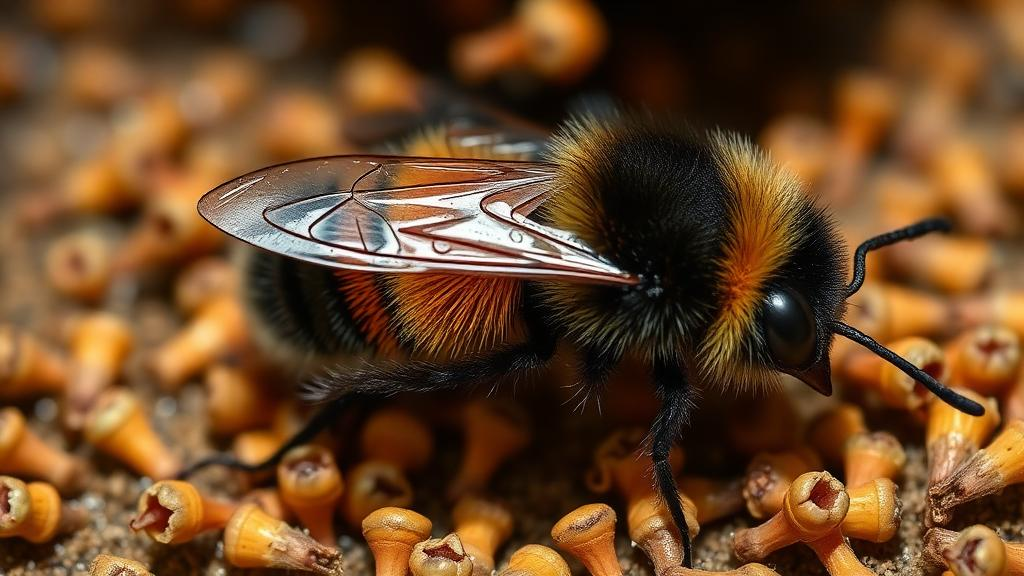
When a bumblebee steps out of its nest on a cold morning or huddles over warm brood on a hot afternoon, the trillions of bacteria lining its gut ride along through every temperature swing. Those bacteria are not casual passengers. They help the bee digest pollen, synthesize nutrients, and fend off intestinal parasites, and they have shared an evolutionary history with their hosts so long that some of them exist nowhere else on Earth. A new controlled experiment suggests that this partnership is far more resilient to heat and cold than many scientists expected, offering a rare piece of good news for pollinators in a warming world.
The study, led by Nuria Blasco-Lavilla and colleagues at the University of Murcia in Spain and published in Frontiers in Insect Science, set out to answer a deceptively simple question: does a short burst of environmental temperature stress scramble the gut microbiota of the buff-tailed bumblebee, Bombus terrestris? The stakes are considerable. As climate change pushes both average temperatures and the frequency of transient extremes upward, ectothermic insects like bees have no internal mechanism to shield their physiology from the environment. If their microbial mutualists were thermally fragile, the bees could lose functions they depend on precisely when they need them most.
Previous research has shown just how vulnerable insect symbioses can be. Stinkbugs maintained at 30 degrees Celsius lost the gut symbionts required for survival at 23 degrees, sometimes within a single generation. Four weeks of heat treatment depleted an obligate bacterial symbiont by 99 percent in two ant species, and continuous exposure to 35 degrees nearly wiped out the bacteriocyte-dwelling symbionts of the whitefly Bemisia tabaci. Obligate symbionts are especially at risk because long coevolution has stripped their genomes down to essential genes, leaving them reliant on the host and prone to accumulating deleterious mutations that translate into proteins with reduced thermal tolerance. Against this backdrop, the expectation for bees was grim.
Yet social bees are a special case. Their guts host a highly specialized microbiota built from five core clades: Gilliamella, Snodgrassella, Lactobacillus, Bombilactobacillus and Bifidobacterium. These bacteria support nutrition and pathogen defense but are not strictly necessary for survival, and they are transmitted horizontally through the fecal-oral route between nestmates. Social bees also thermoregulate their nests, clustering around brood to generate metabolic heat, fanning warm air away, and spreading water for evaporative cooling. The team hypothesized that this nest buffering might protect resident bacteria, and that workers isolated from the colony in small microcolonies would show greater microbiota disruption under the same thermal stress.
The experimental design was elegant in its simplicity. Six young colonies obtained from a commercial supplier were maintained at 28 degrees Celsius and 60 percent humidity. From each colony, two groups of four workers were placed into microcolonies to test the buffering effect of colony thermoregulation. Colonies and their microcolonies were then assigned to one of three treatments: heat at 38 degrees, cold at 9 degrees, or control at 28 degrees, all well within the range of temperatures the species encounters in its natural habitat. After five days of exposure, all bees were returned to 28 degrees for five additional days to assess whether any microbiota changes could be restored. Workers were sampled at three time points: before treatment, after thermal stress, and after recovery.
Guts were extracted aseptically and DNA was amplified across the V3-V4 region of the 16S rRNA gene, then sequenced on an Illumina MiSeq platform. Bioinformatic processing with cutadapt, PEAR and VSEARCH yielded 558,906 reads clustered into 60 operational taxonomic units at 99 percent similarity, with taxonomic assignments made against the BEExact database using the IDTAXA algorithm. The resulting communities were dominated by Lactobacillaceae at 46.7 percent, Neisseriaceae at 23.9 percent, Orbaceae at 19.9 percent, Weeksellaceae at 4.7 percent and Burkholderiaceae at 4 percent. Notably, Bifidobacteriaceae reads, including the core genus Bifidobacterium, were present in the raw dataset but fell below the 0.5 percent relative abundance threshold and were excluded from downstream analyses.
The statistical results were nuanced. A two-way permutational analysis of variance on control workers showed that the colony environment significantly shaped microbiota composition, explaining 34 percent of the variation, while the time of collection did not. When the full dataset was analyzed, temperature treatment had a significant effect on workers during the stress phase, with an F-value of 2.16 and a p-value of 0.026, but not after the recovery period. Post-hoc pairwise comparisons revealed that heat stress showed a numerically greater effect than cold stress, though neither reached statistical significance after adjustment. Alpha diversity, measured with the Shannon index, was lowest in microcolony workers during recovery, but the difference between microcolony and colony workers was not significant.
Differential abundance analysis with ANCOM-BC identified two taxa that shifted under heat exposure: Schmidhempelia spp. decreased significantly, while Limosilactobacillus spp., represented by a single strain of Lactobacillus reuteri, increased. Both genera appeared at low relative abundances and without a clear pattern across samples, and the authors caution that comparisons were based on only four workers per group. In microcolony workers during recovery, Schmidhempelia spp. were significantly more abundant than in colony workers, and strain-level analysis showed that five Lactobacillus strains and one Gilliamella strain decreased in microcolonies while one Schmidhempelia strain, one Bombilactobacillus bombi strain and three unclassified Lactobacillaceae strains increased.
The authors suggest that the robustness of the bumblebee microbiota to temperature stress is best explained by the thermal gauntlet the bacteria already run in nature. Within the bee body, symbionts experience cold when hosts forage or when queens hibernate, and heat when workers and queens incubate larvae and pupae by elevating their abdominal temperature atop brood structures. In vitro studies have shown that strains of Snodgrassella, Gilliamella and Lactobacillus can still grow at 40 degrees Celsius and show better growth rates at temperatures above those typically reached in bumblebee nests. Horizontal transmission adds another layer: bacteria can be directly exposed to environmental temperatures during ex vivo phases outside nests, and their capacity for recombination and horizontal gene transfer preserves the evolutionary potential that obligate symbionts have lost.
Perhaps the most intriguing finding concerns the colony environment itself. Although thermoregulation did not protect endosymbionts from thermal stress as hypothesized, ten days without contact with the origin colony significantly altered microcolony workers’ microbiota, reducing alpha diversity and shifting strain abundances. Previous studies have shown that colony contact is required for bumblebees and honey bees to develop a complete gut microbiota, and this study extends that principle to maintenance. It appears that continuous ingestion of endosymbionts from contaminated colony surfaces is necessary to keep microbiota diversity intact. The authors conclude that worker gut microbiota composition is stable under short-term cold and heat exposure, but they emphasize that longer periods of stress, larger sample sizes and individual-level analyses will be needed to confirm these patterns and to explore how environmental temperature affects the establishment of bumblebee microbiotas in the first place.
Subject of Research: Short-term temperature fluctuations show minimal effects on worker gut microbiota in Bombus terrestris under controlled conditions
Article Title: Short-term temperature fluctuations show minimal effects on worker gut microbiota in Bombus terrestris under controlled conditions
Article References: Short-term temperature fluctuations show minimal effects on worker gut microbiota in Bombus terrestris under controlled conditions. (n.d.). https://doi.org/10.3389/finsc.2026.1867923
Image Credits: AI Generated
DOI: 10.3389/finsc.2026.1867923
Keywords: Short-term, temperature, fluctuations, show, minimal, effects, worker, microbiota, Bombus, terrestris, under, controlled
Cite Scienmag News
Morgan Morrow. (October 16, 2026). Short-term temperature fluctuations show minimal effects on worker gut microbiota in Bombus terrestris under controlled conditions. Scienmag. https://scienmag.com/short-term-temperature-fluctuations-show-minimal-effects-on-worker-gut-microbiota-in-bombus-terrestris-under-controlled-conditions/
Morgan Morrow. "Short-term temperature fluctuations show minimal effects on worker gut microbiota in Bombus terrestris under controlled conditions." Scienmag, 16 October 2026, https://scienmag.com/short-term-temperature-fluctuations-show-minimal-effects-on-worker-gut-microbiota-in-bombus-terrestris-under-controlled-conditions/. Accessed 16 October 2026.
Morgan Morrow. "Short-term temperature fluctuations show minimal effects on worker gut microbiota in Bombus terrestris under controlled conditions." Scienmag. October 16, 2026. https://scienmag.com/short-term-temperature-fluctuations-show-minimal-effects-on-worker-gut-microbiota-in-bombus-terrestris-under-controlled-conditions/


