


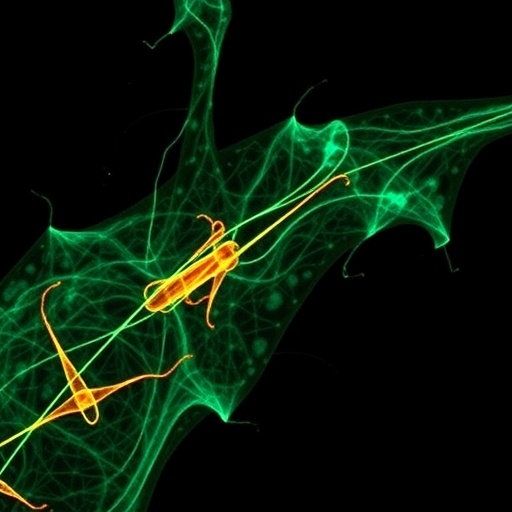
A groundbreaking study published in Nature in 2025 has unraveled the complex cellular ecosystem underlying Crohn’s disease-associated fistulae, providing remarkable insights into the spatial organization and signaling dynamics that fuel these debilitating lesions. By leveraging cutting-edge spatial transcriptomics and multiplex imaging, researchers have mapped the intricate interplay between immune cells, fibroblasts, and vasculature within the fistula tracts, revealing a previously unappreciated choreography of immune-stromal interactions that drive tissue invasion and chronicity.
The analysis reveals that neutrophils and macrophages congregate along non-epithelialized surfaces of the fistula, demarcating zones of superficial granulation tissue. These zones are dominated by SPP1-positive macrophages that produce a suite of chemokines, including CXCL5, CCL3, CCL4, and CXCL2, establishing a feed-forward loop for sustained recruitment of inflammatory cells. Such chemokine-mediated signaling orchestrates an inflammatory milieu that perpetuates tissue damage and complicates resolution, confirming the centrality of innate immune components in early fistula pathology.
Beyond the superficial layers, the study identifies spatially defined strata rich in FAS-LAZ and FAS-ALC fibroblasts, cohabited by MMP9-expressing macrophages with dual remodeling and immunoregulatory capacities. These macrophages express genes such as LYZ, IDO1, C1QA/B, MRC1, and STAT1, indicating a complex phenotype that simultaneously reshapes the extracellular matrix (ECM) and modulates immune responses. Notably, another macrophage cluster in this region produces T cell-attracting chemokines (CXCL9, CXCL10, and CXCL11), suggesting a critical role for these cells in bridging innate and adaptive immunity within fistula tracts.
This chemokine production correlates with the presence of diverse adaptive immune subsets, including CD8+, CD4+, regulatory T cells, dendritic cells, and B cells. The occasional formation of follicle-like aggregates alongside FAS-LOC fibroblasts hints at the emergence of tertiary lymphoid structures, an indication of chronic immune activation and local antigen-driven responses. Such organized lymphoid assemblies could contribute to persistent inflammation and resistance to healing, underscoring the multifaceted nature of immune involvement in fistula evolution.
In more distal zones enriched in FAS-FOZ fibroblasts, immune cell infiltration diminishes markedly, replaced instead by proliferative signatures in endothelial cells and pericytes. This observation testifies to ongoing angiogenesis and vascular remodeling in these regions, processes that are essential for supporting the expanding tissue mass of the fistula tract. The interplay between fibroblast niches and vascular components thus appears to orchestrate the spatial heterogeneity within the lesion, balancing inflammation with tissue reconstruction.
The spatial intercellular signaling landscape of fistulae, as revealed in this study, is defined by robust cytokine–chemokine networks and pathways underpinning angiogenesis, ECM remodeling, and cell adhesion. Fibroblast–macrophage communication emerges as a key axis, featuring molecular interactions such as LRP1-MMP9 and SERPINE1 that regulate ECM turnover, integrin-TGFB1 and SPP1-mediated fibrotic signaling, alongside PDGFRB-driven proliferation signals. The engagement of SPP1-CD44 pairs highlights mechanisms of fibroblast activation critical for the persistent fibrotic state characteristic of fistula tracts.
Strikingly, developmental morphogen pathways also appear hijacked within these niches. The expression of WNT family members WNT2, WNT4, and WNT5A, along with Frizzled receptors, is markedly upregulated in FAS fibroblast subsets. Of particular note is the enrichment of WNT4 and planar cell polarity (PCP) components such as CELSR1 and DVL1 at the invasive leading edges of fistula tracts. This aberrant activation of PCP and related morphogen signaling links directly to invasiveness and proliferative expansion characteristic of pathogenic fibroblast populations.
The identification of actively cycling MKI67-positive fibroblasts at these leading edges further supports the idea that dysregulated morphogen signaling fuels cellular proliferation and tissue invasion, promoting fistula persistence. These findings provide a compelling mechanistic framework that connects developmental signaling pathways, immune activation, and stromal remodeling in a spatially resolved manner, offering new avenues for targeted therapeutic intervention.
Collectively, the data portray a dynamic, multicellular ecosystem within Crohn’s fistulae, where immune-stromal cross-talk is not merely a reaction to injury but a driving force shaping lesion architecture and chronicity. The integrated use of spatial transcriptomics combined with detailed cellular phenotyping uncovers the emergent properties of these niches that cannot be discerned through bulk analyses, marking a significant leap forward in understanding fistula pathogenesis.
Future therapeutic strategies informed by these insights might aim to disrupt harmful immune-fibroblast signaling loops, modulate aberrant morphogen pathways such as WNT-PCP, and restore normal ECM remodeling dynamics. The spatially delineated checkpoints of cellular interaction emerging from this study provide multiple potential molecular targets to halt fistula progression and promote resolution, moving towards precision medicine in inflammatory bowel disease complications.
This landmark research not only deciphers the microenvironmental complexity of Crohn’s fistulae but also underscores the critical importance of spatial context in disease biology. By capturing the interplay between innate and adaptive immunity, fibroblast heterogeneity, and vascular remodeling within an anatomically defined framework, the study sets the stage for next-generation diagnostics and therapies tailored to the intricate cellular topography of chronic lesions.
As Crohn’s disease continues to impose significant clinical burdens worldwide, these revelations offer renewed hope that unraveling spatial tissue niches will lead to breakthroughs in managing fistula-associated morbidity. The intersection of immune dysregulation, stromal plasticity, and developmental pathway misappropriation now emerges as a cardinal theme in fistula biology, spotlighting the need for integrated, spatially informed approaches in inflammatory disease research.
Cite Scienmag News
Denise Maddox. (November 13, 2025). Spatial Fibroblast Niches Drive Crohn’s Fistulae. Scienmag. https://scienmag.com/spatial-fibroblast-niches-drive-crohns-fistulae/
Denise Maddox. "Spatial Fibroblast Niches Drive Crohn’s Fistulae." Scienmag, 13 November 2025, https://scienmag.com/spatial-fibroblast-niches-drive-crohns-fistulae/. Accessed 3 September 2026.
Denise Maddox. "Spatial Fibroblast Niches Drive Crohn’s Fistulae." Scienmag. November 13, 2025. https://scienmag.com/spatial-fibroblast-niches-drive-crohns-fistulae/


