

In an innovative breakthrough, the Spectroscopy Group at the University of the Basque Country (EHU) and the Biofisika Institute (CSIC/EHU) have meticulously unraveled the nuanced interactions between chiral molecules and water at the molecular level. This research is particularly focused on prolinol, a chiral catalyst integral to asymmetric synthesis, recognized for its dynamic conformational behavior when interacting with water molecules. By combining ultra-high-resolution rotational spectroscopy with theoretical computations and solution-phase studies via nuclear magnetic resonance (NMR) and molecular simulations, the team has connected isolated molecular behavior to intricate processes occurring in solution.
Physical chemistry, the backbone of this investigation, hinges on applying physical principles to dissect chemical reactions and molecular transformations. At the heart of their research lies the understanding of microsolvation—the addition of individual water molecules—to capture transient, yet influential, changes in molecular configuration. Chiral molecules, characterized by their non-superimposable mirror images analogous to right and left hands, exemplify complexity in molecular recognition and catalysis. Grasping how these molecules interact with water unveils critical insights relevant across chemistry and biology.
Prolinol serves as an exemplary model molecule due to its bifunctional nature, comprising both alcohol and amine groups. These functionalities establish strong hydrogen-bonding networks with water, underpinning the molecule’s flexibility and capacity for conformational variation. The group’s investigation explored systematically how prolinol’s conformations alter with the incremental addition of one, two, and three water molecules. This stepwise hydration revealed that even minimal hydration can induce profound conformational switching, which contradicts the previously held notion that water acts solely as a passive solvent.
Their findings underscore water’s active role in molecular structure modulation. Remarkably, the presence of just a few water molecules prompts prolinol to adopt conformations otherwise considered energetically unfavorable in isolated or bulk solvent environments. This water-mediated conformational switching is critical because molecular shape dictates reactivity, interaction specificity, and functionality in chemical and biological systems. The research decisively links microscopic solvation phenomena with macroscopic chemical behavior, opening doors to understanding solvent effects at an unprecedented resolution.
The research methodology leveraged ultra-high-resolution rotational spectroscopy, capable of capturing the rotational spectra of isolated molecules with remarkable precision. This allowed direct observation of specific molecular conformers and their hydration complexes without interference from surrounding bulk solvents. Complementing this, theoretical simulations and NMR experiments in solution offered dynamic perspectives, bridging experimental observations with computational predictions. This comprehensive approach ensured robustness and nuanced interpretation of hydration’s influence on molecular conformation.
Beyond basic scientific intrigue, the implications of this study extend into practical applications. Prolinol is widely utilized as both a catalyst and building block in synthetic chemistry, especially in asymmetric catalysis where chirality dictates product outcome. Understanding how hydration influences its conformational landscape aids in optimizing catalytic efficiency and selectivity. Moreover, this work models how chiral molecules might behave in biological environments, where water is ubiquitous and critical in driving function and interactions.
The study also speaks to broader principles in molecular recognition and chemical reactivity. Observing that water acts as a “conformational switch” alters how chemists conceptualize solvation effects, emphasizing the solvent’s integral role rather than a mere background medium. It suggests that nuanced solvent interactions must be considered when designing catalysts, drugs, or materials, particularly those reliant on subtle stereochemical features.
Collaborations with institutions such as King’s College London, the University of Virginia, the Institute of General Organic Chemistry (IQOG-CSIC) in Madrid, and the University of La Rioja enriched the research through interdisciplinary expertise and shared resources. This synergy boosted the study’s capacity to address complex questions surrounding chiral microsolvation, supported by diverse analytical techniques and theoretical frameworks.
The broader scientific community stands to gain from these insights. The methodology exemplifies how combining multiple experimental techniques with advanced simulations can elucidate molecular phenomena previously obscured in ensemble measurements. It’s an emergent paradigm in physical chemistry that enables scientists to dissect molecular behavior with unprecedented clarity, accelerating discovery across chemistry and biophysics.
Emilio J. Cocinero, principal investigator, highlighted the relevance of focusing on only a few solvent molecules to extrapolate behaviors extending into solution chemistry. This level of detail demystifies the continuum from isolated molecules to bulk phase processes, anchoring theoretical models in experimental reality. Such foundational understanding is invaluable for fields ranging from catalysis design to drug development and biomolecular engineering.
In conclusion, this research elegantly demonstrates that water’s role transcends mere solvation, actively dictating molecular conformations and thereby influencing chemical function. The controlled study of microsolvated chiral molecules like prolinol establishes a new benchmark for investigating solute–solvent interplay, promising transformative impacts across multiple scientific disciplines. As scientific tools evolve, such detailed explorations pave the way for rational design and manipulation of molecular systems with tailored properties, grounded in a profound grasp of molecular mechanics at the solvent interface.
Subject of Research: The interactions and conformational changes of chiral prolinol molecules under stepwise hydration with a few water molecules.
Article Title: Stepwise Hydration Reveals Conformational Switching in Chiral Prolinol
News Publication Date: 11-Dec-2025
Web References:
- Spectroscopy Group: http://grupodeespectroscopia.es/MW/
- Emilio J. Cocinero: https://grupodeespectroscopia.es/MW/emilio-cocinero-cv/
- Biofisika Institute: https://www.biofisika.org/en
- Spanish Biophysical Society (highlight): https://sbe.es/highlights-paper-dic-2025/
- Article DOI: http://dx.doi.org/10.1021/jacs.5c13582
References:
- Journal of the American Chemical Society, DOI: 10.1021/jacs.5c13582
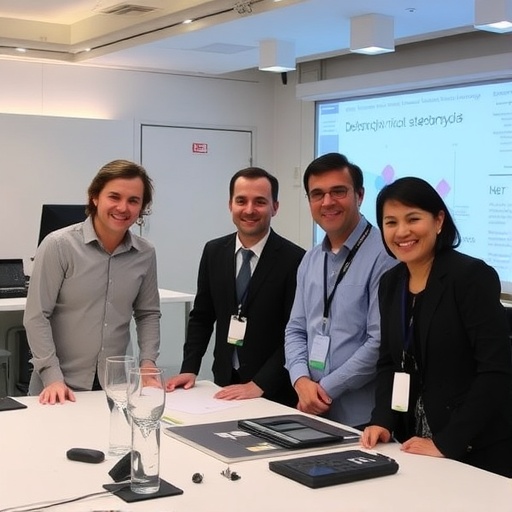
Image Credits: Laura López (From left to right: Aran Insausti, Emilio J. Cocinero, Andrea Vázquez, Jiarui Ma, and Francisco J. Basterretxea, members of the Spectroscopy Group at the University of the Basque Country and the Biofisika Institute microwave section)
Keywords
Physical sciences, Chemistry, Chemical processes, Chemical synthesis, Organic synthesis, Asymmetric catalysis, Biophysics, Spectroscopy


