


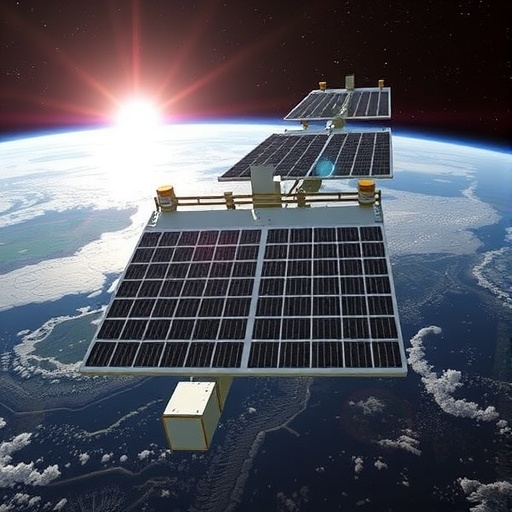
Space-based solar power (SBSP) has emerged as a revolutionary concept that holds the potential to transform Europe’s energy landscape significantly. A groundbreaking study led by researchers from King’s College London suggests that the deployment of SBSP could drastically reduce the European reliance on traditional, land-based renewable energy sources by an astonishing 80%. With ambitious targets aimed at achieving net-zero emissions by 2050, the implications of this research are vast and carry notable importance for Europe’s energy policy and strategy.
For the first time, researchers have quantitatively assessed the prospective impact of harnessing solar energy from outer space specifically for Europe. The research highlights that utilizing space-based solar power could substantially alleviate the demand for battery storage solutions, potentially diminishing that need by over two-thirds. This revelation indicates a monumental shift away from the limiting factors that present-day terrestrial renewable installations confront.
Published in the esteemed journal Joule, the study focuses on a design conceptualized by NASA for solar energy generation expected to be operational by 2050. The findings are revolutionary, demonstrating that the integration of such a system could lead to an overall cost reduction of about 15% across the entirety of Europe’s power system. This includes not only the costs associated with energy generation but also those tied to storage infrastructure and network systems, translating to significant annual savings, estimated to be around 35.9 billion euros.
The current research stands as the first to systematically explore the practicality and potential economic viability of space-based solar technology when applied to the European energy grid. By providing a detailed cost estimation for this technology in the context of Europe, it sets a precedent for further explorations into alternative energy methodologies that could substantially bolster the continent’s sustainability efforts.
Professor Wei He, the lead author of the paper and a senior lecturer in the engineering department at King’s College London, emphasized the importance of their findings. He asserts that this research illustrates, for the first time, the profound advantages such technological advancements could yield for Europe. While the feasibility of SBSP systems continues to be evaluated, the study underlines a compelling case for significant economic and environmental benefits should the technology be adopted widely.
The transition to net-zero emissions by 2050 necessitates an unprecedented shift toward renewable energy resources. The challenges are not only technical but also involve scaling the required infrastructural investments and keeping pace with the rapid pace of innovation in energy technologies. The implementation of space-based solar power could play a pivotal role in overcoming some of these barriers by offering a steady, reliable source of energy.
One of the standout advantages of solar energy captured in space is its resilience against terrestrial challenges. Unlike conventional solar power systems, which can be obstructed by cloud cover or adverse weather conditions, space-based systems operate in an environment free from such atmospheric interferences. Furthermore, they are not prone to natural disasters like floods or earthquakes, which can severely disrupt energy infrastructure on Earth.
The RD1 design, which has been subject to extensive analysis within this study, represents one of two significant designs for space-based solar power systems proposed by NASA. These designs aim to facilitate the continuous collection of solar energy in space, free from the limitations posed by planetary conditions. By deploying large solar panels on satellites in orbit, these systems can harness solar energy continuously, converting it into a stable electrical output that is subsequently transmitted to ground stations for distribution within the energy grid.
Considering the technological intricacies involved, potential hurdles in implementation will require collaborative efforts across scientific disciplines, regulatory frameworks, and public-private partnerships. These elements will be critical in accelerating the development of space-based solar power projects and integrating them into the existing energy structures. This coordinated approach could help to foster an ecosystem conducive to rapid advancements in energy technology.
Moreover, public opinion and policy will play critical roles in shaping the trajectory of space-based solar power development. Stakeholders will need to engage with communities to raise awareness of the benefits of SBSP and to address any concerns regarding the implications of deploying technologies that operate outside Earth’s atmosphere. Building a consensus around this emerging technology will be vital to rallying support for investments and exploratory research required to make space-based solar a reality.
It is important to underscore that while the findings of this research are promising, further studies are required to fully explore the technical, economic, and environmental implications of a large-scale rollout of space-based solar technology. As researchers delve deeper into this field, they will need to address questions surrounding feasibility, investor confidence, and long-term sustainability of such systems.
In conclusion, the research conducted by King’s College London signals a new frontier in renewable energy generation. Space-based solar power has the potential to not only contribute to achieving Europe’s net-zero goals but also transform the very foundation of energy sourcing. As urgency mounts around climate change and sustainability, the prospect of harnessing solar energy directly from space showcases the innovative steps humanity is capable of taking toward a more sustainable future.
Keywords
Space-based solar power, renewable energy, net-zero emissions, energy storage, climate change, sustainability, solar panels, NASA, European energy system, solar energy transmission, technological innovation, energy policy.
Cite Scienmag News
Faith Mcneil. (August 21, 2025). Space-Based Solar Panels Could Slash Europe’s Renewable Energy Requirements by 80%. Scienmag. https://scienmag.com/space-based-solar-panels-could-slash-europes-renewable-energy-requirements-by-80/
Faith Mcneil. "Space-Based Solar Panels Could Slash Europe’s Renewable Energy Requirements by 80%." Scienmag, 21 August 2025, https://scienmag.com/space-based-solar-panels-could-slash-europes-renewable-energy-requirements-by-80/. Accessed 3 September 2026.
Faith Mcneil. "Space-Based Solar Panels Could Slash Europe’s Renewable Energy Requirements by 80%." Scienmag. August 21, 2025. https://scienmag.com/space-based-solar-panels-could-slash-europes-renewable-energy-requirements-by-80/


