


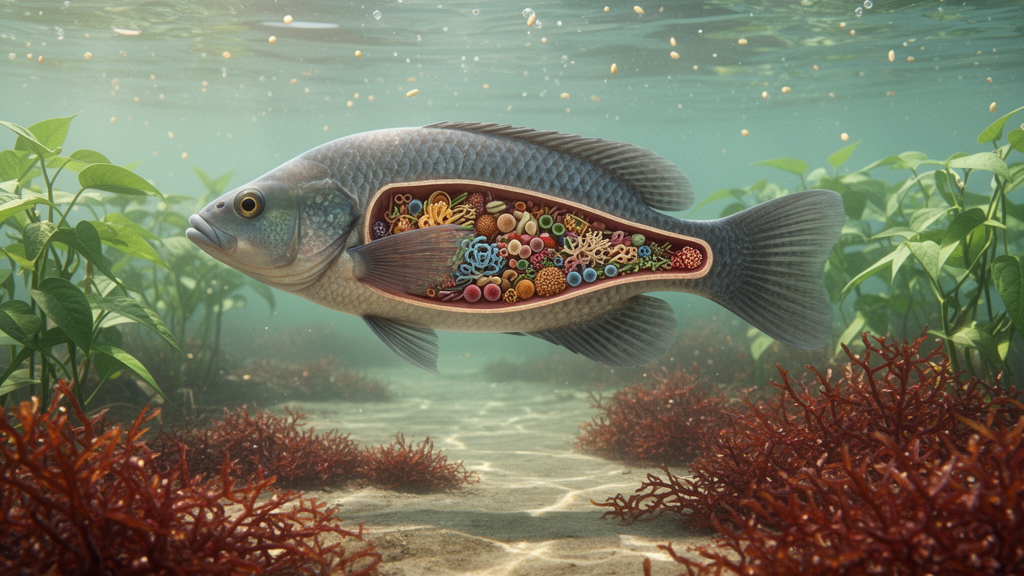
In a 62-day feeding trial, soybean meal and the red seaweed Kappaphycus sp. produced distinct intestinal bacterial communities in farmed Nile tilapia, although the soybean and fishmeal diets did not differ significantly in measured within-group bacterial diversity. The soybean diet supported the strongest growth performance, while the Kappaphycus-containing feed produced the highest Shannon and Simpson diversity indices and the highest apparent protein digestibility. Both ingredients supported growth and survival broadly comparable to the fishmeal control, but the microbial assemblages and predicted metabolic profiles associated with them were not interchangeable. The experiment shows associations among diet, gut community structure, nutrient utilization and fish performance; it does not establish that microbial changes caused the differences in growth.
Researchers assigned reverse-sex Nile tilapia, Oreochromis niloticus, to four treatments, each represented by three 300-litre tanks: a formulated fishmeal diet, a soybean-meal diet, a formulated diet containing 10% Kappaphycus sp., and a natural-food reference in which fish received no formulated feed. The three formulated diets were designed to be isoproteic at approximately 36% crude protein and isoenergetic at approximately 3,600 kilocalories per kilogram. Each treatment contained 60 fish, and the tank rather than the individual fish was treated as the experimental unit. The natural-food group was not nutritionally equivalent to the formulated feeds: its nutrient intake was neither quantified nor controlled, and it was included as an ecological reference for environmental feeding rather than as a controlled comparison between equivalent alternative diets.
The feeding trial revealed clear differences in growth among the treatments. Fish receiving soybean meal had the highest final body weight, 39.42 ± 0.61 grams, and weight gain, 29.37 ± 0.57 grams, followed by the fishmeal and Kappaphycus treatments. The Kappaphycus group reached a final body weight of 37.71 ± 0.32 grams, close to the fishmeal result of 38.32 ± 0.83 grams. Fish relying on natural food grew less, with a final body weight of 22.15 ± 0.21 grams, weight gain of 12.31 ± 0.14 grams and a specific growth rate of 1.31% per day. The corresponding rates were 2.20% per day for soybean, 2.17% for fishmeal and 2.13% for Kappaphycus. Condition factor was also lower in the natural-food group. Survival did not differ significantly among treatments, while feed intake and feed conversion ratio likewise showed no statistically significant differences.
Nutrient digestibility revealed a more mixed performance than final growth alone. The fishmeal diet had the highest apparent digestibility of dry matter, fat and energy, at 92.0% ± 0.4%, 94.8% ± 0.8% and 86.4% ± 0.2%, respectively. Soybean meal produced protein digestibility comparable to fishmeal, 81.1% ± 0.3% versus 80.7% ± 0.7%, but lower apparent digestibility of dry matter, fat and energy. The Kappaphycus-containing feed had the highest protein digestibility among the formulated diets, 84.5% ± 0.3%, but its apparent digestibility of dry matter, fat and energy was 71.3% ± 0.3%, 55.0% ± 0.9% and 60.9% ± 0.6%. Thus, the seaweed feed did not match fishmeal in overall nutrient digestion, despite supporting growth similar to the two formulated alternatives and yielding the strongest protein digestibility.
After the feeding period, investigators collected intestinal samples from four randomly selected fish in each tank. Material from fish within the same tank was pooled before DNA extraction, creating one composite microbial sample per tank and three samples per treatment. This design reduced pseudoreplication and retained treatment-level replication, but it also prevented the researchers from resolving microbiota differences among individual fish sharing a tank. Following DNA extraction, the researchers amplified and sequenced the V3–V4 regions of the bacterial 16S ribosomal RNA gene. The DADA2 workflow was used to infer amplicon sequence variants, merge paired reads, remove chimeras and assign taxonomy against the SILVA 138.2 reference database. Because the analysis was based on 16S sequences, it characterized taxonomic composition and inferred functional potential rather than directly measuring microbial gene expression or metabolism.
Diet was a major statistical influence on overall community structure. Weighted UniFrac ordination and detrended correspondence analysis placed the Kappaphycus group apart from the other treatments, while the natural-food, soybean and fishmeal groups overlapped more substantially. A permutational multivariate analysis of variance attributed 60.3% of community variation to treatment, with a significant result after 4,999 permutations. Multivariate dispersion did not differ among groups, indicating similar within-treatment spread and reducing concern that the ordination pattern was driven solely by unequal dispersion. Shannon and Simpson alpha-diversity indices were highest under the Kappaphycus diet and lowest under natural feeding. The only significant pairwise difference in these indices was between the Kappaphycus and natural-food groups; soybean and fishmeal did not differ significantly from one another or from the remaining treatments.
At the phylum level, Fusobacteriota and Pseudomonadota dominated the communities in every treatment, while the Kappaphycus group showed a notable relative increase in Bacteroidota. The genus Cetobacterium remained the most abundant taxon across all diets, accounting for 70.03% of sequences in natural-fed fish, 61.18% in the fishmeal group, 56.42% in the soybean group and 34.67% in the Kappaphycus group. The Kappaphycus treatment also contained higher proportions of Arenimonas, Dinghuibacter, Pseudomonas, Shewanella and Lactobacillus, whereas fishmeal was characterized by Fuscovulum and Bacillus, and soybean by Shewanella, Pseudomonas and Crenobacter. A Venn analysis identified 17 genera shared by all four groups, indicating that the diets changed community composition while retaining a common core assemblage.
Differential-abundance analysis identified further diet-responsive genera. Compared with fishmeal, soybean increased Romboutsia, Turicibacter, Dinghuibacter, Kineobactrum, Cloacibacterium and Propionivibrio, while reducing Aquihabitans, Bacillus, Ralstonia and Veillonella. Kappaphycus produced a broader set of differences, including increases in Romboutsia, Dinghuibacter, Kineobactrum, Roseomonas, Flavobacterium, Pseudorhodoplanes, Bauldia, Mariniblastus and Pirellula relative to fishmeal. The Kappaphycus treatment also contained the largest number of unique genera, 30, compared with 21 for fishmeal, eight for soybean and seven for natural feeding. Some taxa were absent or nearly absent from comparison groups, producing very large fold changes. For those contrasts, the reported differences are better interpreted as qualitative shifts than as precise quantitative estimates of effect size.
The researchers used PICRUSt2 to infer functional profiles from the 16S sequences, mapping predicted gene families to MetaCyc pathways and Enzyme Commission numbers. These are computational estimates of metabolic potential, not measurements of gene expression, enzyme activity or metabolite production. The Kappaphycus profile showed relatively greater representation of pathways for L-isoleucine, L-valine and L-lysine biosynthesis, as well as glucose-1-phosphate degradation. The soybean profile contained the most pronounced differences, including several nucleotide degradation and biosynthesis routes, central carbon metabolism, the Calvin–Benson–Bassham cycle, non-oxidative pentose phosphate metabolism, ppGpp metabolism and lipid-biosynthesis pathways. Fishmeal shared some nucleotide and carbon-metabolism features with soybean, whereas the natural-food group had a comparatively stable profile without marked overrepresentation of specific pathways.
Predicted enzyme profiles followed the same broad pattern. The Kappaphycus group showed greater predicted representation of enzymes associated with transcriptional regulation, signal transduction, cell-wall remodeling and fatty acid metabolism, including RNA helicase, histidine kinase, serine-type D-Ala-D-Ala carboxypeptidase and 3-oxoacyl-acyl-carrier-protein reductase. Soybean was associated with predicted enrichment of redox-related enzymes, including arsenate reductase and thioredoxin-disulfide reductase, along with aspartate transaminase, tRNA-charging enzymes, a type I site-specific deoxyribonuclease and ATP-binding transport systems. These parallels make a role for microbial metabolism in nutrient use plausible, but the study did not directly test whether the predicted pathways were active or responsible for improved growth. Metagenomic, metatranscriptomic, metaproteomic or metabolomic measurements would be needed to validate the inference. The conclusions are also constrained by three tanks per treatment, one composite sample per tank and a single sampling point at the end of the trial. Even with those limitations, the study provides direct evidence that soybean meal and Kappaphycus can support comparable tilapia growth and survival while reshaping the gut microbiome, and it identifies testable microbial pathways for further investigation.
Subject of Research: Effects of soybean meal and Kappaphycus sp. diets on gut microbiota diversity, predicted functions, nutrient digestibility and growth in farmed Nile tilapia
Article Title: Dietary Soybean and Kappaphycus sp. Differentially Modulate Gut Microbiota Diversity and Predicted Functional Profile in Nile Tilapia (Oreochromis niloticus)
Article References: Viagem, L. D. A., Hakizimana, J. N., Rumisha, C., Cerozi, B. D. S., & Misinzo, G. (2026). Dietary Soybean and Kappaphycus sp. Differentially Modulate Gut Microbiota Diversity and Predicted Functional Profile in Nile Tilapia ( Oreochromis niloticus ). MicrobiologyOpen, 15(5), Article e70442. https://doi.org/10.1002/mbo3.70442
Image Credits: AI Generated
DOI: 10.1002/mbo3.70442
Keywords: Nile tilapia, gut microbiota, soybean meal, Kappaphycus, aquaculture nutrition, 16S rRNA sequencing, microbial diversity, PICRUSt2, feed ingredients, nutrient digestibility, Dietary, Soybean
Cite Scienmag News
Morgan Morrow. (October 22, 2026). Soybean and Kappaphycus reshape farmed tilapia gut microbiomes. Scienmag. https://scienmag.com/soybean-and-kappaphycus-reshape-farmed-tilapia-gut-microbiomes/
Morgan Morrow. "Soybean and Kappaphycus reshape farmed tilapia gut microbiomes." Scienmag, 22 October 2026, https://scienmag.com/soybean-and-kappaphycus-reshape-farmed-tilapia-gut-microbiomes/. Accessed 22 October 2026.
Morgan Morrow. "Soybean and Kappaphycus reshape farmed tilapia gut microbiomes." Scienmag. October 22, 2026. https://scienmag.com/soybean-and-kappaphycus-reshape-farmed-tilapia-gut-microbiomes/


