


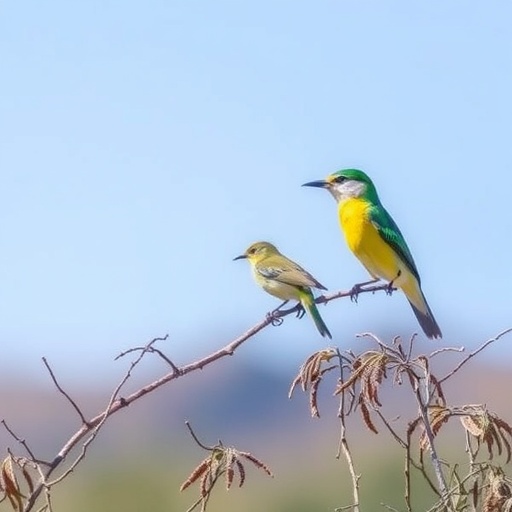
In the face of escalating climate change, understanding the nuanced impacts on biodiversity and human engagement with nature becomes imperative. A recent study focusing on South Africa sheds new light on how climate change might reshape the non-market cultural ecosystem services—specifically birding—that are deeply intertwined with both environmental health and human well-being. This case study ventures beyond conventional biodiversity metrics to explore how shifts in climate variables influence the species composition in different habitats, altering the cultural experience for birdwatchers and nature enthusiasts.
South Africa, renowned for its rich avifauna and vibrant ecosystems, offers a unique landscape where both protected public parks and private locales, such as backyards, serve as important sites for birding activities. The research explores the paradoxical scenario where climate change-induced alterations in habitat suitability may preserve or even enhance bird diversity in residential backyard settings, while simultaneously precipitating declines in biodiversity within officially protected parks. This phenomenon poses intricate challenges for conservation strategies and recreational planning.
Key to this inquiry is the application of macroecological modeling techniques that integrate climate projections with species distribution data. These advanced models forecast how temperature, precipitation, and habitat transformations may affect the spatial distribution and abundance of bird species over the coming decades. The projections suggest that urban and suburban areas—a common backdrop for backyard birding—may experience diverse changes benefiting certain bird populations. In contrast, the more stable but climatically vulnerable public reserves might face significant biodiversity reductions, diminishing their appeal and ecological function.
The social sciences intersect profoundly with these ecological dimensions, as the cultural practices of birding encompass both recreational and economic components. Birding not only fosters psychological well-being but also bolsters eco-tourism industries and community engagement with conservation efforts. The study carefully examines how declining biodiversity in public parks could negatively affect visitation rates and the ensuing non-market economic values derived from these cultural ecosystem services, highlighting the broader socio-economic repercussions of environmental change.
Urban ecology plays a vital role in this dynamic. Urban heat island effects, landscaping choices, and microhabitat availability can create refuges for certain bird species under climate stress. The research underscores how backyard habitats, often overlooked, function as critical nodes for maintaining avian biodiversity in human-dominated landscapes. These findings advocate for integrative conservation approaches that validate and amplify the role of private land stewardship alongside public park management.
Moreover, this study brings to light the significance of ecological diversity and population biology principles in understanding the resilience and vulnerability of bird communities. Species-specific traits, such as thermal tolerance, migratory behavior, and diet specialization, determine how birds might respond to shifting environmental parameters. Such insights deepen our comprehension of population dynamics in the context of rapid global change and inform targeted conservation interventions.
A crucial contribution of the work lies in quantifying the cultural ecosystem services associated with birding through economic valuation frameworks. Employing contingent valuation and non-market benefit assessments, the study reveals how people’s willingness to pay for conservation and recreational access is influenced by expected changes in bird diversity. These valuations offer a potent tool for policymakers to balance ecological preservation with human cultural interests.
Despite its regional focus, the investigation offers broader implications for global conservation policies. It challenges the assumption that protected areas alone suffice for biodiversity conservation in a changing climate and highlights the need for landscape-level integration. Encouraging biodiversity-friendly practices on private and communal lands can foster resilient socio-ecological systems supporting both wildlife and human communities.
The research also touches on the emerging importance of citizen science and technological advancements in monitoring bird populations. Increased public participation through backyard bird counts and digital reporting platforms can provide real-time data to track ecological shifts. This democratization of science enriches datasets, enhances public awareness, and galvanizes grassroots conservation action.
Importantly, the study recognizes the intertwined nature of environmental change and cultural identity. Birds hold symbolic and recreational value, shaping local traditions and fostering connections between people and nature. As climate change threatens these vital links, safeguarding the cultural ecosystem services they provide becomes as crucial as protecting biodiversity itself.
In conclusion, the findings advocate for adaptive management strategies that encompass ecological predictions, cultural values, and socio-economic realities. By integrating diverse scientific disciplines and acknowledging private spaces’ roles, a more holistic framework emerges to navigate the complexities climate change imposes on heritage ecosystems and human experience. This nuanced understanding equips stakeholders to better maintain the rich tapestry of life and leisure that birding embodies in South Africa and beyond.
News Publication Date: 22-Oct-2025
Web References: https://doi.org/10.1371/journal.pclm.0000715
Cite Scienmag News
Margaret Porter. (October 22, 2025). South African Backyard Birders Likely to Maintain Species Diversity Despite Climate Change, While Protected Park Birdwatching Faces Decline. Scienmag. https://scienmag.com/south-african-backyard-birders-likely-to-maintain-species-diversity-despite-climate-change-while-protected-park-birdwatching-faces-decline/
Margaret Porter. "South African Backyard Birders Likely to Maintain Species Diversity Despite Climate Change, While Protected Park Birdwatching Faces Decline." Scienmag, 22 October 2025, https://scienmag.com/south-african-backyard-birders-likely-to-maintain-species-diversity-despite-climate-change-while-protected-park-birdwatching-faces-decline/. Accessed 4 September 2026.
Margaret Porter. "South African Backyard Birders Likely to Maintain Species Diversity Despite Climate Change, While Protected Park Birdwatching Faces Decline." Scienmag. October 22, 2025. https://scienmag.com/south-african-backyard-birders-likely-to-maintain-species-diversity-despite-climate-change-while-protected-park-birdwatching-faces-decline/


