


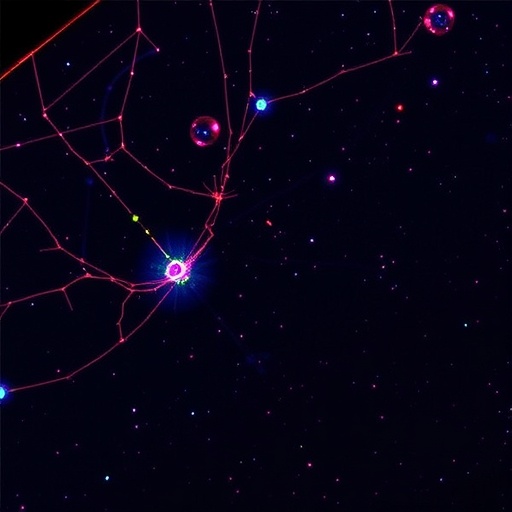
In recent years, the understanding of cellular structures and their roles in health and disease has expanded dramatically. Researchers have increasingly focused on the nuclear speckles, subnuclear bodies enriched in pre-mRNA splicing factors, owing to their crucial involvement in gene expression regulation. A groundbreaking study published in Nature Communications by Dion, Tao, Chambers, and colleagues now reveals the pivotal role of the protein SON in maintaining nuclear speckle integrity and how its dysfunction contributes to proteinopathies, which are linked to numerous neurodegenerative and systemic disorders.
Nuclear speckles, traditionally regarded as mere storage sites for splicing factors, are now recognized as dynamic organelles essential for the regulation of RNA processing. These speckles coordinate the localization and interaction of splicing components, ensuring the proper maturation of messenger RNA (mRNA). Disruptions in the splicing machinery have been implicated in various diseases, notably those characterized by protein aggregation or misfolding, collectively known as proteinopathies. This new investigation delves into how SON, a nuclear speckle-associated protein, orchestrates speckle assembly and function.
SON is a large, multifunctional protein that plays critical roles in RNA splicing, transcription regulation, and cell cycle progression. Previous research indicated that SON facilitates efficient splicing of transcripts with weak splice sites, which are particularly vulnerable to aberrant processing. The present study uncovers that SON is central to the structural maintenance of nuclear speckles, acting as a scaffold protein to organize the splicing machinery effectively. Loss or dysfunction of SON leads to the disintegration of nuclear speckles, with subsequent widespread splicing defects.
Utilizing advanced imaging techniques, including super-resolution microscopy, the authors meticulously documented the morphology of nuclear speckles under different experimental conditions. When SON expression was suppressed, nuclear speckles appeared fragmented and dispersed, correlating with a marked decrease in splicing factor concentration within these nuclear domains. This phenotype was not only morphological but functionally significant, as global transcriptome analysis demonstrated altered splicing patterns and accumulation of aberrant RNA transcripts.
Intriguingly, the study highlights that restoring SON levels or artificially promoting nuclear speckle reformation can reverse these molecular abnormalities. This rehabilitation of nuclear speckles re-established splicing fidelity and ameliorated downstream cellular stress responses that typically culminate in proteotoxicity. Such findings implicate nuclear speckle integrity as a promising therapeutic target, particularly in conditions marked by protein misfolding and aggregation.
Proteinopathies, including Alzheimer’s, Parkinson’s, and Huntington’s diseases, are characterized by the accumulation of misfolded proteins, which impair cellular functions and trigger neurodegeneration. The novel perspective offered by Dion et al. connects these disorders to nuclear speckle dysfunction, positioning SON as a potential molecular gatekeeper against splicing errors that precipitate pathogenic protein accumulation. This concept bridges RNA biology and neurodegeneration, opening novel research avenues that deviate from traditional protein-centric paradigms.
The molecular mechanisms by which SON sustains nuclear speckles were further elucidated through biochemical assays showing SON’s binding affinities to various splicing factors and its involvement in phase separation dynamics. Phase separation—a process by which biomolecules demix to form condensates—has emerged as a fundamental organizing principle within the nucleus. SON facilitates the condensation of splicing factors into distinct speckles, concentrating necessary components for efficient RNA processing. Selective disruption of SON impairs this liquid-liquid phase separation, leading to diffuse distribution of splicing factors and functional deficits.
These insights extend into cellular models derived from patient samples exhibiting proteinopathy phenotypes. Cells with reduced SON function demonstrated prominent nuclear architecture disorganization, accompanied by stress granule formation and increased markers of cellular distress. Remarkably, targeting SON expression pharmacologically or via gene therapy-like approaches reinstated nuclear speckle integrity, reduced mis-splicing, and mitigated toxicity in these patient-derived cells.
The implications of this research transcend the mechanistic understanding of nuclear speckles to suggest new diagnostic and therapeutic strategies. Nuclear speckle rehabilitation through SON-centered interventions may restore normal splicing in affected cells, potentially halting or reversing the progression of proteinopathies. While therapeutic application remains nascent, this study lays the foundational framework for future drug development efforts aimed at modulating nuclear speckle dynamics.
Moreover, the interplay between SON and other nuclear components under stress conditions could elucidate the cellular response to environmental insults. The dynamic regulation of nuclear speckles might represent a cellular adaptive mechanism to preserve genomic integrity and proteostasis. The authors propose that failure of such mechanisms, via SON depletion or mutation, precipitates a cascade of RNA processing errors culminating in pathological protein accumulation.
This study also challenges the existing dogma regarding the compartmentalization of nuclear functions and highlights the intrinsic link between nuclear morphology and transcriptomic fidelity. By emphasizing the contribution of nuclear speckles to the spatial regulation of gene expression, the research expands our comprehension of nuclear architecture as an active participant rather than a passive scaffold.
Future studies inspired by these findings will likely focus on elucidating the precise molecular partners of SON within the nuclear speckles and understanding how these interactions are regulated temporally and in response to cellular stressors. The potential cross-talk between nuclear speckle rehabilitation and broader cellular pathways such as proteasome activity, autophagy, and stress granule dynamics warrants comprehensive investigation.
In conclusion, the work by Dion, Tao, Chambers, and their team represents a milestone in molecular cell biology, molecular neuroscience, and RNA research. It not only unveils SON as a master regulator of nuclear speckle integrity but also positions nuclear speckles as critical nodes in the maintenance of cellular homeostasis, particularly in the context of proteinopathies. These discoveries foster a new conceptual framework that holds promise for innovative therapeutic approaches to some of the most intractable neurodegenerative diseases of our time.
Cite Scienmag News
Juliet Wilcox. (August 5, 2025). SON-Driven Nuclear Speckle Repair Eases Proteinopathies. Scienmag. https://scienmag.com/son-driven-nuclear-speckle-repair-eases-proteinopathies/
Juliet Wilcox. "SON-Driven Nuclear Speckle Repair Eases Proteinopathies." Scienmag, 5 August 2025, https://scienmag.com/son-driven-nuclear-speckle-repair-eases-proteinopathies/. Accessed 3 September 2026.
Juliet Wilcox. "SON-Driven Nuclear Speckle Repair Eases Proteinopathies." Scienmag. August 5, 2025. https://scienmag.com/son-driven-nuclear-speckle-repair-eases-proteinopathies/


