


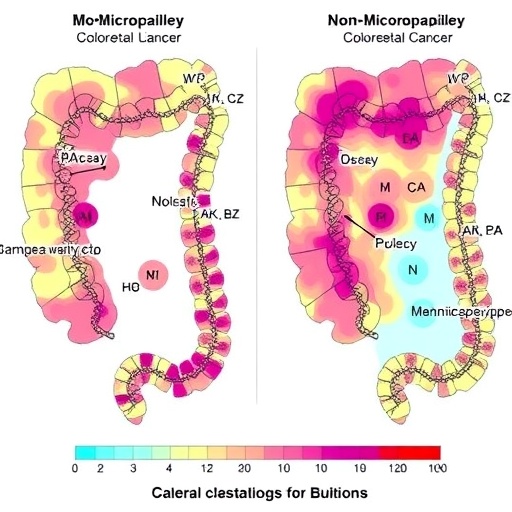
In a groundbreaking study published in BMC Cancer, researchers have unveiled critical insights into the distinct molecular and clinicopathological landscapes of micropapillary colorectal carcinomas (MPCs) compared to their non-micropapillary counterparts. This comprehensive analysis illuminates the aggressive nature of MPCs and offers new avenues for understanding tumor behavior at the genomic level, inviting a reevaluation of diagnostic and therapeutic strategies in colorectal cancer.
Micropapillary carcinoma, a histopathological entity recognized by its unique small papillary clusters devoid of fibrovascular cores, has remained relatively elusive in colorectal cancer research. Despite its known association with poor clinical outcomes, detailed data on its genetic alterations have been scarce. The recent study bridges this knowledge gap by meticulously examining somatic mutations through next-generation sequencing (NGS) in a cohort of 159 colon adenocarcinoma cases, including 10 with MPC components exceeding 5%.
The presence of MPC areas within colorectal tumors was strongly correlated with a more aggressive histological profile. Tumors exhibiting MPC showed higher histologic grades, with 60% categorized as high-grade versus only 14.8% in non-MPC tumors. This sharp distinction underscores the histopathological severity associated with micropapillary differentiation and signals its potential as a prognostic biomarker.
In addition to histologic grade, the pathological staging revealed stark contrasts. MPC tumors were more frequently staged at advanced pathological T (pT4) and N (pN2b) categories, denoting greater local invasion and lymph node involvement. Specifically, half of the MPC cases were pT4 and pN2b stages, significantly exceeding the proportion seen in non-MPC tumors. This progression highlights MPC’s aggressive clinical course and hints at underlying biological mechanisms driving invasiveness.
Further compounding the poor prognosis phenotype, tumor deposits—which reflect direct tumor spread beyond lymph nodes—were observed at an alarming rate of 87.5% in MPC cases, almost doubling that in non-MPC tumors. Alongside, elevated incidences of lymphovascular and perineural invasion confirmed the invasive propensity of MPC, both of which are well-established predictors of diminished survival in colorectal cancer.
Diving into the molecular underpinnings, the researchers focused on key genes frequently implicated in colorectal carcinogenesis: TP53, KRAS, and PIK3CA. These genes are noted for their roles in tumor suppression, signaling pathways, and cell proliferation. Interestingly, while these mutations were prevalent in both MPC and non-MPC groups, no significant statistical differences were found between the cohorts concerning mutation frequencies in TP53, KRAS, PIK3CA, and other genes like BRCA2, ERBB2, BRAF, and MAP2K1.
Despite this lack of mutational disparity, certain genotype-phenotype correlations stand out. The presence of a TP53 mutation was significantly associated with increased tumor deposits and perineural invasion, linking this mutation to more invasive pathologic features. This emphasizes the multifaceted role of TP53 mutations beyond mere cell cycle disruption, extending its impact into tumor microenvironment interactions.
Moreover, gender-specific differences emerged with regard to KRAS mutation status. The data revealed a significantly higher proportion of males among KRAS wild-type cases compared to those harboring KRAS mutations. This unexpected sex difference provokes questions about hormonal, genetic, or environmental factors modulating mutational processes and tumor evolution in colorectal cancer.
Age and tumor staging also displayed variation based on PIK3CA mutation status. Patients with PIK3CA mutations were generally younger and exhibited different T and N staging distributions compared to wild-type cases. Given that PIK3CA mutations modulate PI3K/AKT signaling pathways implicated in cell growth and survival, these findings may point toward distinct tumorigenic trajectories influenced by PIK3CA alterations.
The absence of substantial differences in somatic mutation profiles between MPC and non-MPC tumors suggests that histopathological aggressiveness in MPC may not be driven solely by classic oncogenic mutations. Instead, it intimates the possible contributions of epigenetic modifications, tumor microenvironment dynamics, or alternative genetic mechanisms such as copy number variations and gene expression changes.
This nuanced understanding challenges clinicians and researchers to reconsider the weight placed on mutation status alone when prognosticating colorectal cancers with micropapillary features. The integration of morphological and molecular insights could inform more precise risk stratifications and targeted interventions tailored to the unique biology of MPC.
Histopathologists should take heed of MPC presence during diagnostic evaluation, as it portends worse outcomes and may warrant more aggressive treatment approaches or closer surveillance. Meanwhile, researchers are encouraged to explore the complex interplay of genetic, epigenetic, and stromal factors that orchestrate the distinct behavior of MPC tumors.
In conclusion, this landmark study contributes a critical piece to the colorectal cancer puzzle by highlighting the aggressive clinico-pathological traits of micropapillary colorectal carcinomas without evident differences in common somatic mutations. It opens new frontiers for translational research aiming to decode the mechanisms underlying MPC’s malignancy and to ultimately improve patient care paradigms.
As the oncology field moves toward precision medicine, such insights into tumor heterogeneity and molecular pathology are invaluable. Understanding the subtle yet impactful distinctions between tumor subtypes, like MPC and non-MPC colorectal carcinomas, will shape the future of cancer diagnostics, prognostics, and therapeutics.
This research underscores the essential role of integrated histopathological and molecular investigations, setting a benchmark for future studies dissecting colorectal cancer complexities. It is an important step toward unraveling the biological enigma of micropapillary differentiation and its clinical implications.
The medical community eagerly anticipates follow-up studies that may incorporate larger cohorts and functional analyses to validate and expand upon these findings. Such continued inquiry promises to refine clinical guidelines and enhance outcomes for patients battling this formidable variant of colorectal cancer.
Cite Scienmag News
Nathaniel Bowman. (July 3, 2025). Somatic Mutations in Micropapillary vs. Non-Micropapillary Colorectal Cancer. Scienmag. https://scienmag.com/somatic-mutations-in-micropapillary-vs-non-micropapillary-colorectal-cancer/
Nathaniel Bowman. "Somatic Mutations in Micropapillary vs. Non-Micropapillary Colorectal Cancer." Scienmag, 3 July 2025, https://scienmag.com/somatic-mutations-in-micropapillary-vs-non-micropapillary-colorectal-cancer/. Accessed 3 September 2026.
Nathaniel Bowman. "Somatic Mutations in Micropapillary vs. Non-Micropapillary Colorectal Cancer." Scienmag. July 3, 2025. https://scienmag.com/somatic-mutations-in-micropapillary-vs-non-micropapillary-colorectal-cancer/


