


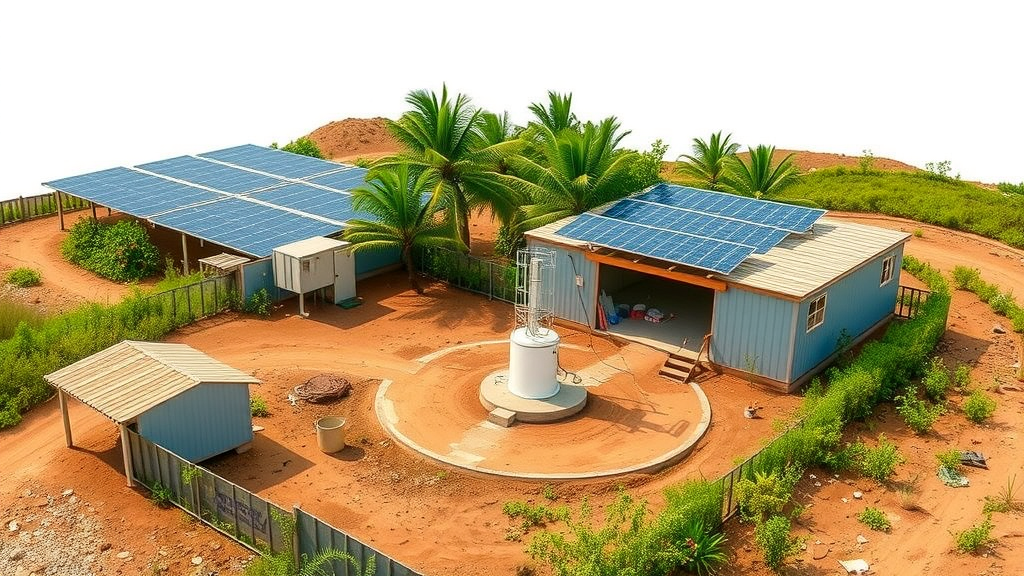
Municipal water pumping stations are among the most energy-hungry and least flexible pieces of public infrastructure. They must run around the clock, moving water from sources to reservoirs and into household taps regardless of what the electricity grid is doing or what power costs at any given hour. For facilities in remote or island locations, that dependence is even more problematic: a single unstable feeder line, a price spike, or a blackout can compromise a service that communities cannot live without. A new study published in Clean Technologies and Environmental Policy explores a way out of this bind, showing how solar photovoltaic panels paired with large battery energy storage systems can transform a critical island water pumping facility into a resilient, largely self-directed microgrid.
The research, led by Karlo Kvaternik of AVL-AST in Zagreb together with colleagues from the University of Zagreb, the Academy of Applied Technical and Preschool Studies in Niš, and Auezov University of South Kazakhstan, focuses on a real municipal water supply pumping station on a Croatian island served by the local water utility. Rather than installing hardware and hoping for the best, the team built a detailed dynamic simulation model of the pumping station, layering in historical water demand data, solar irradiance profiles from the NASA POWER database, commercially available lithium iron phosphate battery parameters, and the actual electricity tariffs charged by the Croatian utility HEP. This digital twin approach allowed them to test multiple microgrid configurations over long time horizons before a single panel was mounted on a roof.
At the heart of the model is a rule-based energy management strategy designed around two money-saving tactics: load shifting and price arbitrage. Load shifting means moving energy-intensive pumping into the middle of the day, when solar output is at its peak and grid electricity is most expensive to avoid. Price arbitrage means charging the batteries during the cheap nightly tariff window and discharging them during expensive daytime hours. Because the pumping station feeds a water reservoir, the researchers had a degree of flexibility that many industrial loads lack: water, unlike electricity, can be stored cheaply. The control system exploits this by letting the reservoir level act as a buffer, pumping more when energy is abundant and less when it is scarce, while a proportional-integral controller keeps the reservoir volume at its target value.
The technical modeling captures the full chain of components with surprising granularity. On the generation side, photovoltaic panels are described by their surface area, nominal conversion efficiency, and an annual degradation rate, with a normal-distribution bell curve representing the daily sweep of solar irradiance from dawn to true noon and back. On the storage side, the battery is modeled with an open-circuit voltage and series resistance that evolve with state-of-charge, and its lifespan is estimated from the accumulated number of charge-discharge cycles and the depth of discharge at which the cells operate. Pump motors, variable speed drives, inverters, and even the medium-voltage to low-voltage transformer all contribute efficiency factors to the calculation, so the financial results reflect real-world losses rather than idealized nameplate figures.
The study’s central finding is a clear techno-economic trade-off between how much money a microgrid configuration needs up front and how much financial resilience it delivers over its life. The minimal configuration, combining a 500 kilowatt-hour battery storage system with 1,700 square meters of solar panels producing up to 340 kilowatts of peak DC power, achieves the fastest return on investment at just 7.6 years. Its appeal is straightforward: low initial capital costs mean the savings on electricity bills begin paying back the investment quickly. However, this lean system simply cannot shift the entire pumping load away from expensive tariff periods, and the facility continues to lean on the grid when water demand runs high and the sun is not cooperating.
At the other end of the spectrum sits the high-capacity configuration: a 2,000 kilowatt-hour battery array, 4,100 square meters of solar panels, and 820 kilowatts of peak DC output. This larger system stretches the payback period out to 13.7 years, a substantial commitment for any municipal budget. The payoff, however, is dramatic. The expanded microgrid virtually eliminates high-tariff grid reliance during periods of low water demand, maximizes long-term profitability across the facility’s operating life, and grants the pumping station a level of energy autonomy that would have been unthinkable for a grid-connected facility a decade ago. For island communities where grid instability and price volatility are chronic, that independence carries a value beyond the spreadsheet.
Perhaps the most reassuring results concern aging. Critics of battery-backed solar often point out that batteries degrade and panels lose efficiency, quietly eroding the savings that justified the investment. The researchers ran a 16-year exploitation assessment covering all their scenarios and found the systems remain sustainably serviceable: the battery energy storage systems maintain a state-of-health above 48 percent at the end of the period, while the photovoltaic panels retain 88.8 percent of their nominal conversion capacity. Those figures matter because they demonstrate that even the most heavily cycled, largest-battery configuration does not collapse into premature replacement costs within a typical municipal planning horizon, and the residual capacity could even support second-life applications after retirement from primary duty.
The implications reach well beyond one Croatian island. Water pumping accounts for a significant share of municipal electricity consumption worldwide, and utilities everywhere face the same combination of rising power prices, aging grid infrastructure, and mounting climate-related disruptions. The study’s digital twin methodology offers a template: by combining historical consumption data, satellite-derived solar resource data, real commercial battery specifications, and actual tariff structures, operators anywhere can size a PV-BESS microgrid to match their own demand patterns and financial constraints. The choice between a fast-payback minimal system and a slower-payback autonomy-maximizing system is not universal; it depends on local tariffs, grid reliability, available land, and the community’s tolerance for upfront debt.
What makes the work particularly timely is the broader movement toward water microgrids as a resilience strategy for critical infrastructure. Researchers have long argued that water systems, like power systems, benefit from decentralized generation and storage, and recent advances in model predictive control and hybrid rule-based energy management have made sophisticated optimization increasingly accessible. This study grounds that vision in concrete numbers: a specific payback range of 7.6 to 13.7 years, specific hardware sizes, and specific degradation trajectories. For municipal engineers and city planners weighing renewable investments against other capital priorities, such transparency is invaluable. The message is ultimately an optimistic one. The technologies needed to make water supply infrastructure energy-independent, cheaper to run, and immune to tariff shocks already exist, are commercially mature, and age gracefully enough to survive a two-decade service life. The remaining task, this research suggests, is simply to size them correctly for the community they serve.
Subject of Research: Improving the energy efficiency and autonomy of a municipal water supply pumping station by integrating solar photovoltaic systems and battery energy storage into a microgrid
Article Title: Energy efficiency improvement of municipal water supply pumping station microgrid using batteries and solar photovoltaic systems
Article References: Energy efficiency improvement of municipal water supply pumping station microgrid using batteries and solar photovoltaic systems. (n.d.). https://doi.org/10.1007/s10098-026-03599-1
Image Credits: AI Generated
DOI: 10.1007/s10098-026-03599-1
Keywords: municipal water supply, energy efficiency, solar photovoltaics, battery energy storage, microgrid, pumping station, return on investment, load shifting, lithium iron phosphate battery, renewable energy, grid resilience, energy management
Cite Scienmag News
Faith Mcneil. (September 23, 2026). Solar-Powered Microgrids Could Slash Energy Costs at Island Water Pumping Stations. Scienmag. https://scienmag.com/solar-powered-microgrids-could-slash-energy-costs-at-island-water-pumping-stations/
Faith Mcneil. "Solar-Powered Microgrids Could Slash Energy Costs at Island Water Pumping Stations." Scienmag, 23 September 2026, https://scienmag.com/solar-powered-microgrids-could-slash-energy-costs-at-island-water-pumping-stations/. Accessed 5 October 2026.
Faith Mcneil. "Solar-Powered Microgrids Could Slash Energy Costs at Island Water Pumping Stations." Scienmag. September 23, 2026. https://scienmag.com/solar-powered-microgrids-could-slash-energy-costs-at-island-water-pumping-stations/


