


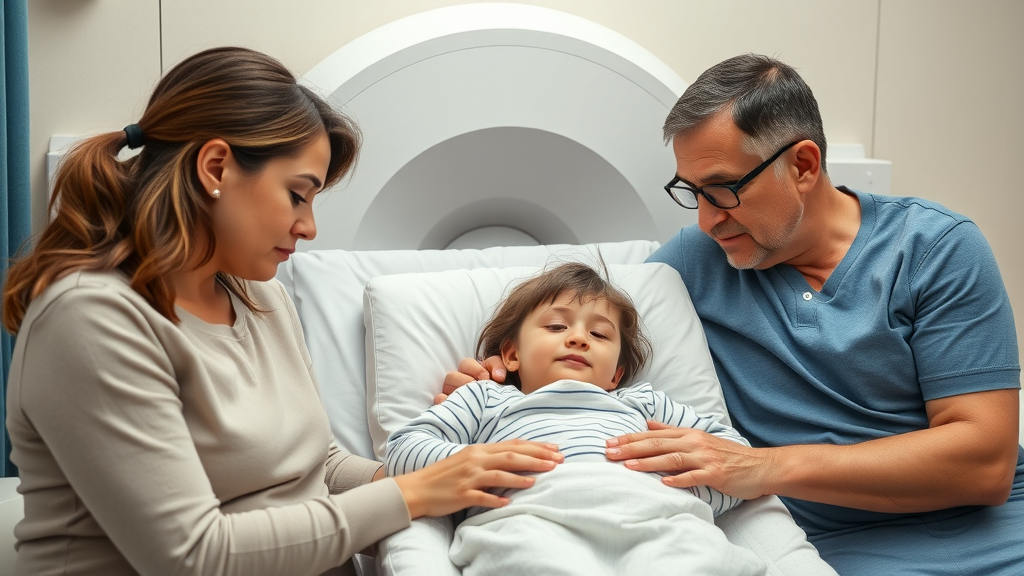
When a child is diagnosed with a cancer that can only be treated with radioactive drugs, the medical team focuses on the tumour. But a new study suggests the invisible casualties of that treatment are often the parents and caregivers themselves, who face isolation, lost income, and profound psychological strain while sitting vigil beside their child in a shielded hospital room. A clinical service review from University College London Hospitals has, for the first time, systematically mapped the holistic needs of parents and carers of children and teenagers undergoing molecular radiotherapy, revealing a landscape of unmet psychosocial, financial, and practical needs that clinicians have been only partially aware of.
Molecular radiotherapy, or MRT, is a treatment in which radioactive drugs such as radioactive iodine, iodine-131 labelled meta-iodobenzylguanidine, or lutetium-177 DOTATATE are administered orally or intravenously to target tumour cells from within. Because these treatments render the patient temporarily radioactive, strict radiation safety protocols governed by the UK’s Ionising Radiation Regulations 2017 require children to remain in isolation until their radioactivity falls to acceptable levels. Parents or other consenting non-pregnant adults may be legally designated as ‘comforters and carers’, wearing protective equipment, monitoring their radiation dose, and managing their time in close contact with the child. The result is a treatment experience that is physically confined, emotionally demanding, and unlike almost any other form of paediatric cancer care.
The research, published in the journal Supportive Care in Cancer, was conducted at a single tertiary referral centre between 2018 and 2022. The team prospectively assessed the holistic needs of parents and caregivers of 50 paediatric and adolescent patients receiving their first cycle of MRT, using holistic needs assessment forms completed before admission. The median age of the patients was 13 years, with ages ranging from 3 to 17. Treatments included radioactive iodine for differentiated thyroid cancer, iodine-131 mIBG for neuroblastoma and related tumours, and lutetium-177 DOTATATE for neuroendocrine tumours. Thematic and axial coding of the assessment responses revealed a consistent pattern of concerns across the families.
The most striking finding concerned money. Ninety-eight percent of participants reported financial stress related to the treatment, and 51 percent had specific financial concerns, mainly linked to lost income from time off work. The longer the hospital stay, the greater the financial strain, a correlation that was particularly strong for families undergoing complex double-administration mIBG protocols, which can require up to five weeks of inpatient care and represented between 75 and 83 percent of those reporting such concerns. Families also cited travel, accommodation, and parking costs, with 20 percent flagging these as stressors. Fourteen percent reported unemployment. Many parents described having to take career breaks or leave jobs entirely to provide care, a burden that national data on cancer caregiving has long suggested but which has never been quantified in the MRT context.
Separation from family emerged as the second most common concern, cited by 52 percent of participants. Parents worried about who would look after siblings, how household responsibilities would be managed, and how the child in isolation would cope with missing school. Isolation itself was reported as a concern by 36 percent, and anxiety about isolation rose sharply with the length of stay. Half to two-thirds of caregivers whose children received two mIBG administrations two weeks apart, with admissions lasting four to five weeks, reported isolation-related worries, compared with just 24 percent of those whose children had shorter radio-iodine treatments. Parents described feeling ‘worried about being confined and claustrophobic’ and emphasised the need for activities, play support, and attention for their child.
The emotional toll was evident throughout the responses. Parents reported feeling ‘helpless, anxious, depressed, struggling, overwhelmed’, and ‘frustrated’, with some describing the period as ‘a very stressful time for us all’. One parent noted that her child might cope, but that she herself would need family support. Fear of recurrence, doubts about treatment effectiveness, and the potential loss of a child accounted for 24 percent of concerns. Yet only 20 percent of participants reported receiving support from medical professionals, a figure the authors attribute to the fact that care is often coordinated locally before treatment and that parents, prioritising their child’s needs above their own, may not seek help even when they need it. The study’s authors stress that careful, iterative handover of information between referring and treatment centres is critically important, not a one-off communication.
Spiritual and religious life also played a role. Fifty-two percent of participants identified with a religion or spiritual belief, primarily Christian or Muslim, and 16 percent highlighted the importance of prayer in coping, with comments such as ‘praying strengthens our body and soul’ and ‘spiritual belief helped immensely in coping with the current situation’. Notably, 48 percent reported no religious or spiritual affiliation, but the study found that many of these individuals nevertheless held personal faith, distinguishing spirituality from organised religion. A six percent minority expressed that they were losing or questioning their faith. The authors argue that ignoring spiritual needs can reduce patient satisfaction and quality of life, and that ethical guidelines urge health professionals to address spirituality as part of holistic care.
The study also identified practical gaps. Twenty-two percent of participants provided additional comments, highlighting concerns about the child’s education, logistical issues such as parking and cooking facilities, and the need for play specialist support. Schools are legally required to arrange education for children in hospital, but radiation protection guidelines mean that MRT patients may not receive face-to-face teaching, and input from schools before admission is described as vital. The authors point to virtual platforms, remote learning, and online peer support groups as promising tools that could help maintain social and educational connections during isolation, drawing on developments accelerated by the COVID-19 pandemic. They also recommend resources such as play specialists and charities like Spread a Smile to provide respite and support.
The study had limitations. Eighteen percent of assessment data was missing, attributed to families not completing the form, as completion was not mandatory during the study period. The authors argue that routine use of holistic needs assessment for all patients, in line with national guidelines, is essential, and that healthcare staff need training in sensitive conversations, particularly around financial and social issues. Without follow-up and allocation of resources to address identified needs, they warn, the assessment tool risks becoming ineffective. Signposting to charities or benefits-support groups should be explored before hospital stays begin, and longer stays heighten the case for flexible working arrangements supported by employers and social policy.
Ultimately, the study’s central message is that support must extend beyond the patient. Molecular radiotherapy for children is concentrated in only a few specialised centres in the United Kingdom because it requires round-the-clock paediatric nursing, medical care, and nuclear medicine facilities in co-location. That centralisation means many families travel long distances, spend weeks away from home, and carry the weight of treatment largely alone. The authors conclude that a coordinated, family-centred, multidisciplinary approach is essential, and that future improvements should include enhanced training for healthcare professionals, virtual peer support, support for education continuity, and better integration of local resources throughout the treatment journey. Holistic needs assessments, they argue, are not a bureaucratic exercise but the first step in identifying unmet needs, fostering engagement, and building the kind of personalised care that families navigating this uniquely isolating treatment genuinely require.
Subject of Research: Holistic care needs of parents and caregivers of children and teenagers receiving molecular radiotherapy for cancer
Article Title: Exploring holistic care needs in paediatric and teenage molecular radiotherapy: a parent and carer perspective
Article References: Exploring holistic care needs in paediatric and teenage molecular radiotherapy: a parent and carer perspective. (n.d.). https://doi.org/10.1007/s00520-026-11214-8
Image Credits: AI Generated
DOI: 10.1007/s00520-026-11214-8
Keywords: molecular radiotherapy, paediatric cancer, holistic needs assessment, caregiver burden, financial toxicity, radiation isolation, family-centred care, psychosocial support, multidisciplinary team, mIBG therapy, radioactive iodine, supportive care
Cite Scienmag News
Nathaniel Bowman. (September 23, 2026). Parents of Children Receiving Molecular Radiotherapy Face Heavy Financial and Emotional Burdens. Scienmag. https://scienmag.com/parents-of-children-receiving-molecular-radiotherapy-face-heavy-financial-and-emotional-burdens/
Nathaniel Bowman. "Parents of Children Receiving Molecular Radiotherapy Face Heavy Financial and Emotional Burdens." Scienmag, 23 September 2026, https://scienmag.com/parents-of-children-receiving-molecular-radiotherapy-face-heavy-financial-and-emotional-burdens/. Accessed 5 October 2026.
Nathaniel Bowman. "Parents of Children Receiving Molecular Radiotherapy Face Heavy Financial and Emotional Burdens." Scienmag. September 23, 2026. https://scienmag.com/parents-of-children-receiving-molecular-radiotherapy-face-heavy-financial-and-emotional-burdens/


