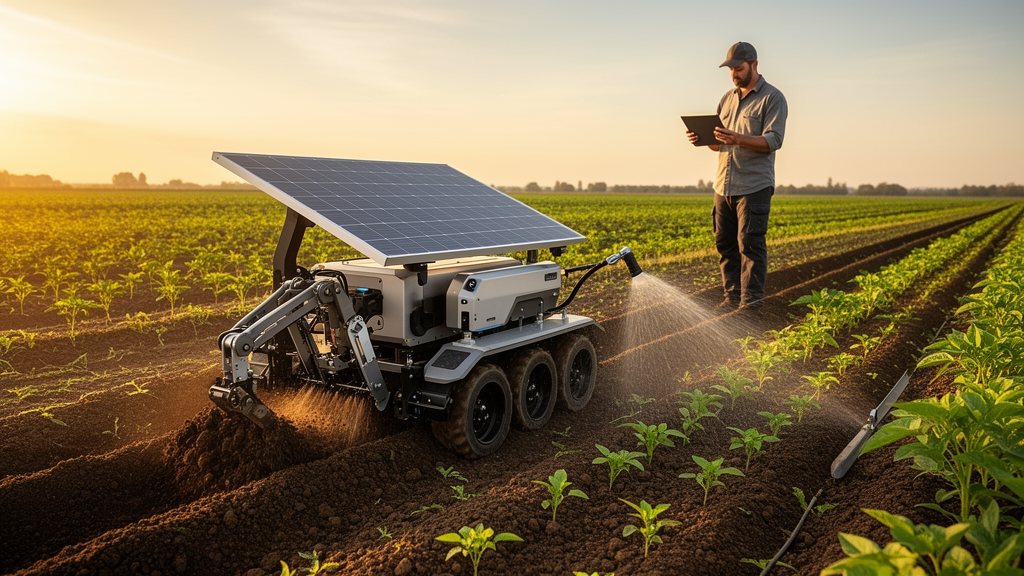
Researchers in Pakistan have built and field-tested a small, solar-powered agricultural robot that digs soil, places seeds, irrigates them and cuts crops, all while streaming temperature, humidity, battery and camera data to a farmer’s phone over the Internet of Things. The prototype, described in the journal Discover Robotics, was developed by a team at the University of Engineering and Technology, Mardan, and evaluated on a tilled outdoor test plot under clear to partly cloudy skies with ambient temperatures between 28 and 36 degrees Celsius. The work targets a specific gap: most existing agricultural robots perform a single task, depend on grid electricity or fuel, and cost more than smallholder farmers in South Asia can afford.
The case for such a machine rests on the structure of Pakistani agriculture, where the sector accounts for nearly one-quarter of gross domestic product and around 40 percent of the labor force, yet farming operations in rural areas remain largely manual, using traditional implements and human or animal labor for plowing, sowing, irrigation and harvesting. The authors argue that these practices are labor-intensive, time-consuming and yield inconsistent results, problems compounded by rural out-migration and rising input costs. Commercial machinery, they note, is typically expensive, fuel-intensive and single-purpose, poorly matched to the small farms common across the region.
At the heart of the robot is a single ESP32 microcontroller, chosen for its dual-core processing, built-in Wi-Fi and Bluetooth, and enough input-output capacity to manage every peripheral without an additional controller. The ESP32 reads a DHT11 temperature and humidity sensor, rated for 0 to 50 degrees Celsius with plus or minus 2 degrees accuracy, and an HC-SR04 ultrasonic sensor for obstacle detection. It drives an L298N dual H-bridge motor controller powering four drive motors, actuates the seeding servo and an ESP32-CAM module for live visual field monitoring, and switches the water pump and cutter motor through a two-channel relay module. Sensor data travel to a Firebase real-time database over Wi-Fi, while a companion Android application built with MIT App Inventor issues control commands and retrieves status data. A web-based dashboard provides a second, browser-accessible interface for live camera viewing and equipment control.
The mechanical platform is a four-wheel-drive chassis carrying a tooth-type metal cultivator that penetrates the soil ahead of seeding, a continuously rotating metal roller that levels and compacts the ground to improve seed-to-soil contact, a hopper-and-servo seed dispenser that releases seeds at controlled intervals, a DC submersible pump feeding a delivery line, and a DC-motor-driven rotating-blade cutter for crop cutting and weed clearance. The team modeled the chassis, motor mounts, battery compartment, solar panel mounting and attachments in CAD before fabricating the prototype from laser-cut acrylic, aluminum sheet and PVC piping, deliberately choosing lightweight materials over steel to reduce tractive power demand. The finished footprint of roughly 450 by 350 by 250 millimeters was checked against typical row spacing on small vegetable and cereal farms.
Engineering calculations underpin the sizing of every subsystem. With a robot mass of 8 kilograms, the tractive force needed to climb a 10-degree slope with a rolling-resistance coefficient of 0.06 works out to 18.3 newtons, requiring 0.23 newton-meters of torque per wheel; the selected 12-volt geared motors deliver 8 kilogram-force centimeters, a motor safety factor of 3.5. A structural check of the chassis beam under a design load factor of 1.5 yields a bending stress of 14.7 megapascals against a yield strength of 95 megapascals, a factor of safety of 6.5. For a target seed spacing of 0.15 meters at a travel speed of 0.30 meters per second, the dispenser must fire every 0.5 seconds, which the servo’s 0.4-second actuation cycle accommodates. The calculated field coverage rate is 270 square meters per hour, or about 1,620 square meters over a six-hour operating day.
The energy budget reveals the prototype’s central tension. Summing the continuous loads of the ESP32, camera, relay module, LCD and sensors gives 2.80 watts; adding the four drive motors brings the typical moving-and-sensing demand to 24.40 watts, and a worst case with simultaneous driving, seeding, pumping and cutting reaches 47.80 watts. Against this, the 20-watt solar panel, rated under standard test conditions of 1,000 watts per square meter and 25 degrees Celsius, produced far less in the field: hourly logging between 06:00 and 18:00 on a representative test day showed output rising from about 0.26 watts shortly after sunrise to a measured peak of just 1 watt near solar noon. The authors attribute the gap to environmental conditions, battery charging characteristics, load-sharing between battery and panel, and variations in irradiance, and are explicit that the panel served as a supplementary source while the rechargeable battery supplied the majority of the operating energy.
That battery is a 12-volt, 7.2-ampere-hour pack storing 86.4 watt-hours, which at the typical 24.40-watt load gives a theoretical backup time of about 3.5 hours without solar input. A battery management system protects the pack from overcharge and over-discharge. In an 8-minute discharge test under typical operating load, logged voltage fell progressively from 12.6 volts to 9.0 volts, staying above 10 volts for roughly the first 7 minutes before a sharper drop marked the onset of depletion. The team stresses that this was a short-duration validation, not a comprehensive endurance assessment: long-term degradation, repeated charge-discharge cycles, seasonal temperature variation and extended field operation were all outside the study’s scope.
Functional performance was mixed but workable. Across 11 consecutive seed-placement trials, the robot achieved an average seed-placement accuracy of 74.45 percent, with a gradual decline over successive trials attributed to seed-flow variations, mechanical alignment drift, falling battery voltage and soil accumulating around the dispensing mechanism. Obstacle-detection reliability of the ultrasonic sensor fell from 100 percent at 16 centimeters to 90 percent at 20 centimeters, 80 percent at 24 centimeters and 75 percent at 28 centimeters, a pattern consistent with weakening reflected signals at range. Irrigation uses a pulsed strategy out of necessity as much as design: the pump delivers only 1.5 liters per minute against a continuous-flow requirement of 9 liters per minute at the working speed, so the pump runs for 6 seconds at each seed location to deliver a target volume of 150 milliliters. The authors caution that the irrigation calculations are for prototype validation under controlled conditions and should not be read as a crop-specific recommendation.
The prototype’s estimated fabrication cost is approximately 65,000 Pakistani rupees, covering the solar panel, battery pack, electronics, mechanical structure, drive motors, sensors and fabrication. The authors position this affordability, together with the integration of four farming functions, renewable power and cloud monitoring in one platform, as the work’s principal contribution compared with previously reported systems that focus on single tasks or require expensive sensing hardware. They also frame the design against the rapid rise of AI-driven agricultural robotics, noting that deep-learning crop detection, LiDAR and GPS-based navigation demand computational resources beyond many smallholder budgets, whereas their platform emphasizes low-cost embedded hardware while leaving room for future AI integration.
The limitations are candidly enumerated. Testing was limited to small-scale field experiments on cultivated sandy loam soil with a manually prepared, reasonably uniform surface; large-area coverage, task completion time and water-use efficiency were not comprehensively evaluated. The DHT11 sensor’s accuracy, response time and operating range fall short of higher-performance alternatives, some operational sequences were triggered partly by hand, and the Wi-Fi-plus-Firebase architecture depends on network coverage, though the robot continues executing its programmed tasks locally during outages and syncs data once connectivity returns. No finite element, modal or structural deformation analysis was performed. The team’s future-work list is correspondingly long: higher-capacity photovoltaic modules with maximum power point tracking, long-duration battery testing, LiDAR and GPS-based autonomous navigation, computer-vision crop monitoring, protective blade guards and emergency stops, statistical performance analysis with confidence intervals, and a full economic assessment through return-on-investment and life-cycle costing. For now, the robot stands as an early experimental validation of a concept rather than a field-ready product: a demonstration that digging, seeding, watering, cutting and remote supervision can share one solar-assisted chassis built to a smallholder’s budget.
Subject of Research: Design and field testing of a solar-powered, IoT-enabled multifunctional agricultural robot prototype
Article Title: Design and development of IoT based solar power agriculture robot
Article References: Ali, M., Ullah, S., Ullah, A., Khan, M. D., & Hassan, M. (2026). Design and development of IoT based solar power agriculture robot. Discover Robotics, 2(1), Article 32. https://doi.org/10.1007/s44430-026-00040-6
Image Credits: AI Generated
DOI: 10.1007/s44430-026-00040-6
Keywords: agricultural robotics, solar power, Internet of Things, ESP32, precision agriculture, seed placement, smallholder farming, Pakistan, battery management, obstacle detection, Firebase, prototype field testing
Cite Scienmag News
Alan Morgan. (October 28, 2026). Solar-powered farm robot digs, sows, waters and cuts crops under remote IoT control. Scienmag. https://scienmag.com/solar-powered-farm-robot-digs-sows-waters-and-cuts-crops-under-remote-iot-control/
Alan Morgan. "Solar-powered farm robot digs, sows, waters and cuts crops under remote IoT control." Scienmag, 28 October 2026, https://scienmag.com/solar-powered-farm-robot-digs-sows-waters-and-cuts-crops-under-remote-iot-control/. Accessed 28 October 2026.
Alan Morgan. "Solar-powered farm robot digs, sows, waters and cuts crops under remote IoT control." Scienmag. October 28, 2026. https://scienmag.com/solar-powered-farm-robot-digs-sows-waters-and-cuts-crops-under-remote-iot-control/