


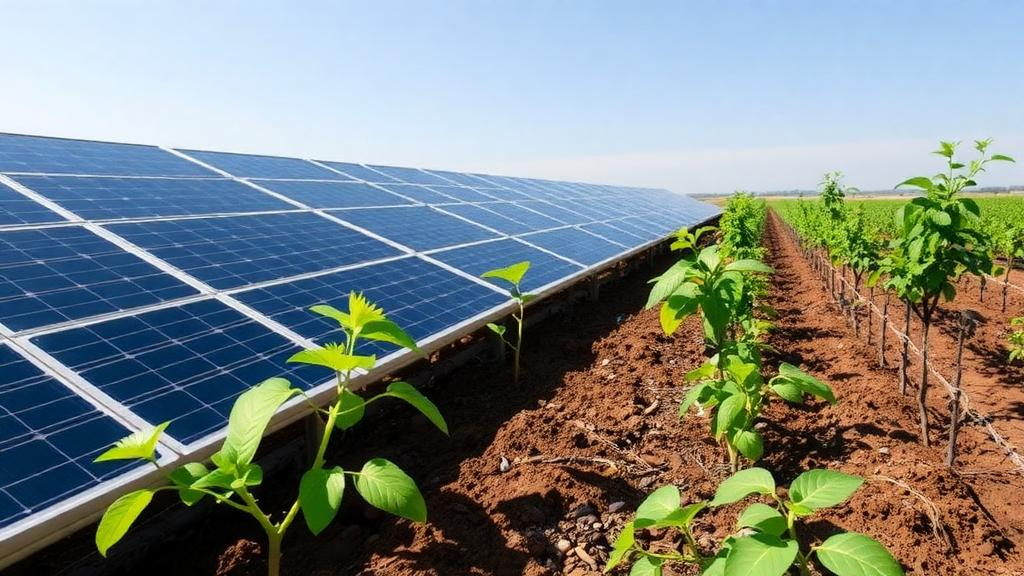
In one of Italy’s most polluted industrial zones, researchers are proposing an unusual alliance: solar panels and heavy-metal-absorbing plants working side by side on the same contaminated ground. A new study published in Environmental Science and Pollution Research presents an integrated agrivoltaic-phytoremediation framework, tested through a case study in Augusta, Sicily, an area so contaminated by decades of petrochemical activity that it has been designated a Site of National Interest for remediation. The work, led by Michele Di Agosto, Claudio Armaro, and Francesco Sergi of the National Research Council of Italy’s Institute of Advanced Energy Technologies, combines plant science, photovoltaic simulation, and techno-economic analysis into a single blueprint for turning degraded land into a dual-purpose asset that cleans soil while generating renewable electricity.
The scale of the problem the researchers set out to address is staggering. More than ten million contaminated sites are estimated to exist worldwide, with mining, foundries, industrial waste, petrochemical production, and fossil fuel combustion among the leading sources of potentially toxic elements, or PTEs, in soil. Traditional remediation has often meant excavating contaminated earth and dumping it in landfills, an approach that is costly, disruptive, and simply moves the problem elsewhere. Phytoremediation offers a gentler alternative: selected plant species extract, stabilize, or sequester pollutants through their roots and tissues. Some hyperaccumulator plants can absorb large quantities of metals without suffering physiological damage, making them living cleanup machines. But phytoremediation has a persistent weakness, namely that it occupies land for years while generating little direct revenue, which has limited its adoption on marginal and contaminated sites.
The Italian team’s answer is to stack a second land use on top of the first. Agrivoltaics, the co-location of solar panels and crops, has gained momentum as a way to squeeze more value from agricultural land, and previous studies have reported land equivalent ratios above 1.2, meaning more than 20 percent higher combined productivity than growing food or generating power separately on equivalent land. By pairing photovoltaic arrays with phytoremediation species, the researchers argue, contaminated land can be cleaned while simultaneously producing renewable energy, and the electricity revenues can make remediation economically viable. The panels may even help the plants, reducing evapotranspiration and soil evaporation through partial shading, a benefit worth an estimated 20 to 30 percent reduction in irrigation requirements in water-scarce Mediterranean environments.
Choosing the right plants was the first challenge. The team screened roughly 100 peer-reviewed publications drawn from Scopus, Web of Science, and Google Scholar, prioritizing studies from Mediterranean, semi-arid, or industrially contaminated settings comparable to Augusta. Candidate species were evaluated using standard phytoremediation performance indicators, including the bioconcentration factor, which measures a plant’s ability to absorb metals from soil; the translocation factor, which describes how efficiently metals move from roots to shoots; and the remediation factor, which captures the share of total soil contaminants extracted over a growing season. Species with a translocation factor above 1 are classified as translocators, suited to phytoextraction, while low values favor phytostabilization, where contaminants are locked in place around the roots. Soil pH, electrical conductivity, organic matter, microbial activity, and contaminant bioavailability all entered the selection calculus, since plants can only absorb metals present in bioavailable forms.
Three species emerged as the most promising candidates, each representing a complementary strategy. Arundo donax, giant reed, is a hardy C3 perennial with high biomass productivity and documented phytoextraction capacity for zinc, alongside phytostabilization of chromium and lead that reduces leaching and groundwater risk. Chrysopogon zizanioides, vetiver grass, is a C4 species with a deep, fibrous root system, exceptional drought tolerance, and proven performance on saline and alkaline soils. Cannabis sativa, industrial hemp, is a moderately shade-tolerant C3 crop with a dense root system that improves soil structure and a high economic value rooted in its fiber, seed, and secondary metabolite applications. The researchers stress that no single species is universally optimal; rather, the trio collectively satisfies the agronomic, physiological, environmental, and economic criteria of the framework.
Contamination tolerance was assessed by comparing biomass production in polluted soils against uncontaminated controls, using experimental data from prior studies. Giant reed showed yield losses of up to 40 percent only at the highest chromium concentration tested, 600 milligrams per kilogram, and remained a strong zinc extractor. Hemp, specifically the late-flowering variety Futura 75, maintained biomass production across all tested levels of cadmium, lead, and nickel contamination, with the steepest decline, up to 50 percent, occurring at the highest nickel concentration of 1,500 milligrams per kilogram. Vetiver tolerated moderate lead and cadmium treatments with limited biomass reduction, though critical combined concentrations of zinc, lead, and cadmium cut its yield in half. Shading effects were estimated separately from meta-analytical response curves for C3 and C4 crop groups, which revealed a non-linear relationship between biomass and solar radiation reduction. C3 cereals showed less-than-proportional yield declines up to roughly 15 percent shading, while C4 species proved markedly more sensitive, a distinction that shaped which plant was matched to which panel technology.
The photovoltaic side of the framework was evaluated through PVsyst simulations for one-hectare plots under Augusta’s real conditions, with panel heights of 4 to 4.5 meters to accommodate tall crops and allow mechanized harvesting. Three configurations were modeled. The first paired giant reed with conventional monofacial modules, 450-watt panels arranged in 11 north-south rows spaced 10 meters apart, totaling 1,026 panels. The second combined vetiver with vertically mounted bifacial modules, 440-watt panels oriented east-west in 11 rows, a layout whose more homogeneous light distribution suits the higher irradiance demands of C4 photosynthesis. The third matched hemp with semi-transparent modules, 528 panels in north-south rows, whose partial light transmittance mitigates shading for the moderately tolerant C3 crop. All simulated energy outputs were conservatively reduced by 20 percent to account for overall system losses, including soiling and air pollution effects.
The results reveal a clear trade-off landscape. The monofacial giant reed configuration delivered the highest electricity production at 568,660 kilowatt-hours per year, with biomass of 26.3 tonnes per hectare annually under shading and a net economic return of 2,906 euros per hectare per year. The bifacial vetiver system produced 297,987 kilowatt-hours annually but achieved the highest biomass yield, 60.0 tonnes per hectare per year, and the best net return, 6,730 euros per hectare per year. The semi-transparent hemp configuration generated 285,638 kilowatt-hours with 14.0 tonnes of biomass and a net return of 1,543 euros per hectare per year. The researchers conclude that the optimal configuration depends on the system’s objectives: monofacial panels maximize energy, semi-transparent panels protect biomass in shade-tolerant crops, and bifacial vertical arrays offer the most balanced compromise, combining satisfactory energy production with the highest net revenue among the three options.
The economic analysis extended to what happens after harvest. The team modeled biomass valorization through thermochemical gasification, assuming a lower heating value of about 18 megajoules per kilogram for lignocellulosic biomass, gasification efficiency near 60 percent, and electrical conversion efficiency of roughly 30 percent through gas engines, at an average European electricity price of about 0.215 euros per kilowatt-hour. Gross revenues ranged from 8,762 euros per hectare per year for vetiver under optimal conditions down to 995 euros for hemp under severe nickel stress. But the ledger darkens when management costs are counted: mechanical harvesting at 20 to 30 euros per tonne, transport at 5 to 15 euros per tonne, pretreatment and chipping at 10 to 15 euros per tonne, and, critically, the disposal of contaminated ashes at 100 to 200 euros per tonne, since burned biomass concentrates the extracted metals. Net revenues can fall by 30 to 50 percent, underscoring the importance of optimizing logistics and exploring alternative pathways such as biochar production or biocomposite manufacturing.
Augusta itself provides a sobering backdrop for the framework. Located in eastern Sicily within the Augusta-Priolo-Melilli petrochemical district, the area hosts refineries and chemical plants whose emissions have released lead, cadmium, mercury, and arsenic, along with polycyclic aromatic hydrocarbons, PCBs, and dioxins, into soil, water, and the degraded marine environment of Augusta Bay. The calcareous soils are structurally deteriorated, clay-rich layers promote water stagnation, and coastal salinity adds another stress factor for crops. The Mediterranean climate, with hot dry summers that can exceed 35 degrees Celsius and scarce rainfall concentrated in autumn and winter, makes water management essential. The researchers are careful to note that their framework remains a modeling exercise: field trials are still needed to determine whether the selected crops can withstand the simultaneous exposure to two major stressors, shading and soil contamination. Still, as energy demand grows and contaminated land multiplies, the vision of solar arrays standing over fields of metal-drinking grass offers a compelling glimpse of remediation that pays for itself.
Subject of Research: Integrating phytoremediation with agrivoltaic systems to decontaminate soils polluted by potentially toxic elements at an industrial site in Augusta, Italy
Article Title: Phytoremediation-agrivoltaic systems for PTEs decontamination: a case study from an industrial site in Augusta, Italy
Article References: Di Agosto, M., Armaro, C., Di Novo, S., Salmeri, F., Randazzo, N., & Sergi, F. (2026). Phytoremediation-agrivoltaic systems for PTEs decontamination: a case study from an industrial site in Augusta, Italy. Environmental Science and Pollution Research, 33(28), 14301-14322. https://doi.org/10.1007/s11356-026-38149-1
Image Credits: AI Generated
DOI: 10.1007/s11356-026-38149-1
Keywords: phytoremediation, agrivoltaics, soil contamination, potentially toxic elements, photovoltaics, heavy metals, Augusta Sicily, industrial hemp, vetiver grass, giant reed, renewable energy, biomass valorization
Cite Scienmag News
Violet Maxwell. (October 11, 2026). Solar Panels and Pollution-Eating Plants Team Up to Clean Toxic Italian Soil. Scienmag. https://scienmag.com/solar-panels-and-pollution-eating-plants-team-up-to-clean-toxic-italian-soil/
Violet Maxwell. "Solar Panels and Pollution-Eating Plants Team Up to Clean Toxic Italian Soil." Scienmag, 11 October 2026, https://scienmag.com/solar-panels-and-pollution-eating-plants-team-up-to-clean-toxic-italian-soil/. Accessed 11 October 2026.
Violet Maxwell. "Solar Panels and Pollution-Eating Plants Team Up to Clean Toxic Italian Soil." Scienmag. October 11, 2026. https://scienmag.com/solar-panels-and-pollution-eating-plants-team-up-to-clean-toxic-italian-soil/


